



 Chat with AI
Exam 31: Transport and Exchange 2: Digestion, nutrition, and Elimination

Exam 1: Science As a Way of Learning: a Guide to the Natural World54 Questions
Exam 2: Fundamental Building Blocks: Chemistry, water, and Ph74 Questions
Exam 3: Lifes Components: Biological Molecules79 Questions
Exam 4: Lifes Home: the Cell79 Questions
Exam 5: Lifes Border: the Plasma Membrane88 Questions
Exam 6: Lifes Mainspring: an Introduction to Energy78 Questions
Exam 7: Vital Harvest: Deriving Energy From Food74 Questions
Exam 8: The Green Worlds Gift: Photosynthesis79 Questions
Exam 9: The Links in Lifes Chain: Genetics and Cell Division77 Questions
Exam 10: Preparing for Sexual Reproduction: Meiosis77 Questions
Exam 11: The First Geneticist: Mendel and His Discoveries74 Questions
Exam 12: Units of Heredity: Chromosomes and Inheritance69 Questions
Exam 13: Passing on Lifes Information: Dna Structure and Replication72 Questions
Exam 14: How Proteins Are Made: Genetic Transcription, translation, and Regulation77 Questions
Exam 15: The Future Isnt What It Used to Be: Biotechnology74 Questions
Exam 16: An Introduction to Evolution: Charles Darwin, evolutionary Thought, and the Evidence for Evolution67 Questions
Exam 17: The Means of Evolution: Microevolution71 Questions
Exam 18: The Outcomes of Evolution: Macroevolution69 Questions
Exam 19: A Slow Unfolding: the History of Life on Earth80 Questions
Exam 20: Arriving Late,traveling Far: the Evolution of Human Beings56 Questions
Exam 21: Viruses,bacteria,archaea,and Protists: the Diversity of Life 168 Questions
Exam 22: Fungi: the Diversity of Life 251 Questions
Exam 23: Animals: the Diversity of Life 371 Questions
Exam 24: Plants: the Diversity of Life 453 Questions
Exam 25: The Angiosperms: Form and Function in Flowering Plants72 Questions
Exam 26: Body Support and Movement: the Integumentary, skeletal, and Muscular Systems71 Questions
Exam 27: Communication and Control 1: the Nervous System70 Questions
Exam 28: Communication and Control 2: the Endocrine System49 Questions
Exam 29: Defending the Body: the Immune System76 Questions
Exam 30: Transport and Exchange 1: Blood and Breath77 Questions
Exam 31: Transport and Exchange 2: Digestion, nutrition, and Elimination76 Questions
Exam 32: An Amazingly Detailed Script: Animal Development74 Questions
Exam 33: How the Baby Came to Be: Human Reproduction78 Questions
Exam 34: An Interactive Living World 1: Populations in Ecology76 Questions
Exam 35: An Interactive Living World 2: Communities in Ecology75 Questions
Exam 36: An Interactive Living World 3: Ecosystems and Biomes82 Questions
Select questions type


Which is the main organic molecule that is digested by the secretions of the stomach?
(Multiple Choice)
4.9/5  (85)
(85) Digestion is a process of mechanical and chemical breakdown of larger food molecules into smaller ones that can be absorbed.
(True/False)
4.7/5 (73)
(73) What are the two main chemicals secreted by the gastric pits in the stomach?
(Short Answer)
4.8/5 (92)
(92) Digestion of which organic molecule takes a somewhat more complicated route than most nutrients?
(Multiple Choice)
4.8/5 (84)
(84) Refer to the figure below, and then answer the question that follows.
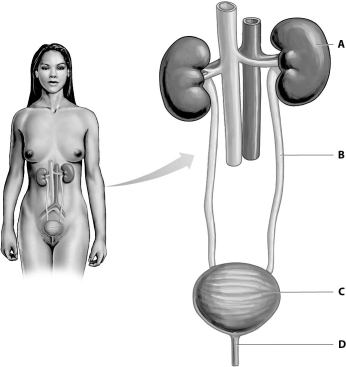 -Which structure,A,B,C,or D,transports urine using peristalsis?
 (Short Answer)
4.8/5 (84)
(84) A friend tells you that she wants to try to be a strict vegetarian or vegan,but her parents are discouraging her from doing so.Her parents say she will not get enough protein or vitamins.What advice can you offer your friend to help her convince her parents she will get enough protein and vitamins on a vegetarian or vegan diet?
(Essay)
4.8/5 (73)
(73) Deficiency of which nutrient can cause muscle cramps,irregular heartbeat,or paralysis?
(Multiple Choice)
4.9/5 (81)
(81) Which part of the brain is responsible for producing and controlling the release of the hormone ADH?
(Short Answer)
4.7/5 (83)
(83) Most digested food is absorbed into the blood by the villi of the small intestine.
(True/False)
4.7/5 (89)
(89) 
The appendix is attached to which portion of the large intestine?
(Multiple Choice)
4.9/5 (68)
(68) Place the following in order of the movement of urine through the urinary system: (1)urethra,(2)ureter,(3)kidney,(4)urinary bladder.
(Multiple Choice)
4.9/5 (83)
(83) A classmate tells you that his mother had her gallbladder removed,and he says she wants to cut down on fat in her diet.He comments that he's not sure why because lipase is the enzyme that breaks down fats,and bile stored in the gallbladder isn't an enzyme.Although his last statement is factually true,how would you help your classmate understand this connection?
(Essay)
4.7/5 (71)
(71) In what way are the essential amino acids different from nonessential amino acids?
(Multiple Choice)
5.0/5 (76)
(76) 
Filters
- Essay(0)
- Multiple Choice(0)
- Short Answer(0)
- True False(0)
- Matching(0)