



 Chat with AI
Exam 11: The First Geneticist: Mendel and His Discoveries

Exam 1: Science As a Way of Learning: a Guide to the Natural World54 Questions
Exam 2: Fundamental Building Blocks: Chemistry, water, and Ph74 Questions
Exam 3: Lifes Components: Biological Molecules79 Questions
Exam 4: Lifes Home: the Cell79 Questions
Exam 5: Lifes Border: the Plasma Membrane88 Questions
Exam 6: Lifes Mainspring: an Introduction to Energy78 Questions
Exam 7: Vital Harvest: Deriving Energy From Food74 Questions
Exam 8: The Green Worlds Gift: Photosynthesis79 Questions
Exam 9: The Links in Lifes Chain: Genetics and Cell Division77 Questions
Exam 10: Preparing for Sexual Reproduction: Meiosis77 Questions
Exam 11: The First Geneticist: Mendel and His Discoveries74 Questions
Exam 12: Units of Heredity: Chromosomes and Inheritance69 Questions
Exam 13: Passing on Lifes Information: Dna Structure and Replication72 Questions
Exam 14: How Proteins Are Made: Genetic Transcription, translation, and Regulation77 Questions
Exam 15: The Future Isnt What It Used to Be: Biotechnology74 Questions
Exam 16: An Introduction to Evolution: Charles Darwin, evolutionary Thought, and the Evidence for Evolution67 Questions
Exam 17: The Means of Evolution: Microevolution71 Questions
Exam 18: The Outcomes of Evolution: Macroevolution69 Questions
Exam 19: A Slow Unfolding: the History of Life on Earth80 Questions
Exam 20: Arriving Late,traveling Far: the Evolution of Human Beings56 Questions
Exam 21: Viruses,bacteria,archaea,and Protists: the Diversity of Life 168 Questions
Exam 22: Fungi: the Diversity of Life 251 Questions
Exam 23: Animals: the Diversity of Life 371 Questions
Exam 24: Plants: the Diversity of Life 453 Questions
Exam 25: The Angiosperms: Form and Function in Flowering Plants72 Questions
Exam 26: Body Support and Movement: the Integumentary, skeletal, and Muscular Systems71 Questions
Exam 27: Communication and Control 1: the Nervous System70 Questions
Exam 28: Communication and Control 2: the Endocrine System49 Questions
Exam 29: Defending the Body: the Immune System76 Questions
Exam 30: Transport and Exchange 1: Blood and Breath77 Questions
Exam 31: Transport and Exchange 2: Digestion, nutrition, and Elimination76 Questions
Exam 32: An Amazingly Detailed Script: Animal Development74 Questions
Exam 33: How the Baby Came to Be: Human Reproduction78 Questions
Exam 34: An Interactive Living World 1: Populations in Ecology76 Questions
Exam 35: An Interactive Living World 2: Communities in Ecology75 Questions
Exam 36: An Interactive Living World 3: Ecosystems and Biomes82 Questions
Select questions type


Refer to the figure below, and then answer the question that follows.
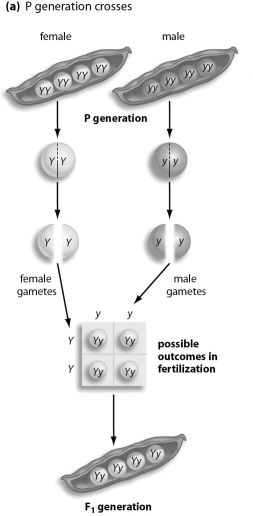 -In his basic experiments,Mendel began with true-breeding parental (P)plants.What results did he see when he cross-fertilized P generation plants that had different traits?
 (Multiple Choice)
4.9/5  (82)
(82) Height is an example a character that displays continuous variation in humans.What is the reason for the range of heights in humans?
(Multiple Choice)
4.7/5 (69)
(69) Identical twins are genetically the same but do not always look or act exactly alike.Propose a hypothesis to explain this.
(Essay)
4.9/5 (78)
(78) A person with the genotype Iᴬᴵᴮ has type AB blood.This is an example of:
(Multiple Choice)
4.9/5 (68)
(68) If all of Mendel's monohybrid crosses had involved traits that function by incomplete dominance,would his results have supported blending inheritance?
(Multiple Choice)
4.8/5 (87)
(87) Mendel's work was presented in ________ but not recognized and rediscovered until ________.
(Multiple Choice)
4.8/5 (91)
(91) Which of the following was not one of Mendel's main inferences from his research?
(Multiple Choice)
4.8/5 (80)
(80) A and a are dominant and recessive alleles,respectively,of the same gene.Which genotype(s)would result in an individual with the recessive phenotype?
(Multiple Choice)
4.7/5 (73)
(73) Let S = smooth pea and s = wrinkled pea; Y = yellow pea and y = green pea.What are the different possible genotypes of the gametes produced by a plant that is heterozygous for both characters?
(Multiple Choice)
4.7/5 (75)
(75) A particular quality of an organism is referred to as a ________,each variation of which is a particular ________.
(Short Answer)
5.0/5 (87)
(87) A and a are dominant and recessive alleles,respectively,of the same gene.Which genotype(s)would result in an individual with the dominant phenotype?
(Multiple Choice)
4.8/5 (87)
(87) Let S = smooth pea and s = wrinkled pea; Y = yellow pea and y = green pea.What pea phenotype would be produced by the genotype SsYy?
(Multiple Choice)
4.8/5 (80)
(80) In order to track the inheritance of two characters,you would need to do a:
(Multiple Choice)
4.9/5 (92)
(92) In humans,freckles are dominant to no freckles,and unattached earlobes are dominant to attached earlobes.Two individuals who both have freckles and unattached earlobes have a child with no freckles and attached earlobes.What are the genotypes of the parents? (F = freckles; E = unattached earlobes)
(Multiple Choice)
4.9/5 (80)
(80) In a breeding experiment with yellow and green true-breeding parents,Mendel took yellow seeds from his F₂ generation,planted them,and self-pollinated the flowers to produce an F₃ generation.He saw that some produced all yellow seeds,and some produced a mix of yellow and green seeds.How can these results be explained?
(Essay)
4.8/5 (85)
(85) In Mendel's pea plant experiments,in order for him to have observed a 3:1 phenotypic ratio in the F₂ generation,which of the following must be true?
(Multiple Choice)
4.9/5 (87)
(87) Cystic fibrosis (CF)is a disease caused by a recessive allele,and the disease appears only in the homozygous recessive genotype.Two parents do not have cystic fibrosis,but they produce a child with this disorder.Fully explain what has occurred,using the appropriate terminology and diagram (you must provide this diagram).
(Essay)
5.0/5 (91)
(91) If an individual has genotype AaBb,how many different gametes can he or she produce? What combinations of alleles are possible?
(Essay)
4.8/5 (84)
(84) 
Filters
- Essay(0)
- Multiple Choice(0)
- Short Answer(0)
- True False(0)
- Matching(0)