



 Chat with AI
Exam 10: Preparing for Sexual Reproduction: Meiosis

Exam 1: Science As a Way of Learning: a Guide to the Natural World54 Questions
Exam 2: Fundamental Building Blocks: Chemistry, water, and Ph74 Questions
Exam 3: Lifes Components: Biological Molecules79 Questions
Exam 4: Lifes Home: the Cell79 Questions
Exam 5: Lifes Border: the Plasma Membrane88 Questions
Exam 6: Lifes Mainspring: an Introduction to Energy78 Questions
Exam 7: Vital Harvest: Deriving Energy From Food74 Questions
Exam 8: The Green Worlds Gift: Photosynthesis79 Questions
Exam 9: The Links in Lifes Chain: Genetics and Cell Division77 Questions
Exam 10: Preparing for Sexual Reproduction: Meiosis77 Questions
Exam 11: The First Geneticist: Mendel and His Discoveries74 Questions
Exam 12: Units of Heredity: Chromosomes and Inheritance69 Questions
Exam 13: Passing on Lifes Information: Dna Structure and Replication72 Questions
Exam 14: How Proteins Are Made: Genetic Transcription, translation, and Regulation77 Questions
Exam 15: The Future Isnt What It Used to Be: Biotechnology74 Questions
Exam 16: An Introduction to Evolution: Charles Darwin, evolutionary Thought, and the Evidence for Evolution67 Questions
Exam 17: The Means of Evolution: Microevolution71 Questions
Exam 18: The Outcomes of Evolution: Macroevolution69 Questions
Exam 19: A Slow Unfolding: the History of Life on Earth80 Questions
Exam 20: Arriving Late,traveling Far: the Evolution of Human Beings56 Questions
Exam 21: Viruses,bacteria,archaea,and Protists: the Diversity of Life 168 Questions
Exam 22: Fungi: the Diversity of Life 251 Questions
Exam 23: Animals: the Diversity of Life 371 Questions
Exam 24: Plants: the Diversity of Life 453 Questions
Exam 25: The Angiosperms: Form and Function in Flowering Plants72 Questions
Exam 26: Body Support and Movement: the Integumentary, skeletal, and Muscular Systems71 Questions
Exam 27: Communication and Control 1: the Nervous System70 Questions
Exam 28: Communication and Control 2: the Endocrine System49 Questions
Exam 29: Defending the Body: the Immune System76 Questions
Exam 30: Transport and Exchange 1: Blood and Breath77 Questions
Exam 31: Transport and Exchange 2: Digestion, nutrition, and Elimination76 Questions
Exam 32: An Amazingly Detailed Script: Animal Development74 Questions
Exam 33: How the Baby Came to Be: Human Reproduction78 Questions
Exam 34: An Interactive Living World 1: Populations in Ecology76 Questions
Exam 35: An Interactive Living World 2: Communities in Ecology75 Questions
Exam 36: An Interactive Living World 3: Ecosystems and Biomes82 Questions
Select questions type


Refer to the figure below, and then answer the question that follows.
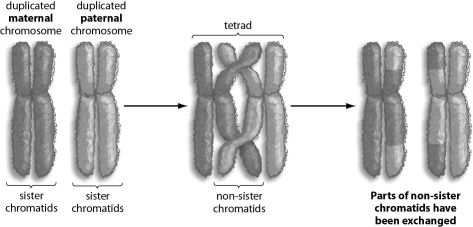 -If crossing over occurs as shown in the figure above,which of the following is true?
 (Multiple Choice)
4.9/5  (82)
(82) From an evolutionary perspective,why is sexual reproduction advantageous over asexual reproduction?
(Multiple Choice)
4.7/5 (83)
(83) Refer to the figure below, and then answer the question that follows.
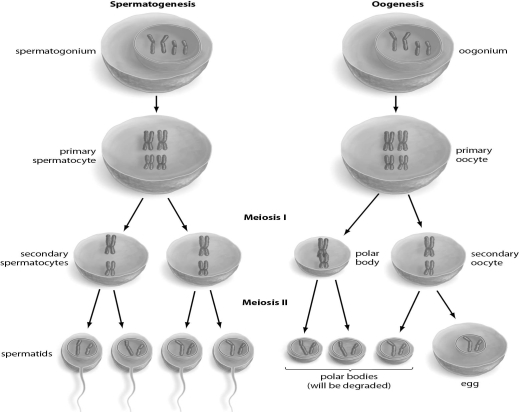 -A difference between spermatogenesis and oogenesis is:
 (Multiple Choice)
4.9/5 (71)
(71) A 2n cell from an organism has 40 chromosomes.How many chromosomes would be in a haploid gamete from this organism?
(Multiple Choice)
4.8/5 (79)
(79) Explain why a life cycle that includes meiosis must also include fertilization.What is the advantage of such a life cycle?
(Essay)
4.7/5 (72)
(72) In gamete formation,the starting cells in females are the ________,and the starting cells in males are ________.
(Multiple Choice)
4.9/5 (76)
(76) The number of chromosomes present in a human cell at anaphase of mitosis and anaphase of meiosis II is the same.
(True/False)
4.9/5 (98)
(98) Homologous chromosomes pair up to form a structure called a:
(Multiple Choice)
4.7/5 (75)
(75) In a human cell that is haploid,how many chromosomes are there? How many are autosomes,and how many are sex chromosomes?
(Multiple Choice)
4.8/5 (74)
(74) Imagine that a species has eight chromosomes (four homologous pairs).If some event occurred that prevented meiosis from occurring after replication,how many chromosomes would this species have after two generations?
(Multiple Choice)
4.7/5 (83)
(83) You have homologous pairs of chromosomes in each of your cells.In what way are these pairs of chromosomes identical?
(Multiple Choice)
4.8/5 (73)
(73) Once produced,a zygote will divide by ________ to develop into a whole organism.
(Short Answer)
4.8/5 (67)
(67) The number of chromosomes present in a cell in metaphase I and metaphase II is the same.
(True/False)
5.0/5 (68)
(68) What event occurs in both anaphase of mitosis and anaphase II of meiosis II?
(Multiple Choice)
5.0/5 (76)
(76) How are the products of meiosis and the products of mitosis different?
(Multiple Choice)
4.9/5 (75)
(75) What is the result of independent assortment during meiosis?
(Multiple Choice)
4.9/5 (73)
(73) 
Filters
- Essay(0)
- Multiple Choice(0)
- Short Answer(0)
- True False(0)
- Matching(0)