



 Chat with AI
Exam 2: Fundamental Building Blocks: Chemistry, water, and Ph

Exam 1: Science As a Way of Learning: a Guide to the Natural World54 Questions
Exam 2: Fundamental Building Blocks: Chemistry, water, and Ph74 Questions
Exam 3: Lifes Components: Biological Molecules79 Questions
Exam 4: Lifes Home: the Cell79 Questions
Exam 5: Lifes Border: the Plasma Membrane88 Questions
Exam 6: Lifes Mainspring: an Introduction to Energy78 Questions
Exam 7: Vital Harvest: Deriving Energy From Food74 Questions
Exam 8: The Green Worlds Gift: Photosynthesis79 Questions
Exam 9: The Links in Lifes Chain: Genetics and Cell Division77 Questions
Exam 10: Preparing for Sexual Reproduction: Meiosis77 Questions
Exam 11: The First Geneticist: Mendel and His Discoveries74 Questions
Exam 12: Units of Heredity: Chromosomes and Inheritance69 Questions
Exam 13: Passing on Lifes Information: Dna Structure and Replication72 Questions
Exam 14: How Proteins Are Made: Genetic Transcription, translation, and Regulation77 Questions
Exam 15: The Future Isnt What It Used to Be: Biotechnology74 Questions
Exam 16: An Introduction to Evolution: Charles Darwin, evolutionary Thought, and the Evidence for Evolution67 Questions
Exam 17: The Means of Evolution: Microevolution71 Questions
Exam 18: The Outcomes of Evolution: Macroevolution69 Questions
Exam 19: A Slow Unfolding: the History of Life on Earth80 Questions
Exam 20: Arriving Late,traveling Far: the Evolution of Human Beings56 Questions
Exam 21: Viruses,bacteria,archaea,and Protists: the Diversity of Life 168 Questions
Exam 22: Fungi: the Diversity of Life 251 Questions
Exam 23: Animals: the Diversity of Life 371 Questions
Exam 24: Plants: the Diversity of Life 453 Questions
Exam 25: The Angiosperms: Form and Function in Flowering Plants72 Questions
Exam 26: Body Support and Movement: the Integumentary, skeletal, and Muscular Systems71 Questions
Exam 27: Communication and Control 1: the Nervous System70 Questions
Exam 28: Communication and Control 2: the Endocrine System49 Questions
Exam 29: Defending the Body: the Immune System76 Questions
Exam 30: Transport and Exchange 1: Blood and Breath77 Questions
Exam 31: Transport and Exchange 2: Digestion, nutrition, and Elimination76 Questions
Exam 32: An Amazingly Detailed Script: Animal Development74 Questions
Exam 33: How the Baby Came to Be: Human Reproduction78 Questions
Exam 34: An Interactive Living World 1: Populations in Ecology76 Questions
Exam 35: An Interactive Living World 2: Communities in Ecology75 Questions
Exam 36: An Interactive Living World 3: Ecosystems and Biomes82 Questions
Select questions type


Oil spills in the ocean are often treated with chemical dispersants.These materials are similar to detergents in that the molecules have both hydrophilic and hydrophobic portions.Based on this,predict what will happen when chemical dispersants are used to treat oil spills.
(Essay)
4.9/5  (85)
(85) How are ions formed? Why do ionic compounds readily dissolve in water?
(Essay)
4.9/5 (84)
(84) Isotopes differ from each other in the number of protons that they possess.
(True/False)
5.0/5 (96)
(96) Sodium chloride (NaCl)crystals (table salt)form as a result of:
(Multiple Choice)
4.9/5 (70)
(70) The ionic bond of sodium chloride is formed as a result of:
(Multiple Choice)
4.7/5 (81)
(81) If a neutral atom has an atomic number of 10,then we know that it has:
(Multiple Choice)
4.8/5 (81)
(81) A single covalent chemical bond represents a sharing of ________ electrons between two atoms.
(Short Answer)
4.7/5 (72)
(72) You shake up a bottle of vinegar and oil dressing to mix it each time you use it.The reason you need to do this is that:
(Multiple Choice)
4.8/5 (81)
(81) Explain how a polar molecule,such as water,can have a difference in electrical charge but is also electrically neutral.
(Essay)
4.9/5 (77)
(77) When sodium chloride dissolves in water,the sodium and chloride ions are pulled into solution by:
(Multiple Choice)
4.7/5 (60)
(60) The electrons of an atom contribute significantly to the mass of an atom.
(True/False)
4.9/5 (82)
(82) Isotopes are atoms of the same element that differ in their:
(Multiple Choice)
4.8/5 (83)
(83) Which of the following would form the fewest covalent bonds?
(Multiple Choice)
4.9/5 (86)
(86) The number of atoms coming out of a chemical reaction must equal the number of atoms going into a chemical reaction.This follows the principle of:
(Multiple Choice)
4.8/5 (93)
(93) As the difference in the electronegativity between atoms forming a chemical bond increases,the:
(Multiple Choice)
4.8/5 (84)
(84) Refer to the figure below, and then answer the question that follows.
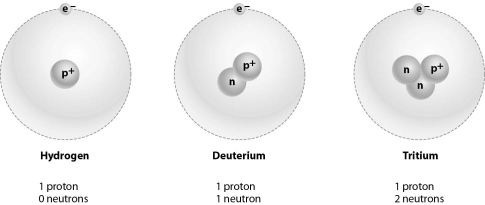 -Hydrogen,deuterium,and tritium are considered the same element because:
 (Multiple Choice)
4.8/5 (78)
(78) Two hydrogen atoms (atomic number 1)form a covalent bond.Which of the following is true?
(Multiple Choice)
4.7/5 (82)
(82) 
Filters
- Essay(0)
- Multiple Choice(0)
- Short Answer(0)
- True False(0)
- Matching(0)