



 Chat with AI
Exam 8: Consumer Choice and Behavioral Economics

Exam 1: Economics: Foundations and Models145 Questions
Exam 2: Trade-Offs, Comparative Advantage, and the Market System151 Questions
Exam 3: Where Prices Come From: the Interaction of Demand and Supply159 Questions
Exam 4: Economic Efficiency, Government Price Setting, and Taxes127 Questions
Exam 5: Externalities, Environmental Policy, and Public Goods141 Questions
Exam 6: Elasticity: the Responsiveness of Demand and Supply149 Questions
Exam 7: Comparative Advantage and the Gains From International Trade125 Questions
Exam 8: Consumer Choice and Behavioral Economics154 Questions
Exam 9: Technology, Production, and Costs169 Questions
Exam 10: Firms in Perfectly Competitive Markets153 Questions
Exam 11: Monopolistic Competition140 Questions
Exam 12: Oligopoly: Firms in Less Competitive Markets130 Questions
Exam 13: Monopoly and Antitrust Policy146 Questions
Exam 14: The Markets for Labour and Other Factors of Production149 Questions
Exam 15: Public Choice, Taxes, and the Distribution of Income134 Questions
Exam 16: Pricing Strategy132 Questions
Exam 17: Firms, the Stock Market, and Corporate Governance137 Questions
Select questions type


Which of the following is not a common mistake made by consumers?
(Multiple Choice)
4.9/5  (77)
(77) Professor Parallax chooses two students in his economics class, Jasmine and Cassandra, to participate in the ultimatum game.He chooses Jasmine to be the allocator and Cassandra to be the recipient.He gives Jasmine $50 and as the allocator, she gets to decide how to split the money with Cassandra.If Cassandra decides to accept the amount allocated to her by Jasmine, both students get to keep the money.If Cassandra decides to reject her allocation, neither student gets to keep the money.How much will each student end up with if each student acts as if fairness is the most important consideration? How much will each student end up with if only Cassandra acts as if fairness is the most important consideration? How much will each student end up with if neither student cares about fairness?
(Essay)
4.7/5 (90)
(90) In 2012 Bon Jovi announced its "Because we can" tour would make 1,000 ticket available at the "fan friendly" price of 19.95 before service fees at all of their shows.The band has made tickets priced below $20 a feature of all their recent concerts.These tickets sold quickly indicating demand was larger than supply at the price of $19.95.Why might this pricing strategy not mean lower profits for the band?
(Essay)
5.0/5 (67)
(67) If a consumer receives 22 units of marginal utility for consuming the first can of pop, 20 units from consuming the second, and 15 from the third, the total utility of consuming the three units is
(Multiple Choice)
4.8/5 (65)
(65) Consider a downward-sloping demand curve.When the price of an inferior good increases, the income and substitution effects
(Multiple Choice)
4.8/5 (90)
(90) Table 8.2
 Table 8.2 above shows Keira's utility from soup and sandwiches. The price of soup is $2 per cup and the price of a sandwich is $3. Keira has $18 to spend on these two goods.
-Refer to Table 8.2.Holding prices constant, when Keira's income changed from $18 to $23, what happens to her total utility and to the marginal utilities of the last cup of soup and the last sandwich purchased?
Table 8.2 above shows Keira's utility from soup and sandwiches. The price of soup is $2 per cup and the price of a sandwich is $3. Keira has $18 to spend on these two goods.
-Refer to Table 8.2.Holding prices constant, when Keira's income changed from $18 to $23, what happens to her total utility and to the marginal utilities of the last cup of soup and the last sandwich purchased? (Multiple Choice)
4.9/5 (95)
(95) Consider a downward-sloping demand curve.When the price of a normal good decreases, the income and substitution effects
(Multiple Choice)
4.9/5 (83)
(83) Consider the following hypothetical scenarios:
Scenario A: You are about to purchase a pair of 7 for All Mankind jeans for $175 and a t-shirt for $45.The sales attendant at the store tells you that the pair of jeans you wish to buy is on sale for $160 at another store, located about a 20-minute drive away.
Scenario B: You are about to purchase a pair of 7 for All Mankind jeans for $175 and a t-shirt for $45.The sales attendant at the store tells you that the t-shirt you wish to buy is on sale for $30 at another store, located about a 20-minute drive away.
Based on standard economic theory, under which scenario would you make the 20-minute trip to the other store?
(Multiple Choice)
4.9/5 (73)
(73) Research by Daniel Kahneman, Jack Knetch, and Richard Thaler has shown that companies like airlines were explicitly able to include a fuel surcharge in their prices because
(Multiple Choice)
4.9/5 (78)
(78) The substitution effect of a price increase causes a decrease in the quantity demanded of an inferior good.
(True/False)
4.8/5 (89)
(89) If your total satisfaction increases when you consume another unit, your marginal utility must be
(Multiple Choice)
4.8/5 (83)
(83) The average price of gasoline in your neighbourhood is $1.30 per litre.Your neighbour, Diana tells you that you can "save a lot" by frequenting a gas station 30 kilometers outside your neighbourhood where the price of gasoline is $1.15 per litre However, she cautions you that there are usually long lines at that station.Is her suggestion beneficial to you?
(Multiple Choice)
4.9/5 (78)
(78) One explanation for the increase in product sales because of celebrity endorsements is that people seem to receive ________ from goods they believe are popular.
(Multiple Choice)
4.9/5 (71)
(71) Figure 8.5
 -Refer to Figure 8.5.Which diagram demonstrates a decrease in total utility following an increase in the price of candy?
 (Multiple Choice)
4.9/5 (79)
(79) The demand curve for canned peas is downward sloping.If the price of canned peas, an inferior good, rises,
(Multiple Choice)
4.9/5 (87)
(87) The economic model of consumer behavior explains how consumers' tastes and preferences are formed.
(True/False)
4.9/5 (78)
(78) Figure 8.3
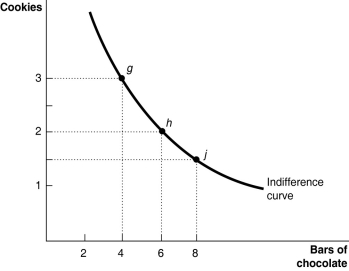 -Refer to Figure 8.3.What is the marginal rate of substitution between g and h?
 (Multiple Choice)
4.8/5 (83)
(83) 
Filters
- Essay(0)
- Multiple Choice(0)
- Short Answer(0)
- True False(0)
- Matching(0)