



 Chat with AI
Exam 29: Protists

Exam 1: Biology and the Tree of Life35 Questions
Exam 2: Water and Carbon: the Chemical Basis of Life51 Questions
Exam 3: Protein Structure and Function54 Questions
Exam 4: Nucleic Acids and the Rna World40 Questions
Exam 5: An Introduction to Carbohydrates40 Questions
Exam 6: Lipids, membranes, and the First Cells54 Questions
Exam 7: Inside the Cell38 Questions
Exam 8: Cell-Cell Interactions38 Questions
Exam 9: Cellular Respiration and Fermentation38 Questions
Exam 10: Photosynthesis39 Questions
Exam 11: The Cell Cycle39 Questions
Exam 12: Meiosis39 Questions
Exam 13: Mendel and the Gene42 Questions
Exam 14: Dna and the Gene: Synthesis and Repair39 Questions
Exam 15: How Genes Work39 Questions
Exam 16: Transcription, RNA Processing, and Translation39 Questions
Exam 17: Control of Gene Expression in Bacteria38 Questions
Exam 18: Control of Gene Expression in Eukaryotes39 Questions
Exam 19: Analyzing and Engineering Genes41 Questions
Exam 20: Genomics41 Questions
Exam 21: Principles of Development39 Questions
Exam 22: An Introduction to Animal Development40 Questions
Exam 23: An Introduction to Plant Development37 Questions
Exam 24: Evolution by Natural Selection42 Questions
Exam 25: Evolutionary Processes50 Questions
Exam 26: Speciation41 Questions
Exam 27: Phylogenies and the History of Life43 Questions
Exam 28: Bacteria and Archaea38 Questions
Exam 29: Protists36 Questions
Exam 30: Green Algae and Land Plants54 Questions
Exam 31: Fungi40 Questions
Exam 32: An Introduction to Animals42 Questions
Exam 33: Protostome Animals38 Questions
Exam 34: Deuterostome Animals43 Questions
Exam 35: Viruses35 Questions
Exam 36: Plant Form and Function36 Questions
Exam 37: Water and Sugar Transport in Plants42 Questions
Exam 38: Plant Nutrition37 Questions
Exam 39: Plant Sensory Systems, signals, and Responses65 Questions
Exam 40: Plant Reproduction41 Questions
Exam 41: Animal Form and Function38 Questions
Exam 42: Water and Electrolyte Balance in Animals41 Questions
Exam 43: Animal Nutrition43 Questions
Exam 44: Gas Exchange and Circulation46 Questions
Exam 45: Electrical Signals in Animals40 Questions
Exam 46: Animal Sensory Systems and Movement43 Questions
Exam 47: Chemical Signals in Animals38 Questions
Exam 48: Animal Reproduction39 Questions
Exam 49: The Immune System in Animals38 Questions
Exam 50: An Introduction to Ecology41 Questions
Exam 51: Behavioural Ecology39 Questions
Exam 52: Population Ecology49 Questions
Exam 53: Community Ecology39 Questions
Exam 54: Ecosystems41 Questions
Exam 55: Biodiversity and Conservation Biology38 Questions
Select questions type


The data graphed in Figure 29.3 could be an artifact if latrunculin A kills this species of diatoms (i.e.,that may be why the cells are not moving).Which of the following would be the best evidence that latrunculin A is not killing the cells?
(Multiple Choice)
4.9/5  (81)
(81) By examining the phylogenetic tree diagrammed above,what conclusion can you draw about the species G.microti?
(Multiple Choice)
4.8/5 (94)
(94) How are algal blooms (red tides)typically harmful to humans?
(Multiple Choice)
4.8/5 (71)
(71) The manufacture of which of the following products involves using materials that once belonged to a protist?
(Multiple Choice)
4.8/5 (81)
(81) Which of the following movements are matched correctly with the appendage that facilitates that movement in protists?
(Multiple Choice)
4.8/5 (79)
(79) Alternation of generations occurs in protists.Which of the following represents the correct sequence of events for this mode of reproduction?
(Multiple Choice)
4.8/5 (84)
(84) Which of the following protists causes the human disease malaria?
(Multiple Choice)
4.9/5 (78)
(78) Phytoplankton is comprised of photosynthetic protists and bacteria.For the most part,humans do not consume phytoplankton.Why,then,are they important to humans?
(Multiple Choice)
4.8/5 (86)
(86) A particular species of protist has obtained a chloroplast via secondary endosymbiosis.How can you tell?
(Multiple Choice)
4.8/5 (76)
(76) Which of the following best describes what scientists (the Bell research group)concluded about the effect of atmospheric CO₂ increases on phytoplankton's primary productivity?
(Multiple Choice)
4.9/5 (71)
(71) What is meant by the term "high-selected" lines in the phytoplankton experiment?
(Multiple Choice)
4.8/5 (76)
(76) Figure 29.1 Use the following information to answer the corresponding question(s).
Giardia intestinalis can cause disease in several different mammalian species, including humans. Giardia organisms (G. intestinalis)that infect humans are similar morphologically to those that infect other mammals; thus, they have been considered a single species, though other species in the Giardia genus infect other organisms. However, G. intestinalis has been divided into different subgroups based on their host and a few other characteristics.
In 1999, a DNA sequence comparison study tested the hypothesis that these subgroups actually constitute different species. The following phylogenetic tree was constructed from the sequence comparison of rRNA from several subgroups of G. intestinalis and a few other morphologically distinct species of Giardia. The researchers concluded that the subgroups of Giardia are sufficiently different from one another genetically that they could be considered different species. (T. Monis et al. 1999. Molecular systematics of the parasitic protozoan Giardia intestinalis. Mol. Biol. Evol. 16[9]:1135-44.)
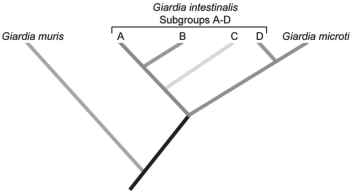 -According to the phylogenetic tree in the figure above,Giardia intestinalis constitutes a ________ group.
 (Multiple Choice)
4.7/5 (82)
(82) Imagine there are 25 different species of protists living in a tide pool.Some of these species reproduce both sexually and asexually,and some of them can reproduce only asexually.The pool gradually becomes infested with disease-causing viruses and bacteria.Which species are more likely to thrive in the changing environment?
(Multiple Choice)
4.9/5 (71)
(71) Which of the following statements best describes the term synapomorphy?
(Multiple Choice)
4.9/5 (76)
(76) You isolate a previously undescribed protist species from the soil outside your residence.Which of the following technique(s)would provide useful data for describing,classifying,and naming this new species?
(Multiple Choice)
4.8/5 (81)
(81) 
Filters
- Essay(0)
- Multiple Choice(0)
- Short Answer(0)
- True False(0)
- Matching(0)