Multiple Choice
Figure 29.1 Use the following information to answer the corresponding question(s) .
Giardia intestinalis can cause disease in several different mammalian species, including humans. Giardia organisms (G. intestinalis) that infect humans are similar morphologically to those that infect other mammals; thus, they have been considered a single species, though other species in the Giardia genus infect other organisms. However, G. intestinalis has been divided into different subgroups based on their host and a few other characteristics.
In 1999, a DNA sequence comparison study tested the hypothesis that these subgroups actually constitute different species. The following phylogenetic tree was constructed from the sequence comparison of rRNA from several subgroups of G. intestinalis and a few other morphologically distinct species of Giardia. The researchers concluded that the subgroups of Giardia are sufficiently different from one another genetically that they could be considered different species. (T. Monis et al. 1999. Molecular systematics of the parasitic protozoan Giardia intestinalis. Mol. Biol. Evol. 16[9]:1135-44.)
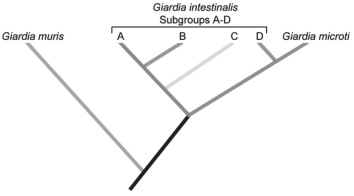
-According to the phylogenetic tree in the figure above,Giardia intestinalis constitutes a ________ group.
A) paraphyletic
B) monophyletic
C) polyphyletic
Correct Answer:

Verified
Correct Answer:
Verified
Q16: A particular species of protist has obtained
Q26: Alternation of generations occurs in protists.Which of
Q27: Which of the following protists causes the
Q28: Phytoplankton is comprised of photosynthetic protists and
Q30: Which of the following best describes what
Q31: What is meant by the term "high-selected"
Q33: Imagine there are 25 different species of
Q34: Which of the following statements best describes
Q35: What is the major distinguishing feature of
Q36: You isolate a previously undescribed protist species