



 Chat with AI
Exam 16: The Markets for Labor and Other Factors of Production

Exam 1: Economics: Foundations and Models24 Questions
Exam 2: Trade-Offs, Comparative Advantage, and the Market System12 Questions
Exam 3: Where Prices Come From: The Interaction of Demand and Supply29 Questions
Exam 4: Economic Efficiency, Government Price Setting, and Taxes39 Questions
Exam 5: Externalities, Environmental Policy, and Public Goods21 Questions
Exam 6: Elasticity: The Responsiveness of Demand and Supply23 Questions
Exam 7: The Economics of Health Care35 Questions
Exam 8: Firms, the Stock Market, and Corporate Governance23 Questions
Exam 9: Comparative Advantage and the Gains From International Trade26 Questions
Exam 10: Consumer Choice and Behavioral Economics21 Questions
Exam 11: Technology, Production, and Costs43 Questions
Exam 12: Firms in Perfectly Competitive Markets23 Questions
Exam 13: Monopolistic Competition: The Competitive Model in a More Realistic Setting14 Questions
Exam 14: Oligopoly: Firms in Less Competitive Markets8 Questions
Exam 15: Monopoly and Antitrust Policy55 Questions
Exam 16: The Markets for Labor and Other Factors of Production49 Questions
Exam 17: Public Choice, Taxes, and the Distribution of Income69 Questions
Select questions type


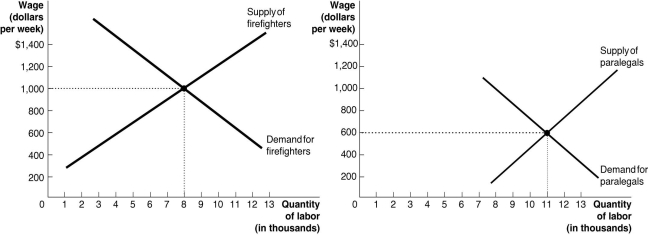 -Refer to Figure 16-5 to answer the following questions.
a. What is the equilibrium quantity of firefighters hired, and what is the equilibrium wage?
b. What is the equilibrium quantity of paralegals hired, and what is the equilibrium wage?
c. Explain why firefighters might earn a higher weekly wage than paralegals.
d. Suppose that comparable worth legislation is passed, and the government requires that firefighters and paralegals be paid the same wage, $800 per week. Now how many firefighters will be hired and how many paralegals will be hired?
-Refer to Figure 16-5 to answer the following questions.
a. What is the equilibrium quantity of firefighters hired, and what is the equilibrium wage?
b. What is the equilibrium quantity of paralegals hired, and what is the equilibrium wage?
c. Explain why firefighters might earn a higher weekly wage than paralegals.
d. Suppose that comparable worth legislation is passed, and the government requires that firefighters and paralegals be paid the same wage, $800 per week. Now how many firefighters will be hired and how many paralegals will be hired? (Essay)
4.7/5  (73)
(73)
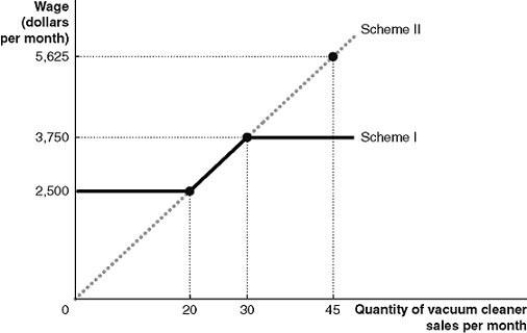 Figure 16-6 shows two different compensation schemes for the Vortex Vacuum Cleaner Company.
Under Scheme I, the firm pays a consistent wage of $2,500 per month to all its salespeople for sales up to 20 vacuum cleaners. For sales of 21-30 vacuum cleaners, its salespeople earn $125 per vacuum cleaner, with wages capped at $3,750 per month for sales over 30 vacuum cleaners. If a salesperson has three consecutive months of sales below 20 vacuum cleaners, the person loses his or her job.
Scheme II represents a straight commission, with salespeople earning a commission of $125 per vacuum cleaner sold, with no wage cap.
-Refer to Figure 16-6. Which of the following statements about Scheme II is false?
Figure 16-6 shows two different compensation schemes for the Vortex Vacuum Cleaner Company.
Under Scheme I, the firm pays a consistent wage of $2,500 per month to all its salespeople for sales up to 20 vacuum cleaners. For sales of 21-30 vacuum cleaners, its salespeople earn $125 per vacuum cleaner, with wages capped at $3,750 per month for sales over 30 vacuum cleaners. If a salesperson has three consecutive months of sales below 20 vacuum cleaners, the person loses his or her job.
Scheme II represents a straight commission, with salespeople earning a commission of $125 per vacuum cleaner sold, with no wage cap.
-Refer to Figure 16-6. Which of the following statements about Scheme II is false? (Multiple Choice)
4.8/5 (86)
(86)
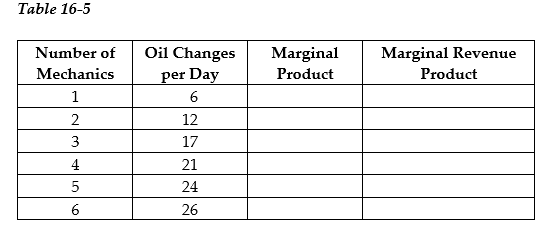 -Refer to Table 16-5. Oil Can Harry's, a new automobile service shop, is ready to start hiring. The table above shows the relationship between the number of mechanics the firm hires and the quantity of oil changes it produces.
a. Suppose the price of an oil change is $20. Complete the table by filling in the values for marginal product and marginal revenue product.
b. Oil Can Harry's is an input price-taker. Suppose the wage paid to mechanics is $80 per day. What is the profit-maximizing number of mechanics?
c. Suppose the wage rate rises to $100 per day.
(i) What happens to the firm's demand curve for mechanics?
(ii) What happens to the profit-maximizing quantity of mechanics?
d. Suppose the wage rate is $60 per day and the price of an oil change is now $15.
(i) What happens to the firm's demand curve for mechanics?
(ii) What happens to the profit-maximizing quantity of mechanics?
-Refer to Table 16-5. Oil Can Harry's, a new automobile service shop, is ready to start hiring. The table above shows the relationship between the number of mechanics the firm hires and the quantity of oil changes it produces.
a. Suppose the price of an oil change is $20. Complete the table by filling in the values for marginal product and marginal revenue product.
b. Oil Can Harry's is an input price-taker. Suppose the wage paid to mechanics is $80 per day. What is the profit-maximizing number of mechanics?
c. Suppose the wage rate rises to $100 per day.
(i) What happens to the firm's demand curve for mechanics?
(ii) What happens to the profit-maximizing quantity of mechanics?
d. Suppose the wage rate is $60 per day and the price of an oil change is now $15.
(i) What happens to the firm's demand curve for mechanics?
(ii) What happens to the profit-maximizing quantity of mechanics? (Essay)
4.7/5 (80)
(80) In academia, professors in some disciplines receive higher salaries than others. For example, professors teaching in business schools receive higher salaries than professors in the English department. Suppose at Unity College, assistant professors in the business school earn $80,000 while assistant professors in the English department earn $50,000. Now suppose the government passes comparable worth legislation that requires academic institutions to pay all faculty the same salaries.
-Refer to Scenario 16-1. Following the passage of comparable worth legislation, Unity College responds by placing salaries for all assistant professors at $80,000. Which of the following is the result of the legislation?
(Multiple Choice)
4.8/5 (70)
(70) Research has found that, holding constant students' characteristics, the earnings of people who graduate from highly selective colleges are ________ 30 years after graduation than are the earnings of people who graduated from less selective colleges.
(Multiple Choice)
4.7/5 (85)
(85)
Figure 16-6 shows two different compensation schemes for the Vortex Vacuum Cleaner Company.
Under Scheme I, the firm pays a consistent wage of $2,500 per month to all its salespeople for sales up to 20 vacuum cleaners. For sales of 21-30 vacuum cleaners, its salespeople earn $125 per vacuum cleaner, with wages capped at $3,750 per month for sales over 30 vacuum cleaners. If a salesperson has three consecutive months of sales below 20 vacuum cleaners, the person loses his or her job.
Scheme II represents a straight commission, with salespeople earning a commission of $125 per vacuum cleaner sold, with no wage cap.
-Refer to Figure 16-6. Salespeople would be indifferent to the two pay schemes if their monthly sales were
Figure 16-6 shows two different compensation schemes for the Vortex Vacuum Cleaner Company.
Under Scheme I, the firm pays a consistent wage of $2,500 per month to all its salespeople for sales up to 20 vacuum cleaners. For sales of 21-30 vacuum cleaners, its salespeople earn $125 per vacuum cleaner, with wages capped at $3,750 per month for sales over 30 vacuum cleaners. If a salesperson has three consecutive months of sales below 20 vacuum cleaners, the person loses his or her job.
Scheme II represents a straight commission, with salespeople earning a commission of $125 per vacuum cleaner sold, with no wage cap.
-Refer to Figure 16-6. Salespeople would be indifferent to the two pay schemes if their monthly sales were (Multiple Choice)
4.8/5 (83)
(83) Figure 16-3
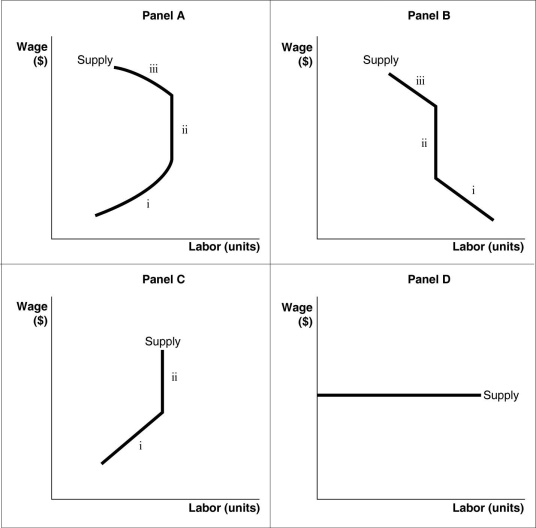 -Refer to Figure 16-3. Panel D is appropriate when used to represent
 (Multiple Choice)
4.9/5 (83)
(83) 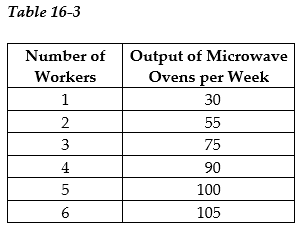 Hotspur Incorporated, a manufacturer of microwave ovens, is a price taker in its input and output markets. The firm hires labor at a constant wage rate of $800 per week and sells microwave ovens at a constant price of $80. Table 16-3 shows the relationship between the quantity of labor it hires and the quantity of microwave ovens it produces. Assume that labor is the only variable input.
-Refer to Table 16-3. What is Hotspur's profit maximizing quantity of labor?
Hotspur Incorporated, a manufacturer of microwave ovens, is a price taker in its input and output markets. The firm hires labor at a constant wage rate of $800 per week and sells microwave ovens at a constant price of $80. Table 16-3 shows the relationship between the quantity of labor it hires and the quantity of microwave ovens it produces. Assume that labor is the only variable input.
-Refer to Table 16-3. What is Hotspur's profit maximizing quantity of labor? (Multiple Choice)
4.8/5 (79)
(79) 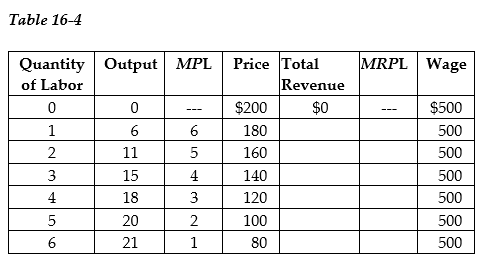 Table 16-4 lists data for the production of Apple iPods. Apple is assumed to be a price maker, so to increase its sales of iPods the firm must lower its price. MPL and MRPL refer to the marginal product of labor and the marginal revenue product of labor, respectively.
-Refer to Table 16-4. What are the price and quantity of workers that result in the maximum amount of profit Apple would earn from selling iPods?
Table 16-4 lists data for the production of Apple iPods. Apple is assumed to be a price maker, so to increase its sales of iPods the firm must lower its price. MPL and MRPL refer to the marginal product of labor and the marginal revenue product of labor, respectively.
-Refer to Table 16-4. What are the price and quantity of workers that result in the maximum amount of profit Apple would earn from selling iPods? (Multiple Choice)
4.8/5 (76)
(76) 
Filters
- Essay(0)
- Multiple Choice(0)
- Short Answer(0)
- True False(0)
- Matching(0)