



 Chat with AI
Exam 2: Trade-Offs, Comparative Advantage, and the Market System

Exam 1: Economics: Foundations and Models24 Questions
Exam 2: Trade-Offs, Comparative Advantage, and the Market System12 Questions
Exam 3: Where Prices Come From: The Interaction of Demand and Supply29 Questions
Exam 4: Economic Efficiency, Government Price Setting, and Taxes39 Questions
Exam 5: Externalities, Environmental Policy, and Public Goods21 Questions
Exam 6: Elasticity: The Responsiveness of Demand and Supply23 Questions
Exam 7: The Economics of Health Care35 Questions
Exam 8: Firms, the Stock Market, and Corporate Governance23 Questions
Exam 9: Comparative Advantage and the Gains From International Trade26 Questions
Exam 10: Consumer Choice and Behavioral Economics21 Questions
Exam 11: Technology, Production, and Costs43 Questions
Exam 12: Firms in Perfectly Competitive Markets23 Questions
Exam 13: Monopolistic Competition: The Competitive Model in a More Realistic Setting14 Questions
Exam 14: Oligopoly: Firms in Less Competitive Markets8 Questions
Exam 15: Monopoly and Antitrust Policy55 Questions
Exam 16: The Markets for Labor and Other Factors of Production49 Questions
Exam 17: Public Choice, Taxes, and the Distribution of Income69 Questions
Select questions type


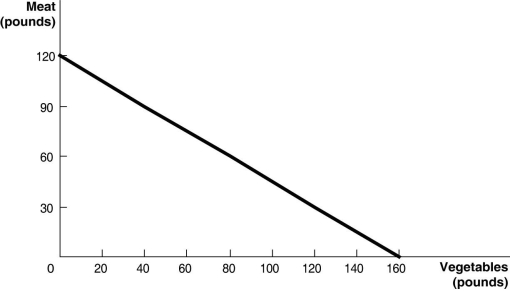 Figure 2-2 above shows the production possibilities frontier for Mendonca, an agrarian nation that produces two goods, meat and vegetables.
-Refer to Figure 2-2. What is the opportunity cost of one pound of meat?
Figure 2-2 above shows the production possibilities frontier for Mendonca, an agrarian nation that produces two goods, meat and vegetables.
-Refer to Figure 2-2. What is the opportunity cost of one pound of meat?
Free
(Multiple Choice)
4.8/5  (79)
(79) Correct Answer: Verified
B
An iPad contains hundreds of parts that are designed, manufactured, and assembled by firms around the world. Using many different firms in the production of the iPad addresses which of the following fundamental economic questions?
Free
(Multiple Choice)
4.9/5 (89)
(89) Correct Answer:Verified
VerifiedB
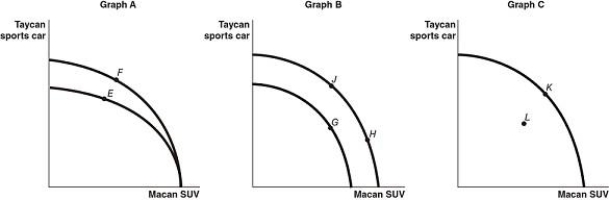 Porsche is developing all-electric and hybrid electric vehicles, and has announced that by 2025, they expect more than 50 percent of their worldwide sales will be all-electric or hybrid models. Figure 2-7 shows changes to Porsche's production possibilities frontier at its manufacturing facilities in response to new developments and different strategic production decisions.
-Refer to Figure 2-7. Assume that in 2025, Porsche temporarily shuts down part of it manufacturing facilities for an extensive renovation, and this reduces the amount of production capacity available for both types of vehicles. This is best represented by the
Porsche is developing all-electric and hybrid electric vehicles, and has announced that by 2025, they expect more than 50 percent of their worldwide sales will be all-electric or hybrid models. Figure 2-7 shows changes to Porsche's production possibilities frontier at its manufacturing facilities in response to new developments and different strategic production decisions.
-Refer to Figure 2-7. Assume that in 2025, Porsche temporarily shuts down part of it manufacturing facilities for an extensive renovation, and this reduces the amount of production capacity available for both types of vehicles. This is best represented by theFree
(Multiple Choice)
4.8/5 (86)
(86) Correct Answer:Verified
VerifiedC
In December 2019, a bipartisan group of senators introduced a bill which would expand the authority of the United States Customs and Border Protection agency to seize counterfeit goods at the U.S. border that infringe on intellectual property rights. If passed, this legislation would prevent the importation of counterfeit products into the United States. The estimated global trade value of counterfeit products in 2019 was over $1 trillion.
Source: Paul D. Ackerman, Gary A. Abelev, and Aimee N. Soucie, "Proposed Counterfeit Goods Seizure Act of 2019 Would Provide Design Patent Protection at the US Border," huntonretailindustryblog.com, December 18, 2019.
-Refer to the Article Summary. If the Counterfeit Goods Seizure Act of 2019 becomes law, all of the following would most likely occur except
(Multiple Choice)
4.8/5 (73)
(73) Porsche is developing all-electric and hybrid electric vehicles, and has announced that by 2025, they expect more than 50 percent of their worldwide sales will be all-electric or hybrid models. Figure 2-7 shows changes to Porsche's production possibilities frontier at its manufacturing facilities in response to new developments and different strategic production decisions.
-Refer to Figure 2-7. Assume a technological advancement greatly reduces the cost to produce batteries for its Taycan sports car. This is best represented by the
Porsche is developing all-electric and hybrid electric vehicles, and has announced that by 2025, they expect more than 50 percent of their worldwide sales will be all-electric or hybrid models. Figure 2-7 shows changes to Porsche's production possibilities frontier at its manufacturing facilities in response to new developments and different strategic production decisions.
-Refer to Figure 2-7. Assume a technological advancement greatly reduces the cost to produce batteries for its Taycan sports car. This is best represented by the (Multiple Choice)
4.7/5 (72)
(72) Socialist politicians including Senator Bernie Sanders and Congresswoman Alexandria Ocasio-Cortez advocate a larger role for government in the economy, including all of the following except
(Multiple Choice)
4.7/5 (80)
(80) Figure 2-2 above shows the production possibilities frontier for Mendonca, an agrarian nation that produces two goods, meat and vegetables.
-Refer to Figure 2-2. What is the opportunity cost of one pound of vegetables?
Figure 2-2 above shows the production possibilities frontier for Mendonca, an agrarian nation that produces two goods, meat and vegetables.
-Refer to Figure 2-2. What is the opportunity cost of one pound of vegetables? (Multiple Choice)
4.8/5 (70)
(70) Porsche is developing all-electric and hybrid electric vehicles, and has announced that by 2025, they expect more than 50 percent of their worldwide sales will be all-electric or hybrid models. Figure 2-7 shows changes to Porsche's production possibilities frontier at its manufacturing facilities in response to new developments and different strategic production decisions.
-Refer to Figure 2-7. Assume that in response to changing consumer demands, Porsche cuts back on the production of Macan SUVs and increases its production of Taycan sports cars. This strategy is best represented by the
Porsche is developing all-electric and hybrid electric vehicles, and has announced that by 2025, they expect more than 50 percent of their worldwide sales will be all-electric or hybrid models. Figure 2-7 shows changes to Porsche's production possibilities frontier at its manufacturing facilities in response to new developments and different strategic production decisions.
-Refer to Figure 2-7. Assume that in response to changing consumer demands, Porsche cuts back on the production of Macan SUVs and increases its production of Taycan sports cars. This strategy is best represented by the (Multiple Choice)
4.8/5 (79)
(79) 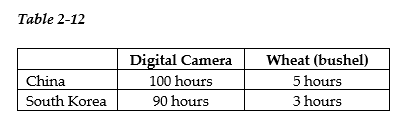 -Refer to Table 2-12. This table shows the number of labor hours required to produce a digital camera and a bushel of wheat in China and South Korea.
a. Assume each country has a total of 9,000 labor hours to devote to the production of the two goods and draw the production possibilities frontier for each country. Put "Digital Camera" on the horizontal axis and "Wheat" on the vertical axis. Be sure to identify the intercept values on your graphs.
b. Suppose each country allocates 60% of its labor hours to wheat production and 40% to the production of digital cameras. Complete Table 2-13 below to show each country's output of the two products.
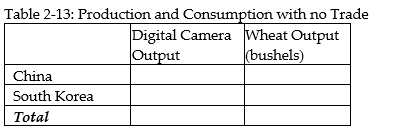 c. If the two countries do not trade and consume whatever they produce, identify the current production and consumption point for each country on their respective production possibilities frontiers. Label China's consumption point "C" and South Korea's consumption point "K."
d. Suppose the two countries specialize and trade. Which country should produce digital cameras and which should produce wheat? Explain your answer.
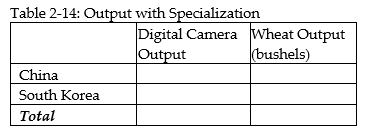
e. Complete Table 2-14 below to show each country's output with specialization.
 f. Did specialization increase the combined output for the two countries without any increase in resources? If so, by how much?
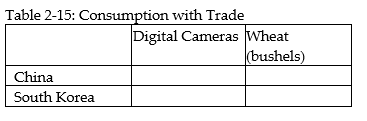
g. Suppose China and South Korea agree to trade so that in exchange for 1,200 bushels of wheat, the exporter of wheat receives 48 digital cameras. Complete Table 2-15 below to show each country's consumption bundle after trade.
 h. Show the consumption points after trade on each country's production possibilities frontier. Label these points "B" for China and "J" for South Korea.
i. Has trade made the two countries better off? Explain your answer.
-Refer to Table 2-12. This table shows the number of labor hours required to produce a digital camera and a bushel of wheat in China and South Korea.
a. Assume each country has a total of 9,000 labor hours to devote to the production of the two goods and draw the production possibilities frontier for each country. Put "Digital Camera" on the horizontal axis and "Wheat" on the vertical axis. Be sure to identify the intercept values on your graphs.
b. Suppose each country allocates 60% of its labor hours to wheat production and 40% to the production of digital cameras. Complete Table 2-13 below to show each country's output of the two products.
c. If the two countries do not trade and consume whatever they produce, identify the current production and consumption point for each country on their respective production possibilities frontiers. Label China's consumption point "C" and South Korea's consumption point "K."
d. Suppose the two countries specialize and trade. Which country should produce digital cameras and which should produce wheat? Explain your answer.
e. Complete Table 2-14 below to show each country's output with specialization.
f. Did specialization increase the combined output for the two countries without any increase in resources? If so, by how much?
g. Suppose China and South Korea agree to trade so that in exchange for 1,200 bushels of wheat, the exporter of wheat receives 48 digital cameras. Complete Table 2-15 below to show each country's consumption bundle after trade.
h. Show the consumption points after trade on each country's production possibilities frontier. Label these points "B" for China and "J" for South Korea.
i. Has trade made the two countries better off? Explain your answer. (Essay)
4.9/5 (73)
(73) 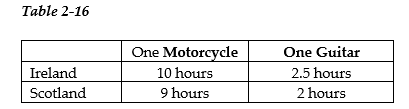 -Refer to Table 2-16. This table shows the number of labor hours required to produce a motorcycle and a guitar in Ireland and Scotland.
a. Which country has an absolute advantage in the production of motorcycles?
b. Which country has an absolute advantage in the production of guitars?
c. What is Ireland's opportunity cost of producing one motorcycle?
d. What is Scotland's opportunity cost of producing one motorcycle?
e. What is Ireland's opportunity cost of producing one guitar?
f. What is Scotland's opportunity cost of producing one guitar?
g. If each country specializes in the production of the product in which it has a comparative advantage, which country should produce motorcycles?
h. If each country specializes in the production of the product in which it has a comparative advantage, which country should produce guitars?
-Refer to Table 2-16. This table shows the number of labor hours required to produce a motorcycle and a guitar in Ireland and Scotland.
a. Which country has an absolute advantage in the production of motorcycles?
b. Which country has an absolute advantage in the production of guitars?
c. What is Ireland's opportunity cost of producing one motorcycle?
d. What is Scotland's opportunity cost of producing one motorcycle?
e. What is Ireland's opportunity cost of producing one guitar?
f. What is Scotland's opportunity cost of producing one guitar?
g. If each country specializes in the production of the product in which it has a comparative advantage, which country should produce motorcycles?
h. If each country specializes in the production of the product in which it has a comparative advantage, which country should produce guitars? (Essay)
5.0/5 (71)
(71) 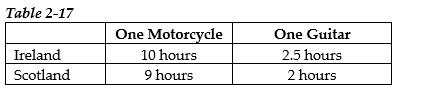 -Refer to Table 2-17. This table shows the number of labor hours required to produce a motorcycle and a guitar in Ireland and Scotland.
a. Assume each country has a total of 2,700 labor hours to devote to the production of the two goods and draw the production possibilities frontier for each country. Put "Motorcycle" on the horizontal axis and "Guitar" on the vertical axis. Be sure to identify the intercept values on your graphs.
b. Suppose each country allocates 55% of its labor hours to guitar production and 45% to the production of motorcycles. Complete Table 2-18 below to show each country's output of the two products.
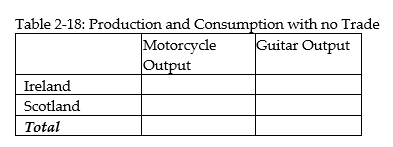 c. If the two countries do not trade and consume whatever they produce, identify the current production and consumption point for each country on their respective production possibilities frontiers. Label Ireland's consumption point "I" and Scotland's consumption point "S."
d. Suppose the two countries specialize and trade. Which country should produce motorcycles and which should produce guitars? Explain your answer.
e. Complete Table 2-19 below to show each country's output with specialization.
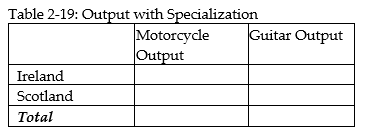 f. Did specialization increase the combined output for the two countries without any increase in resources? If so, by how much?
g. Suppose Ireland and Scotland agree to trade so that in exchange for 600 guitars, the exporter of guitars receives 140 motorcycles. Complete Table 2-20 below to show each country's consumption bundle after trade.
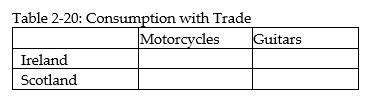 h. Show the consumption points after trade on each country's production possibilities frontier. Label these points "X" for Ireland and "Y" for Scotland.
i. Has trade made the two countries better off? Explain your answer.
-Refer to Table 2-17. This table shows the number of labor hours required to produce a motorcycle and a guitar in Ireland and Scotland.
a. Assume each country has a total of 2,700 labor hours to devote to the production of the two goods and draw the production possibilities frontier for each country. Put "Motorcycle" on the horizontal axis and "Guitar" on the vertical axis. Be sure to identify the intercept values on your graphs.
b. Suppose each country allocates 55% of its labor hours to guitar production and 45% to the production of motorcycles. Complete Table 2-18 below to show each country's output of the two products.
c. If the two countries do not trade and consume whatever they produce, identify the current production and consumption point for each country on their respective production possibilities frontiers. Label Ireland's consumption point "I" and Scotland's consumption point "S."
d. Suppose the two countries specialize and trade. Which country should produce motorcycles and which should produce guitars? Explain your answer.
e. Complete Table 2-19 below to show each country's output with specialization.
f. Did specialization increase the combined output for the two countries without any increase in resources? If so, by how much?
g. Suppose Ireland and Scotland agree to trade so that in exchange for 600 guitars, the exporter of guitars receives 140 motorcycles. Complete Table 2-20 below to show each country's consumption bundle after trade.
h. Show the consumption points after trade on each country's production possibilities frontier. Label these points "X" for Ireland and "Y" for Scotland.
i. Has trade made the two countries better off? Explain your answer. (Essay)
4.9/5 (80)
(80) In 2017, Tesla Motors introduced the Model 3, its first low cost model which it had hoped to sell for $35,000 but realized that it would lose several thousand dollars per car at that price. Prior to the introduction of the Model 3, Tesla's two existing models (the Model S sedan and the Model X SUV) had starting prices of over $70,000 and at those prices, the company was earning a profit on each car sold. Tesla CEO Elon Musk said that "Higher volume and manufacturing design improvements are crucial for Tesla [to sell the Model 3 at a price of $35,000]...." In deciding to increase volume and improve manufacturing design for the Model 3, Tesla
(Multiple Choice)
4.9/5 (74)
(74) 
Filters
- Essay(0)
- Multiple Choice(0)
- Short Answer(0)
- True False(0)
- Matching(0)