



 Chat with AI
Exam 17: Public Choice, Taxes, and the Distribution of Income

Exam 1: Economics: Foundations and Models24 Questions
Exam 2: Trade-Offs, Comparative Advantage, and the Market System12 Questions
Exam 3: Where Prices Come From: The Interaction of Demand and Supply29 Questions
Exam 4: Economic Efficiency, Government Price Setting, and Taxes39 Questions
Exam 5: Externalities, Environmental Policy, and Public Goods21 Questions
Exam 6: Elasticity: The Responsiveness of Demand and Supply23 Questions
Exam 7: The Economics of Health Care35 Questions
Exam 8: Firms, the Stock Market, and Corporate Governance23 Questions
Exam 9: Comparative Advantage and the Gains From International Trade26 Questions
Exam 10: Consumer Choice and Behavioral Economics21 Questions
Exam 11: Technology, Production, and Costs43 Questions
Exam 12: Firms in Perfectly Competitive Markets23 Questions
Exam 13: Monopolistic Competition: The Competitive Model in a More Realistic Setting14 Questions
Exam 14: Oligopoly: Firms in Less Competitive Markets8 Questions
Exam 15: Monopoly and Antitrust Policy55 Questions
Exam 16: The Markets for Labor and Other Factors of Production49 Questions
Exam 17: Public Choice, Taxes, and the Distribution of Income69 Questions
Select questions type


An analysis from the Congressional Budget Office showed that the primary source of income of the top 1 percent of income earners is
(Multiple Choice)
4.8/5  (76)
(76) 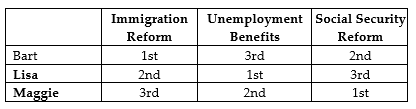 -Refer to Table 17-3. The table above outlines the rankings of three members of the U.S. Senate on three spending alternatives. Assume that Congress can spend additional revenue on only one of the three spending alternatives and that Bart, Lisa, and Maggie, all members of the Senate, participate in a series of votes in which they are to determine which of the spending alternatives should receive funding. Three votes will be taken: (1) Immigration Reform and Unemployment Benefits (2) Immigration Reform and Social Security Reform and (3) Unemployment Benefits and Social Security Reform.
Show the results of each vote and determine whether the voting paradox will occur as a result of these votes.
-Refer to Table 17-3. The table above outlines the rankings of three members of the U.S. Senate on three spending alternatives. Assume that Congress can spend additional revenue on only one of the three spending alternatives and that Bart, Lisa, and Maggie, all members of the Senate, participate in a series of votes in which they are to determine which of the spending alternatives should receive funding. Three votes will be taken: (1) Immigration Reform and Unemployment Benefits (2) Immigration Reform and Social Security Reform and (3) Unemployment Benefits and Social Security Reform.
Show the results of each vote and determine whether the voting paradox will occur as a result of these votes. (Essay)
5.0/5 (91)
(91) In 2018, over 80 percent of the revenue of the U.S. federal government was raised through
(Multiple Choice)
4.9/5 (70)
(70) A wealth tax like the one proposed by Senator Elizabeth Warren would perform best in meeting which of the following principles?
(Multiple Choice)
4.8/5 (92)
(92) 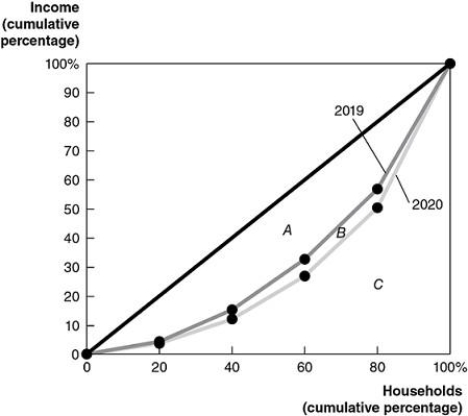 -Refer to Figure 17-8 to answer the following questions.
a. Did the distribution of income become more equal in 2020 than it was in 2019, or did it become less equal? Explain.
b. If area A = 1,900, area B = 450, and area C = 2,650, calculate the Gini coefficient for 2019 and the Gini coefficient for 2020.
-Refer to Figure 17-8 to answer the following questions.
a. Did the distribution of income become more equal in 2020 than it was in 2019, or did it become less equal? Explain.
b. If area A = 1,900, area B = 450, and area C = 2,650, calculate the Gini coefficient for 2019 and the Gini coefficient for 2020. (Essay)
4.9/5 (76)
(76) Perhaps the greatest efficiency loss from a wealth tax would result from the ________ as a result of the tax.
(Multiple Choice)
4.7/5 (71)
(71) In 2018, which type of tax raised the most revenue for the U.S. federal government? Which type of tax raised the most revenue for state and local governments?
(Essay)
4.8/5 (81)
(81)
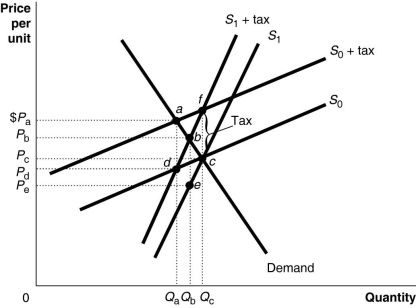 Figure 17-2 shows a demand curve and two sets of supply curves, one set more elastic than the other.
-Refer to Figure 17-2. If the government imposes an excise tax of $1.00 on every unit sold, the consumer's burden of the tax
Figure 17-2 shows a demand curve and two sets of supply curves, one set more elastic than the other.
-Refer to Figure 17-2. If the government imposes an excise tax of $1.00 on every unit sold, the consumer's burden of the tax (Multiple Choice)
4.8/5 (77)
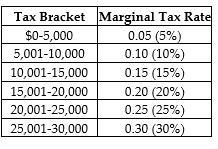
(77) Last year, Anthony Millanti earned exactly $30,000 of taxable income. Assume that the income tax system used to determine Anthony's tax liability is progressive. The table below lists the tax brackets and the marginal tax rates that apply to each bracket.
a. Draw a new table that lists the amounts of income tax that Anthony is obligated to pay for each tax bracket, and the total tax he owes the government. (Assume that there are no allowable tax deductions, tax credits, personal exemptions, or any other deductions that Anthony can use to reduce his tax liability).
b. Determine Anthony's average tax rate.
(Essay)
4.9/5 (82)
(82) 
Filters
- Essay(0)
- Multiple Choice(0)
- Short Answer(0)
- True False(0)
- Matching(0)