



 Chat with AI
Exam 1: Preliminaries: Introduction to Statistical Investigations

Exam 1: Preliminaries: Introduction to Statistical Investigations46 Questions
Exam 2: Significance: How Strong Is the Evidence75 Questions
Exam 3: Generalization: How Broadly Do the Results Apply64 Questions
Exam 4: Estimation: How Large Is the Effect61 Questions
Exam 5: Causation: Can We Say What Caused the Effect30 Questions
Exam 6: Comparing Two Proportions46 Questions
Exam 7: Comparing Two Means46 Questions
Exam 8: Paired Data: One Quantitative Variable48 Questions
Exam 9: Comparing More Than Two Proportions46 Questions
Exam 10: Comparing More Than Two Means28 Questions
Exam 11: Two Quantitative Variables73 Questions
Exam 12: Modeling Randomness129 Questions
Select questions type


An environmental science teacher at a high school with a large population of students was curious whether the majority (more than half) of students at the school regularly recycle plastic bottles. The teacher asks 146 students at the school: "Do you recycle plastic bottles more often than you throw them in the trash?" (Yes/No). Suppose that 89 of the students answered "Yes".
-If 50% of students at the school regularly recycle plastic bottles, there is only a 0.60% chance that 89 or more students out of 146 would have answered Yes to the teacher's survey. What does this tell you about the proportion of all students at the school that regularly recycle plastic bottles?
(Multiple Choice)
4.9/5  (77)
(77) A researcher designed a study to test whether players of the "Drop 7" smartphone app at-tain a higher score if offered a monetary incentive. Of 40 volunteers, 20 were randomly as-signed to a group where high scorers were paid $5 and the other 20 to a group simply told to "do your best." The researcher found that, on average, the volunteers in the group getting the monetary incentive scored substantially higher than those who did not receive a mone-tary incentive (mean score of 13,500 points in the group without the monetary incentive; 15,900 points in the monetary incentive group). Identify the steps of a statistical investiga-tion in this study by answering the following questions about this study.
-Step 2: Design a study and collect data. What are the observational units in this study?
(Multiple Choice)
4.8/5 (89)
(89) A classmate claims that he can smell the difference between a Starbucks cup of coffee and a Dunkin' Donuts cup of coffee. You decide to test this claim by blindfolding him and presenting him with two cups of coffee - one from Starbucks and one from Dunkin' Donuts.
-Your classmate guesses the correct brand of coffee in 65 out of 100 trials. Does this convince you that your classmate's claim is true?
(Multiple Choice)
4.8/5 (79)
(79) A researcher designed a study to test whether players of the "Drop 7" smartphone app at-tain a higher score if offered a monetary incentive. Of 40 volunteers, 20 were randomly as-signed to a group where high scorers were paid $5 and the other 20 to a group simply told to "do your best." The researcher found that, on average, the volunteers in the group getting the monetary incentive scored substantially higher than those who did not receive a mone-tary incentive (mean score of 13,500 points in the group without the monetary incentive; 15,900 points in the monetary incentive group). Identify the steps of a statistical investiga-tion in this study by answering the following questions about this study.
-Step 2: Design a study and collect data. What are the variables in this study and their types? Select all that apply.
(Multiple Choice)
4.8/5 (89)
(89) In June of 2012, New York City Mayor Michael Bloomberg proposed banning the sale of any regular soda or other sugary drinks in containers larger than 16 oz. A fast food chain polled a random sample of 2500 of its regular customers and found that 63% opposed the ban, 28% supported the ban, and 9% had no opinion.
-What are the observational units?
(Multiple Choice)
4.9/5 (65)
(65) The plots below were created using a data set containing information about movies re-leased in 1995 and 2005. Note: M = million. 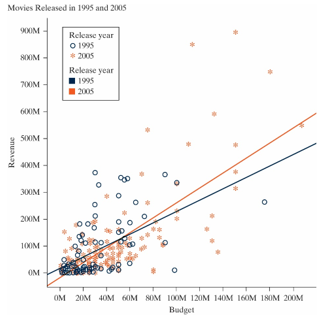
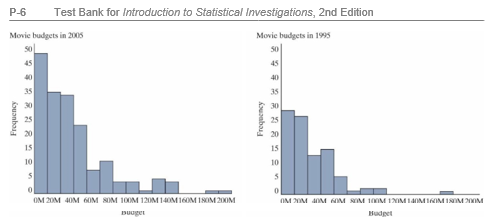 -Did the association between movie budget and movie revenue change between 1995 and 2005?
 (Multiple Choice)
4.8/5 (92)
(92) Which of the following research questions could be investigated with a statistical study?
(Multiple Choice)
4.7/5 (91)
(91) A researcher designed a study to test whether players of the "Drop 7" smartphone app at-tain a higher score if offered a monetary incentive. Of 40 volunteers, 20 were randomly as-signed to a group where high scorers were paid $5 and the other 20 to a group simply told to "do your best." The researcher found that, on average, the volunteers in the group getting the monetary incentive scored substantially higher than those who did not receive a mone-tary incentive (mean score of 13,500 points in the group without the monetary incentive; 15,900 points in the monetary incentive group). Identify the steps of a statistical investiga-tion in this study by answering the following questions about this study.
-Step 4: Draw inferences beyond the data. What is the researchers' conclusion about the difference in anxiety levels between the two groups?
(Multiple Choice)
4.9/5 (65)
(65) Suppose you plan to flip a fair coin and count the number of times the coin lands on "heads". Let H represent "heads" and T represent "tails".
-Which of the following sequences of heads and tails is the least likely to occur?
(Multiple Choice)
4.8/5 (89)
(89) A meteorologist is hoping to find a better model for predicting when and where an avalanche will occur around ski areas in Montana. She plans to collect information from a ski area weather station each day between November 1 through March 31 for each of the next three winters. For each day, the meteorologist will record the high and low tem-perature, amount of snowfall, maximum wind velocity, whether at least half the daylight hours were sunny, and whether an avalanche occurred.
-What are the observational units?
(Multiple Choice)
4.9/5 (71)
(71) Suppose you plan to roll a six-sided die.
-Which of the following sequences of die rolls is the least likely to occur?
(Multiple Choice)
4.9/5 (83)
(83) Which of the following sets of numbers has the largest standard deviation?
(Multiple Choice)
4.9/5 (72)
(72) Researchers investigated whether larger bowls increase the mean amount of ice cream people scoop when serving themselves. In a sample of volunteers, participants were ran-domly given either a small (17 oz.) bowl or a large (34 oz.) bowl. They were then invited to scoop as much ice cream as they liked, and the amount of ice cream (in ounces) was measured. The mean amount of ice cream for the participants given a small bowl was 6.43 ounces; the mean amount of ice cream for the participants given a large bowl was 8.15 ounces.
-Are the two variables in the study categorical or quantitative?
(Multiple Choice)
4.8/5 (75)
(75) A classmate claims that he can smell the difference between a Starbucks cup of coffee and a Dunkin' Donuts cup of coffee. You decide to test this claim by blindfolding him and presenting him with two cups of coffee - one from Starbucks and one from Dunkin' Donuts.
-Your classmate guesses the correct brand of coffee both times in two trials. Does this convince you that your classmate's claim is true?
(Multiple Choice)
4.8/5 (73)
(73) A researcher designed a study to test whether players of the "Drop 7" smartphone app at-tain a higher score if offered a monetary incentive. Of 40 volunteers, 20 were randomly as-signed to a group where high scorers were paid $5 and the other 20 to a group simply told to "do your best." The researcher found that, on average, the volunteers in the group getting the monetary incentive scored substantially higher than those who did not receive a mone-tary incentive (mean score of 13,500 points in the group without the monetary incentive; 15,900 points in the monetary incentive group). Identify the steps of a statistical investiga-tion in this study by answering the following questions about this study.
-Step 3: Explore the data. What are the average scores in the two groups?
Monetary incentive group: ___(B1)___
"Do your best" group: ___ (B2)___
(Short Answer)
4.8/5 (71)
(71) An environmental science teacher at a high school with a large population of students was curious whether the majority (more than half) of students at the school regularly recycle plastic bottles. The teacher asks 146 students at the school: "Do you recycle plastic bottles more often than you throw them in the trash?" (Yes/No). Suppose that 89 of the students answered "Yes".
-How could we simulate the teacher's survey if 50% of students at the school would have answered Yes? Select all that apply.
(Multiple Choice)
4.7/5 (89)
(89) A histogram that has the majority of data on the left with a long right tail is skewed left.
(True/False)
4.8/5 (89)
(89) Researchers investigated whether larger bowls increase the mean amount of ice cream people scoop when serving themselves. In a sample of volunteers, participants were ran-domly given either a small (17 oz.) bowl or a large (34 oz.) bowl. They were then invited to scoop as much ice cream as they liked, and the amount of ice cream (in ounces) was measured. The mean amount of ice cream for the participants given a small bowl was 6.43 ounces; the mean amount of ice cream for the participants given a large bowl was 8.15 ounces.
-What two variables were measured in this study? Select two.
(Multiple Choice)
4.8/5 (89)
(89) The plots below were created using a data set containing information about movies re-leased in 1995 and 2005. Note: M = million.
-Identify all variables measured on the observational units that are displayed in the three plots above. Select all that apply.
-Identify all variables measured on the observational units that are displayed in the three plots above. Select all that apply. (Multiple Choice)
4.8/5 (97)
(97) Many football bets include a "point-spread" so that the team that is favored needs to win by more than that amount for a "victory." The point-spreads are designed by professional odds makers with the intention that the probability of the favored team winning by the required amount is 0.50.
-In many, many football games, the favored team will win by the point-spread in about 50% of those games.
(True/False)
4.9/5 (68)
(68) 
Filters
- Essay(0)
- Multiple Choice(0)
- Short Answer(0)
- True False(0)
- Matching(0)