



 Chat with AI
Exam 1: Preliminaries: Introduction to Statistical Investigations

Exam 1: Preliminaries: Introduction to Statistical Investigations46 Questions
Exam 2: Significance: How Strong Is the Evidence75 Questions
Exam 3: Generalization: How Broadly Do the Results Apply64 Questions
Exam 4: Estimation: How Large Is the Effect61 Questions
Exam 5: Causation: Can We Say What Caused the Effect30 Questions
Exam 6: Comparing Two Proportions46 Questions
Exam 7: Comparing Two Means46 Questions
Exam 8: Paired Data: One Quantitative Variable48 Questions
Exam 9: Comparing More Than Two Proportions46 Questions
Exam 10: Comparing More Than Two Means28 Questions
Exam 11: Two Quantitative Variables73 Questions
Exam 12: Modeling Randomness129 Questions
Select questions type


The plots below were created using a data set containing information about movies re-leased in 1995 and 2005. Note: M = million. 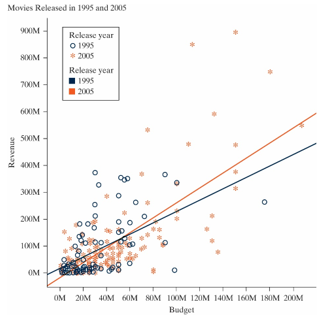
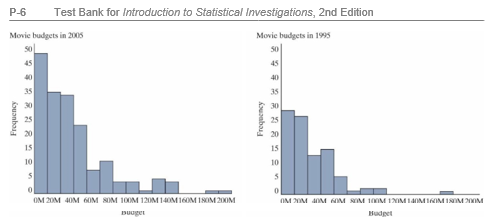 -What is the shape of the distribution of movie budgets in the year 1995?
Free
(Multiple Choice)
4.8/5  (90)
(90) Correct Answer: Verified
D
Many football bets include a "point-spread" so that the team that is favored needs to win by more than that amount for a "victory." The point-spreads are designed by professional odds makers with the intention that the probability of the favored team winning by the required amount is 0.50.
-The favored team won by the required amount in 7 out of 10 games. Describe how you could conduct a simulation to estimate the probability of this happening if the true proportion that the favored team won by the required amount is 0.50.
Free
(Multiple Choice)
4.7/5 (84)
(84) Correct Answer:Verified
VerifiedC
The lottery game Powerball advertises that the probability of winning a prize is 0.04. This means that if 100 people play Powerball, then 4 of them will win a prize.
Free
(True/False)
4.8/5 (89)
(89) Correct Answer:Verified
VerifiedFalse
In June of 2012, New York City Mayor Michael Bloomberg proposed banning the sale of any regular soda or other sugary drinks in containers larger than 16 oz. A fast food chain polled a random sample of 2500 of its regular customers and found that 63% opposed the ban, 28% supported the ban, and 9% had no opinion.
-What type of variable was measured in this study?
(Multiple Choice)
4.9/5 (80)
(80) Van Nood et al. (2013) studied patients with "Clostridium difficile" infections, which cause persistent diarrhea. One variable was treatment: some patients were given the antibiotic vancomycin, and some patients were given a fecal transplant. The other variable was whether the patient was cured (cured or not cured). Van Nood randomly assigned an equal number of patients to each treatment. The researchers found that 18% of the patients in the antibiotic vancomycin treatment group were cured, whereas 69% of patients in the fecal transplant were cured.
-Out of 100 Clostridium difficile patients taking the antibiotic vancomycin, 18 of them will be cured.
(True/False)
4.8/5 (82)
(82) Suppose you plan to flip a fair coin and count the number of times the coin lands on "heads". Let H represent "heads" and T represent "tails".
-You plan to flip the coin n times. For which of the following values of n would you have the highest probability of observing all heads?
(Multiple Choice)
4.8/5 (72)
(72) The plots below were created using a data set containing information about movies re-leased in 1995 and 2005. Note: M = million.
-Which year had smaller variability in movie revenue?
-Which year had smaller variability in movie revenue? (Multiple Choice)
5.0/5 (79)
(79) Suppose you plan to roll a six-sided die.
-You plan to roll the die n times. With each roll, you record whether the die landed on an odd number or an even number. For which of the following values of n would you have the lowest probability of observing all even number rolls?
(Multiple Choice)
4.8/5 (78)
(78) Van Nood et al. (2013) studied patients with "Clostridium difficile" infections, which cause persistent diarrhea. One variable was treatment: some patients were given the antibiotic vancomycin, and some patients were given a fecal transplant. The other variable was whether the patient was cured (cured or not cured). Van Nood randomly assigned an equal number of patients to each treatment. The researchers found that 18% of the patients in the antibiotic vancomycin treatment group were cured, whereas 69% of patients in the fecal transplant were cured.
-Explain what the value 0.69 means, as if to someone who has never studied probability or statistics.
(Multiple Choice)
4.8/5 (81)
(81) A meteorologist is hoping to find a better model for predicting when and where an avalanche will occur around ski areas in Montana. She plans to collect information from a ski area weather station each day between November 1 through March 31 for each of the next three winters. For each day, the meteorologist will record the high and low tem-perature, amount of snowfall, maximum wind velocity, whether at least half the daylight hours were sunny, and whether an avalanche occurred.
-For each variable below, select whether it is categorical or quantitative.
i. High temperature ___(1)___
ii. Whether an avalanche occurred ___(2)___
iii. Whether at least half the daylight hours were sunny ___(3)___
Drop-down options for (1), (2), and (3):
•categorical
•quantitative
(Short Answer)
4.9/5 (78)
(78) Which of the following sets of numbers has the smallest standard deviation?
(Multiple Choice)
4.9/5 (84)
(84) The following plots display data exam scores for two different statistics classes. 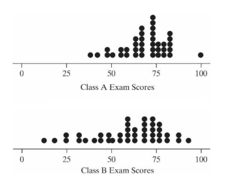 -What is the shape of the distribution of exam scores for Class B?
 (Multiple Choice)
4.7/5 (80)
(80) Which of the following variables are likely to be skewed right? Select all that apply.
(Multiple Choice)
5.0/5 (74)
(74) A researcher designed a study to test whether players of the "Drop 7" smartphone app at-tain a higher score if offered a monetary incentive. Of 40 volunteers, 20 were randomly as-signed to a group where high scorers were paid $5 and the other 20 to a group simply told to "do your best." The researcher found that, on average, the volunteers in the group getting the monetary incentive scored substantially higher than those who did not receive a mone-tary incentive (mean score of 13,500 points in the group without the monetary incentive; 15,900 points in the monetary incentive group). Identify the steps of a statistical investiga-tion in this study by answering the following questions about this study.
-Step 2: Design a study and collect data. How many observational units did the researcher collect data on?
(Short Answer)
4.9/5 (71)
(71) In June of 2012, New York City Mayor Michael Bloomberg proposed banning the sale of any regular soda or other sugary drinks in containers larger than 16 oz. A fast food chain polled a random sample of 2500 of its regular customers and found that 63% opposed the ban, 28% supported the ban, and 9% had no opinion.
-What variable was measured in this study?
(Multiple Choice)
4.9/5 (79)
(79) The lottery game Powerball advertises that the probability of winning a prize is 0.04. This means that, in the long run, if thousands of people play Powerball, then about 4% of them will win a prize.
(True/False)
4.8/5 (72)
(72) The plots below were created using a data set containing information about movies re-leased in 1995 and 2005. Note: M = million.
-Which year had a lower mean movie budget?
-Which year had a lower mean movie budget? (Multiple Choice)
4.7/5 (81)
(81) A researcher designed a study to test whether players of the "Drop 7" smartphone app at-tain a higher score if offered a monetary incentive. Of 40 volunteers, 20 were randomly as-signed to a group where high scorers were paid $5 and the other 20 to a group simply told to "do your best." The researcher found that, on average, the volunteers in the group getting the monetary incentive scored substantially higher than those who did not receive a mone-tary incentive (mean score of 13,500 points in the group without the monetary incentive; 15,900 points in the monetary incentive group). Identify the steps of a statistical investiga-tion in this study by answering the following questions about this study.
-Step 1: Ask a research question. What is the research question being investigated in this study?
(Multiple Choice)
4.7/5 (80)
(80) A researcher designed a study to test whether players of the "Drop 7" smartphone app at-tain a higher score if offered a monetary incentive. Of 40 volunteers, 20 were randomly as-signed to a group where high scorers were paid $5 and the other 20 to a group simply told to "do your best." The researcher found that, on average, the volunteers in the group getting the monetary incentive scored substantially higher than those who did not receive a mone-tary incentive (mean score of 13,500 points in the group without the monetary incentive; 15,900 points in the monetary incentive group). Identify the steps of a statistical investiga-tion in this study by answering the following questions about this study.
-Step 5: Formulate conclusions. In order to make the conclusions of the study more relevant, what is the researcher hoping about the volunteers in this study as compared to all "Drop 7" players?
(Multiple Choice)
4.9/5 (68)
(68) Researchers investigated whether larger bowls increase the mean amount of ice cream people scoop when serving themselves. In a sample of volunteers, participants were ran-domly given either a small (17 oz.) bowl or a large (34 oz.) bowl. They were then invited to scoop as much ice cream as they liked, and the amount of ice cream (in ounces) was measured. The mean amount of ice cream for the participants given a small bowl was 6.43 ounces; the mean amount of ice cream for the participants given a large bowl was 8.15 ounces.
-What are the observational units?
(Multiple Choice)
4.9/5 (87)
(87) 
Filters
- Essay(0)
- Multiple Choice(0)
- Short Answer(0)
- True False(0)
- Matching(0)