



 Chat with AI
Exam 2: Foundations of Recruitment and Selection I

Exam 1: An Introduction to Recruitment and Selection69 Questions
Exam 2: Foundations of Recruitment and Selection I63 Questions
Exam 3: Foundations of Recruitment and Selection II74 Questions
Exam 4: Job Analysis and Competency Models92 Questions
Exam 5: Recruitment, Selection, and Job Performance64 Questions
Exam 6: Recruitment68 Questions
Exam 7: Selection I: Applicant Screening70 Questions
Exam 8: Selection II: Testing and Other Assessments87 Questions
Exam 9: Selection III: Interviewing70 Questions
Exam 10: Decision Making63 Questions
Select questions type


Which of the following concepts is defined as the hypothetical difference between an individual's observed score on any particular measurement and the individual's true score?

Free
(Multiple Choice)
4.8/5  (82)
(82) Correct Answer: Verified
A
To estimate reliability, it is important to adopt a strategy to develop approximations of parallel measures. Which of the following is NOT such a strategy?
Free
(Multiple Choice)
4.9/5 (74)
(74) Correct Answer:Verified
VerifiedC
What concept is defined as follows: the decrease in magnitude of the validity coefficient associated with measurement error of the predictor, the criterion, or both?
Free
(Multiple Choice)
4.9/5 (78)
(78) Correct Answer:Verified
VerifiedC
What do you get when you square the reliability coefficient?
(Multiple Choice)
4.8/5 (76)
(76) What is a defining characteristic of a science-based selection process?
(Multiple Choice)
4.9/5 (92)
(92) Scribe Engineering, a medium-sized information technology company, is having difficulties recruiting and retaining several of its administrative assistant positions. Traditionally, Scribe has used a practice-based selection process. As the new HRM, what would you suggest to the CEO?
(Essay)
4.9/5 (87)
(87) Which of the following is NOT a reason to use practice-based selection approaches?
(Multiple Choice)
4.8/5 (62)
(62) What is the best way for HR professionals to make sure that their selection decisions meet the standards set by courts and tribunals?
(Multiple Choice)
4.8/5 (77)
(77) What is a potential outcome of a science-based selection process?
(Multiple Choice)
4.7/5 (74)
(74) The employer's goal in selection is to hire an applicant who possesses the necessary knowledge, skills, abilities, and other attributes to perform the job being filled.
(True/False)
4.7/5 (78)
(78) 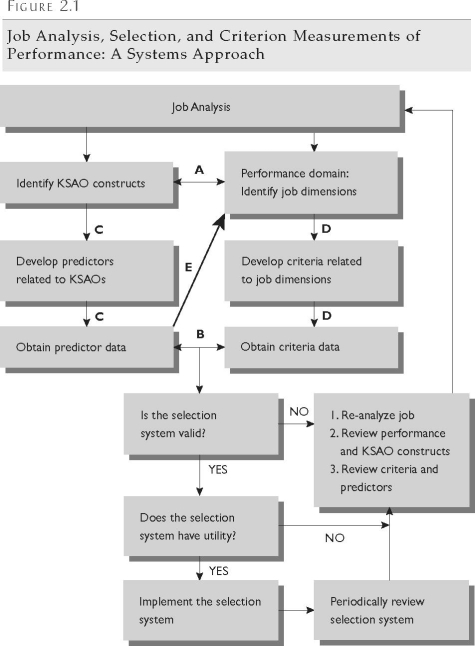 -Refer to Figure 2.1. What process does line E represent?
What is a potential outcome of a practice-based selection process?
(Multiple Choice)
4.9/5 (81)
(81) The principle that every test taker should be assessed in an equitable manner is known as equity.
(True/False)
4.8/5 (75)
(75) Employers must know the legal and professional standards in order to increase the likelihood that their selection processes are compliant.
(True/False)
4.9/5 (73)
(73) In their mid-1970s research, what procedure did researchers Schmidt and Hunter use to challenge the idea that a validity coefficient is specific to the context in which it is measured?
(Multiple Choice)
4.9/5 (88)
(88) What is a defining characteristic of a practice-based selection process?
(Multiple Choice)
4.9/5 (87)
(87) 
Filters
- Essay(0)
- Multiple Choice(0)
- Short Answer(0)
- True False(0)
- Matching(0)