



 Chat with AI
Exam 11: Exploring the Reserve Accounting System, Money Markets, and Financial Instruments

Exam 1: Understanding the Financial System and Its Impact on the Economy and Markets137 Questions
Exam 2: Financial Systems, Monetary Units, and the Role of Money in the Economy133 Questions
Exam 3: Financial Indices, Market Information, and Economic Data141 Questions
Exam 4: The Financial Crisis and Its Impact on the Mortgage Market and Economy128 Questions
Exam 5: Understanding Interest Rates, Savings, and the Wealth Effect133 Questions
Exam 6: Financial Concepts and Interest Rates137 Questions
Exam 7: Effects of Inflation and Yield Curves on Stock Prices and Investments122 Questions
Exam 8: Understanding Risk and Market Factors in Financial Securities128 Questions
Exam 9: Exploring Financial Markets and Hedging Strategies138 Questions
Exam 10: Factors Affecting the Volume of CDs117 Questions
Exam 11: Exploring the Reserve Accounting System, Money Markets, and Financial Instruments124 Questions
Exam 12: Exploring Central Banks and Their Impact on the Economy and Financial System122 Questions
Exam 13: Central Banking and Monetary Policy: Exploring Tools and Strategies146 Questions
Exam 14: Banking and Financial Services: Regulations, Operations, and Trends138 Questions
Exam 15: Comparative Analysis of Financial Institutions and Their Operations104 Questions
Exam 16: Exploring Various Aspects of Pension Funds, Finance Companies, and Insurance Industry135 Questions
Exam 17: The Impact of Deregulation and Regulation on Financial Institutions and Banking Industry in the United States116 Questions
Exam 18: Treasury Auctions, Public Debt, and Government Borrowing: Exploring the Us Treasury System135 Questions
Exam 19: Corporate Bond Pricing, Market Development, and Financing Strategies98 Questions
Exam 20: The Truth About Regulation Fd and Stock Holdings: Debunking Common Myths in the Financial Market131 Questions
Exam 21: Flexible Savings Account Options104 Questions
Exam 22: Mortgage Market and Mortgage Instruments109 Questions
Exam 23: International Financial Transactions and Balance of Payments120 Questions
Exam 24: International Banking and Financial Regulations76 Questions
Exam 25: Exploring the Complexities of Financial Services and Regulation118 Questions
Select questions type


What is the discount rate (DR) and the investment return (IR) on the following commercial notes?
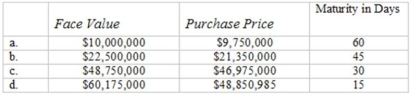
(Short Answer)
4.9/5  (96)
(96) Non-bank thrift institutions that offer transaction accounts must keep reserve balances at the Federal Reserve banks.
(True/False)
4.9/5 (75)
(75) The majority of federal funds transactions are overnight loans.
(True/False)
5.0/5 (82)
(82) Money market CDs must be negotiable instruments with minimum denominations of $100,000.
(True/False)
4.8/5 (88)
(88) A primary uses of the bankers acceptances to finance the purchase of internationally traded goods while those goods are in transit.
(True/False)
4.9/5 (82)
(82) The commercial paper market all but dried up during the recent credit crisis of 2007-2009.
(True/False)
4.8/5 (87)
(87) One-year T-bills are usually auctioned on a different schedule than 13-week and 26-week bills.
(True/False)
4.8/5 (60)
(60) There has recently been a lot of criticism over the operation of the U.S. mortgage market.
(True/False)
4.7/5 (82)
(82) The form of commercial paper in which loans or credit receivables are pooled into packages and then paper is issued as claims against that pool is known as:
(Multiple Choice)
5.0/5 (81)
(81) Negotiable CDs, by attracting funds out of expensive checking accounts, help to lower the average cost of bank funds.
(True/False)
4.7/5 (69)
(69) Which of the following statements regarding Fannie and Freddie, government-sponsored agencies, is/are true?
(Multiple Choice)
4.9/5 (79)
(79) Why are acceptances not as widely used inside the United States as they are in international markets?
(Short Answer)
4.7/5 (80)
(80) Contemporaneous reserve accounting has replaced lagged reserve accounting as a means of calculating deposit reserves nowadays in most large U.S. banks.
(True/False)
4.9/5 (73)
(73) The period of time over which a bank must hold its required amount of legal reserves is known as the reserve computation period.
(True/False)
4.8/5 (79)
(79) The following are among uses of funds for securities dealers:
(Multiple Choice)
4.8/5 (82)
(82) Federal agencies active in the financial markets are usually set up to aid so-called disadvantaged sectors of the economy. Please give some examples of disadvantaged sectors.
(Short Answer)
4.8/5 (75)
(75) With the lagged reserve accounting system there is a 60-day lag between the reserve computation and reserve maintenance periods for non personal time deposits and other non transaction liabilities.
(True/False)
4.8/5 (92)
(92) 
Filters
- Essay(0)
- Multiple Choice(0)
- Short Answer(0)
- True False(0)
- Matching(0)