



 Chat with AI
Exam 14: Banking and Financial Services: Regulations, Operations, and Trends

Exam 1: Understanding the Financial System and Its Impact on the Economy and Markets137 Questions
Exam 2: Financial Systems, Monetary Units, and the Role of Money in the Economy133 Questions
Exam 3: Financial Indices, Market Information, and Economic Data141 Questions
Exam 4: The Financial Crisis and Its Impact on the Mortgage Market and Economy128 Questions
Exam 5: Understanding Interest Rates, Savings, and the Wealth Effect133 Questions
Exam 6: Financial Concepts and Interest Rates137 Questions
Exam 7: Effects of Inflation and Yield Curves on Stock Prices and Investments122 Questions
Exam 8: Understanding Risk and Market Factors in Financial Securities128 Questions
Exam 9: Exploring Financial Markets and Hedging Strategies138 Questions
Exam 10: Factors Affecting the Volume of CDs117 Questions
Exam 11: Exploring the Reserve Accounting System, Money Markets, and Financial Instruments124 Questions
Exam 12: Exploring Central Banks and Their Impact on the Economy and Financial System122 Questions
Exam 13: Central Banking and Monetary Policy: Exploring Tools and Strategies146 Questions
Exam 14: Banking and Financial Services: Regulations, Operations, and Trends138 Questions
Exam 15: Comparative Analysis of Financial Institutions and Their Operations104 Questions
Exam 16: Exploring Various Aspects of Pension Funds, Finance Companies, and Insurance Industry135 Questions
Exam 17: The Impact of Deregulation and Regulation on Financial Institutions and Banking Industry in the United States116 Questions
Exam 18: Treasury Auctions, Public Debt, and Government Borrowing: Exploring the Us Treasury System135 Questions
Exam 19: Corporate Bond Pricing, Market Development, and Financing Strategies98 Questions
Exam 20: The Truth About Regulation Fd and Stock Holdings: Debunking Common Myths in the Financial Market131 Questions
Exam 21: Flexible Savings Account Options104 Questions
Exam 22: Mortgage Market and Mortgage Instruments109 Questions
Exam 23: International Financial Transactions and Balance of Payments120 Questions
Exam 24: International Banking and Financial Regulations76 Questions
Exam 25: Exploring the Complexities of Financial Services and Regulation118 Questions
Select questions type


Construct the report of condition (balance sheet) for First National Bank for December 31 of the year just ended from following information.
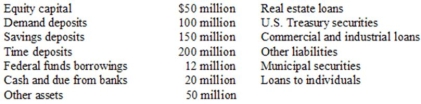
(Essay)
4.7/5  (81)
(81) Loans granted to finance the purchase of buildings, machinery and equipment are called working capital loans.
(True/False)
4.7/5 (82)
(82) The U.S. banking system is moving toward consolidation which means:
(Multiple Choice)
5.0/5 (77)
(77) No U.S. banks are permitted to offer investment banking services involving corporate securities inside the United States.
(True/False)
4.8/5 (76)
(76) The FDIC Improvement Act in 1991 granted the Federal Deposit Insurance Corporation authority to close the U.S. offices of foreign banks if these are operated in an unsafe manner.
(True/False)
4.9/5 (76)
(76) A relatively new fund-raising device used by banks and a few other financial intermediaries in recent years in which better quality loans are packaged into asset pools as collateral for bank security issues sold to investors is known as:
(Multiple Choice)
4.7/5 (90)
(90) The structural change which makes banking organizations looking more and more like other financial-service providers is called:
(Multiple Choice)
4.9/5 (74)
(74) For the EC (European Community), conversion to the Euro will offer the following benefits:
(Multiple Choice)
4.8/5 (80)
(80) The most important security held in U.S. bank investment portfolios today is:
(Multiple Choice)
4.9/5 (78)
(78) The banking system can create money only dollar for dollar with the amount of excess reserves in the banking system.
(True/False)
4.9/5 (80)
(80) According to the text, which of the following is not a permissible activity for bank holding companies?
(Multiple Choice)
4.8/5 (90)
(90) Vault cash held by a depository institution does not count as part of the legal reserves of a U.S. depository institution.
(True/False)
4.8/5 (73)
(73) From 1975 to year 2000, the number of U.S. commercial banks and the average size of a U.S. bank have changed as follows:
(Multiple Choice)
4.8/5 (71)
(71) The banking system can take a given volume of cash reserves and:
(Multiple Choice)
4.8/5 (82)
(82) Recent problems in the financial system will likely cause bank consolidation to:
(Multiple Choice)
4.9/5 (75)
(75) The number and different sizes of commercial banks in a given community or market area is referred to as:
(Multiple Choice)
4.7/5 (96)
(96) Lease financing by commercial banks generally carries a higher yield to banks than direct loans but lacks any tax advantage as direct loans do.
(True/False)
5.0/5 (78)
(78) Primary reserves are the banker's first line of defense against withdrawals.
(True/False)
5.0/5 (84)
(84) 
Filters
- Essay(0)
- Multiple Choice(0)
- Short Answer(0)
- True False(0)
- Matching(0)