



 Chat with AI
Exam 11: Firms in Perfectly Competitive Markets

Exam 1: Market Failure, Market Efficiency and Welfare10 Questions
Exam 2: Elasticities18 Questions
Exam 3: Market in Motion and Price Controls17 Questions
Exam 4: Demand Supply and Market Equilibrium15 Questions
Exam 5: Economics Eight Powerful Ideas and the Role and Method of Economics11 Questions
Exam 6: International Finance13 Questions
Exam 7: International Trade, Income Poverty and Health Care14 Questions
Exam 8: The Markets for Labor Capital and Land11 Questions
Exam 9: Oligopoly and Strategic Behavior55 Questions
Exam 10: Monopolistic Competition, Product Differentiation, Monopoly and Antitrust50 Questions
Exam 11: Firms in Perfectly Competitive Markets35 Questions
Exam 12: The Firm Production and Costs71 Questions
Exam 13: Consumer Choice Theory15 Questions
Select questions type


Exhibit
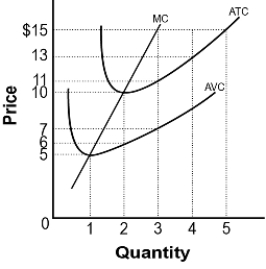 -Refer to Exhibit 12.7. In the short-run, if the market price is $10, the competitive firm will earn:?
Free
(Multiple Choice)
4.8/5  (77)
(77) Correct Answer: Verified
B
Exhibit
-Refer to Figure 12.7. At what price would other firm be encouraged to enter this market?
-Refer to Figure 12.7. At what price would other firm be encouraged to enter this market?Free
(Multiple Choice)
4.7/5 (74)
(74) Correct Answer:Verified
VerifiedD
Assume a perfectly competitive firm sells its output for $150 per unit. At its current 2,000 units of output, marginal cost is $140 and increasing, and average variable cost is $143. Assuming it wants to maximize its profits, it should:?
Free
(Multiple Choice)
4.8/5 (85)
(85) Correct Answer:Verified
VerifiedA
Exhibit
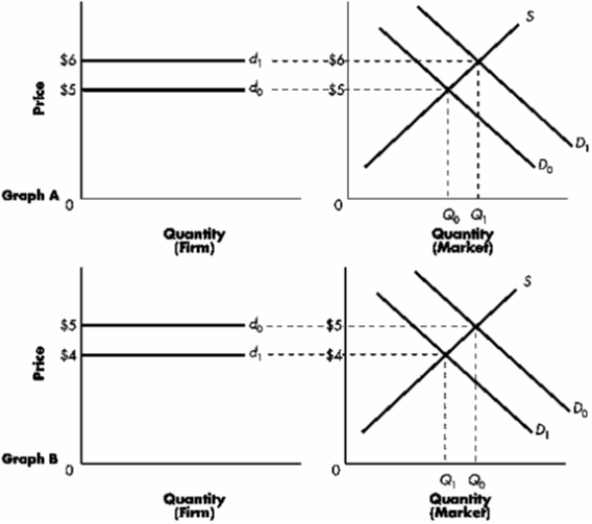 -Refer to Exhibit. In Graph B, the market demand has decreased from d0 to d1, and as a result:
 (Multiple Choice)
4.9/5 (86)
(86) Exhibit
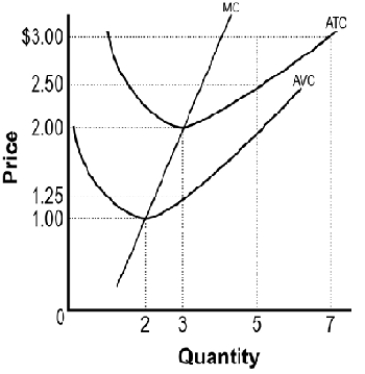 -Refer to Exhibit. Competitive firms will operate at an economic loss but not shut down in the short run if the market price?
 (Multiple Choice)
5.0/5 (82)
(82) Exhibit
-Refer to Exhibit. When market price is $15, a profit-maximizing firm's short-run profits are:?
-Refer to Exhibit. When market price is $15, a profit-maximizing firm's short-run profits are:? (Multiple Choice)
5.0/5 (84)
(84) Exhibit
-Refer to Exhibit. When market price is $2, a profit-maximizing competitive firm's profit is?
-Refer to Exhibit. When market price is $2, a profit-maximizing competitive firm's profit is? (Multiple Choice)
4.9/5 (72)
(72) Exhibit
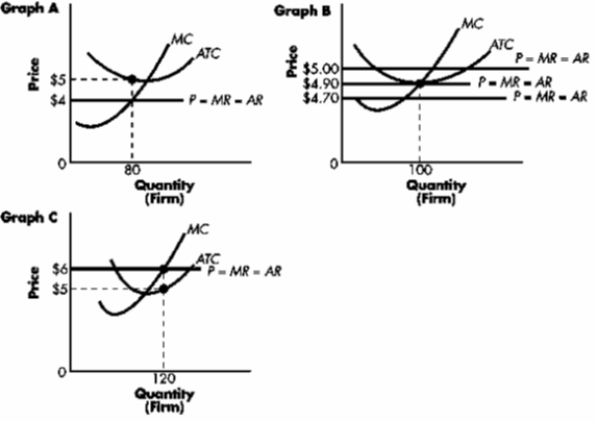 -Refer to Exhibit. Total revenue for the firm in Graph A equals:?
 (Multiple Choice)
4.8/5 (90)
(90) Exhibit
-Refer to Exhibit 12.7. In the short-run, if the market price is less than $5, the competitive firm will earn:?
-Refer to Exhibit 12.7. In the short-run, if the market price is less than $5, the competitive firm will earn:? (Multiple Choice)
4.7/5 (74)
(74) Exhibit
-Refer to Exhibit. In Graph A, the market demand has increased from d0 to d1, and as a result:
-Refer to Exhibit. In Graph A, the market demand has increased from d0 to d1, and as a result: (Multiple Choice)
4.8/5 (81)
(81) Exhibit
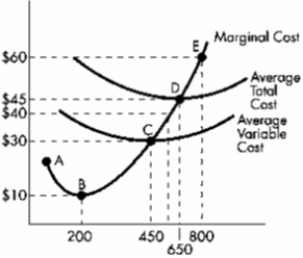 -Refer to Exhibit. In the short run, if the market price falls below ____, the firm should shut down.
 (Multiple Choice)
4.9/5 (77)
(77) Exhibit
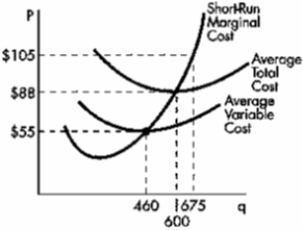 -Refer to Exhibit. Suppose the market price equals $88 and the firm is currently producing 600 units of output. In this situation, the firm:?
 (Multiple Choice)
4.8/5 (79)
(79) Exhibit
-Refer to Exhibit. In the short-run, if the market price is higher than $10, the competitive firm will earn:
-Refer to Exhibit. In the short-run, if the market price is higher than $10, the competitive firm will earn: (Multiple Choice)
4.9/5 (63)
(63) A perfectly competitive, increasing cost industry is initially in long run equilibrium. Then, there is an increase in demand. Compared with the initial equilibrium, once the new long run equilibrium is reached:?
(Multiple Choice)
4.9/5 (73)
(73) Exhibit
-Refer to Exhibit. When the market price equals $54, the firm:?should continue operating temporarily despite an economic loss because the firm is able to cover a portion of its fixed costs.
-Refer to Exhibit. When the market price equals $54, the firm:?should continue operating temporarily despite an economic loss because the firm is able to cover a portion of its fixed costs. (Multiple Choice)
4.9/5 (71)
(71) Exhibit
-Refer to Exhibit. The lowest price at which the firm can earn at least zero economic profit is:?
-Refer to Exhibit. The lowest price at which the firm can earn at least zero economic profit is:? (Multiple Choice)
4.9/5 (67)
(67) Exhibit
The following table shows how the total cost of producing canisters of peanuts varies with output and capital in the long run in a perfectly competitive industry.
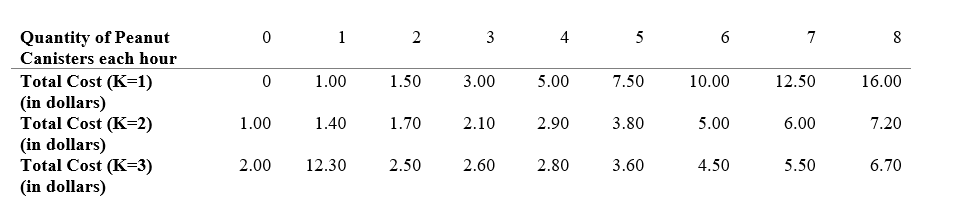 -Refer to Exhibit. What levels of capital (K=1, K=2, or K=3) would the firm choose in the long run for producing three canisters and five canisters of peanuts per hour, respectively?
 (Essay)
5.0/5 (88)
(88) Exhibit
-Refer to Exhibit. When the market price is $2, a competitive profit-maximizing firm's total revenue is:?
-Refer to Exhibit. When the market price is $2, a competitive profit-maximizing firm's total revenue is:? (Multiple Choice)
4.9/5 (61)
(61) Exhibit
The figure shows the price, marginal cost, and average cost curves of a perfectly competitive firm.
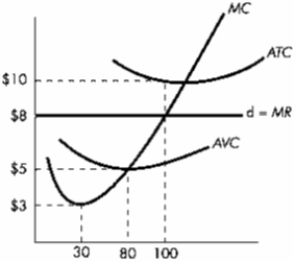 -Refer to Exhibit. The firm depicted above should:
 (Multiple Choice)
4.9/5 (74)
(74) Exhibit
-Refer to Exhibit. Graph B exhibits a price-taking firm:
-Refer to Exhibit. Graph B exhibits a price-taking firm: (Multiple Choice)
4.8/5 (84)
(84) 
Filters
- Essay(0)
- Multiple Choice(0)
- Short Answer(0)
- True False(0)
- Matching(0)