



 Chat with AI
Exam 10: Monopolistic Competition, Product Differentiation, Monopoly and Antitrust

Exam 1: Market Failure, Market Efficiency and Welfare10 Questions
Exam 2: Elasticities18 Questions
Exam 3: Market in Motion and Price Controls17 Questions
Exam 4: Demand Supply and Market Equilibrium15 Questions
Exam 5: Economics Eight Powerful Ideas and the Role and Method of Economics11 Questions
Exam 6: International Finance13 Questions
Exam 7: International Trade, Income Poverty and Health Care14 Questions
Exam 8: The Markets for Labor Capital and Land11 Questions
Exam 9: Oligopoly and Strategic Behavior55 Questions
Exam 10: Monopolistic Competition, Product Differentiation, Monopoly and Antitrust50 Questions
Exam 11: Firms in Perfectly Competitive Markets35 Questions
Exam 12: The Firm Production and Costs71 Questions
Exam 13: Consumer Choice Theory15 Questions
Select questions type


Exhibit
Consider the following demand and cost information for a monopoly.
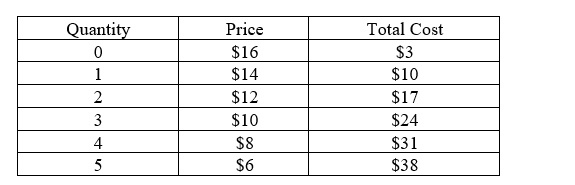 -Refer to Exhibit. At the profit-maximizing price, how much profit will the monopoly earn?
Free
(Multiple Choice)
4.7/5  (77)
(77) Correct Answer: Verified
D
Exhibit
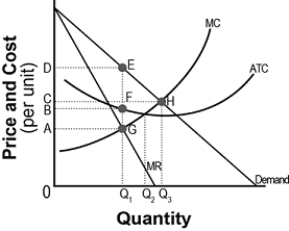 -Refer to Exhibit. What area measures the monopolist's total costs?
Free
(Multiple Choice)
4.8/5 (84)
(84) Correct Answer:Verified
VerifiedC
Exhibit
-Refer to Exhibit. How much output will the monopolist produce?
-Refer to Exhibit. How much output will the monopolist produce?Free
(Multiple Choice)
4.8/5 (79)
(79) Correct Answer:Verified
VerifiedA
Exhibit
Consider the following demand and cost information for a monopoly.
-Refer to Exhibit. What price should the monopoly charge to maximize profit?
-Refer to Exhibit. What price should the monopoly charge to maximize profit? (Multiple Choice)
4.9/5 (76)
(76) Exhibit
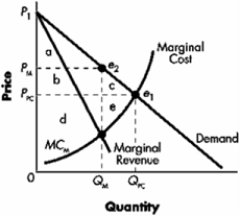 -Refer to Exhibit. In single price monopoly, total welfare is area:
 (Multiple Choice)
4.9/5 (79)
(79) Based on the table below what is the marginal revenue of the 14th unit of output??QuantityPrice13$50.0014$49.7515$49.50
(Multiple Choice)
4.9/5 (88)
(88) Exhibit
The following diagram contains information on cost and revenue curves facing a regulated monopoly.
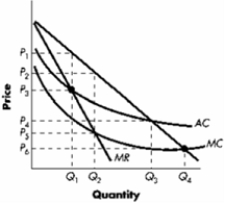 -Refer to Exhibit. If the government is able to regulate the monopolist using marginal-cost pricing, what price and output combinations are expected to result?
 (Multiple Choice)
4.7/5 (80)
(80) Exhibit
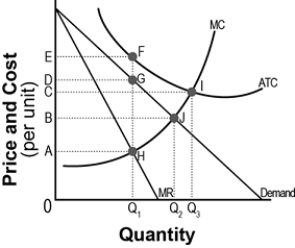 -Refer to Exhibit. What area measures the monopolist's loss?
 (Multiple Choice)
4.9/5 (78)
(78) A natural monopolist will voluntarily choose to produce at the point where P = MC.
(True/False)
4.8/5 (79)
(79) Exhibit
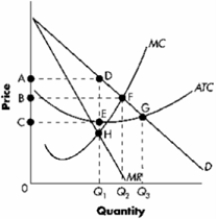 -Refer to Exhibit. The welfare loss due to monopoly is indicated in the diagram as area:
 (Multiple Choice)
4.8/5 (85)
(85) Exhibit
The graph depicts a monopolistically competitive firm's demand, marginal revenue, and cost curves.
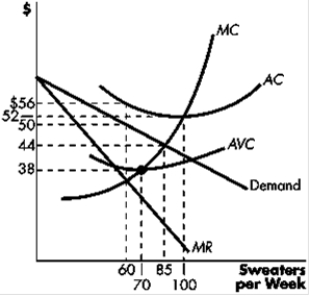 -Refer to Exhibit. If the firm produces the profit-maximizing (or loss-minimizing) level of output, it will produce:
 (Multiple Choice)
4.9/5 (82)
(82) Exhibit
-Refer to Exhibit. In perfect competition, deadweight loss is area:
-Refer to Exhibit. In perfect competition, deadweight loss is area: (Multiple Choice)
4.7/5 (80)
(80) Exhibit
-Refer to Exhibit. What price will the monopolist charge?
-Refer to Exhibit. What price will the monopolist charge? (Multiple Choice)
4.9/5 (84)
(84) Exhibit
The following diagrams depict firms in monopolistically competitive markets.
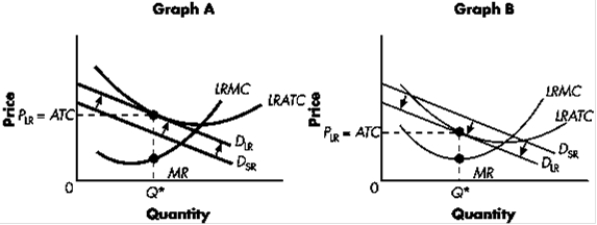 -Refer to Exhibit. Graph ____ demonstrates firms entering the market, and a resulting ____ of the firm's share of the market.
 (Multiple Choice)
4.7/5 (79)
(79) Which of the following is (are) true of a monopoly?
(i)A monopoly has the ability to set its price.
(ii)A monopolists marginal revenue will always increase when it lowers the price of its product.
(iii)A monopoly can never experience an economic loss.
(Multiple Choice)
4.8/5 (67)
(67) Exhibit
-Refer to Exhibit. If the firm is profit maximizing, the region bounded by CADE represents:
-Refer to Exhibit. If the firm is profit maximizing, the region bounded by CADE represents: (Multiple Choice)
4.9/5 (77)
(77) Exhibit
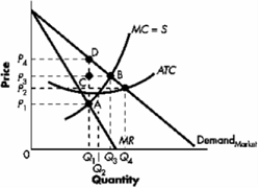 -Refer to Exhibit. Identify the area of the welfare loss due to monopoly pricing and output practices.
 (Multiple Choice)
4.8/5 (73)
(73) Exhibit
-Refer to Exhibit. What area measures the monopolist's total revenue?
-Refer to Exhibit. What area measures the monopolist's total revenue? (Multiple Choice)
4.9/5 (66)
(66) Exhibit
The following diagram depicts monopolistically competitive firms.
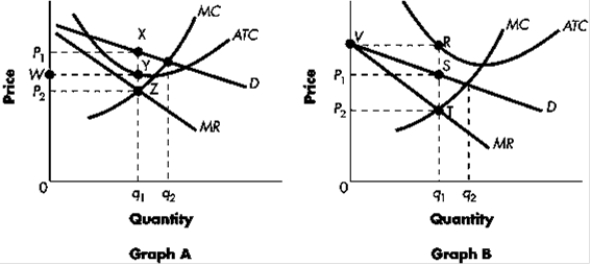 -Refer to Exhibit. In Graph B, the profit-maximizing (loss-minimizing) firm is making a ____ shown by the area ____.
 (Multiple Choice)
4.7/5 (73)
(73) Exhibit
The graph depicts a monopolistically competitive firm's demand, marginal revenue, and cost curves.
-Refer to Exhibit. Based on the diagram, it follows that:
-Refer to Exhibit. Based on the diagram, it follows that: (Multiple Choice)
4.9/5 (83)
(83) 
Filters
- Essay(0)
- Multiple Choice(0)
- Short Answer(0)
- True False(0)
- Matching(0)