



 Chat with AI
Exam 30: Money Growth and Inflation

Exam 1: Ten Principles of Economics237 Questions
Exam 2: Thinking Like an Economist267 Questions
Exam 3: Interdependence and the Gains From Trade217 Questions
Exam 4: The Market Forces of Supply and Demand303 Questions
Exam 5: Elasticity and Its Applications282 Questions
Exam 6: Supply, demand, and Government Policies252 Questions
Exam 7: Consumers, producers, and the Efficiency of Markets248 Questions
Exam 8: Application: the Costs of Taxation245 Questions
Exam 9: Application: International Trade245 Questions
Exam 10: Externalities288 Questions
Exam 11: Public Goods and Common Resources258 Questions
Exam 12: The Design of the Tax System328 Questions
Exam 13: The Costs of Production303 Questions
Exam 14: Firms in Competitive Markets271 Questions
Exam 15: Monopoly306 Questions
Exam 16: Oligopoly291 Questions
Exam 17: Monopolistic Competition257 Questions
Exam 18: The Markets for the Factors of Production284 Questions
Exam 19: Earnings and Discrimination286 Questions
Exam 20: Income Inequality and Poverty247 Questions
Exam 21: The Theory of Consumer Choice238 Questions
Exam 22: Frontiers of Microeconomics199 Questions
Exam 23: Measuring a Nations Income215 Questions
Exam 24: Measuring the Cost of Living208 Questions
Exam 25: Production and Growth240 Questions
Exam 26: Saving, investment, and the Financial System282 Questions
Exam 27: The Basic Tools of Finance249 Questions
Exam 28: Unemployment242 Questions
Exam 29: The Monetary System277 Questions
Exam 30: Money Growth and Inflation224 Questions
Exam 31: Open-Economy Macroeconomics: Basic Concepts256 Questions
Exam 32: A Macroeconomic Theory of the Open Economy217 Questions
Exam 33: Aggregate Demand and Aggregate Supply302 Questions
Exam 34: The Influence of Monetary and Fiscal Policy on Aggregate Demand249 Questions
Exam 35: The Short Run Trade Off Between Inflation and Unemployment246 Questions
Exam 36: Five Debates Over Macroeconomic Policy140 Questions
Select questions type


When the money market is drawn with the value of money on the vertical axis,the price level increases if
(Multiple Choice)
4.8/5  (85)
(85) Suppose that monetary neutrality and the Fisher effect both hold.An increase in the money supply growth rate raises.
(Multiple Choice)
4.7/5 (78)
(78) According to the classical dichotomy,which of the following is not influenced by monetary factors?
(Multiple Choice)
4.8/5 (91)
(91) Which of the following concerning the history of U.S.inflation is not correct?
(Multiple Choice)
4.9/5 (65)
(65) When the money market is drawn with the value of money on the vertical axis,the price level decreases if
(Multiple Choice)
4.8/5 (80)
(80) Use the figure below for the following questions.
Figure 30-1
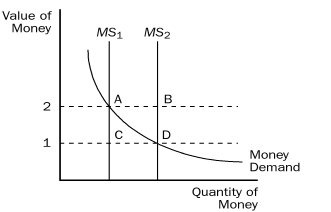 -Refer to Figure 30-1.If the money supply is MS₂ and the value of money is 2,there is excess
 (Multiple Choice)
4.8/5 (81)
(81) You buy stock and its price rises just as much as the price level.Before taxes you made
(Multiple Choice)
5.0/5 (81)
(81) In the 1970s in response to recessions caused by an increase in the price of oil,the central banks in many countries increased the money supply.The central banks might have done this by
(Multiple Choice)
4.8/5 (80)
(80) What assumptions are necessary to argue that the quantity equation implies that increases in the money supply lead to proportional changes in the price level?
(Essay)
4.8/5 (77)
(77) Given a nominal interest rate of 6 percent,in which case would you earn the lowest after-tax real rate of interest?
(Multiple Choice)
5.0/5 (93)
(93) Governments may prefer an inflation tax to some other kind of tax because the inflation tax
(Multiple Choice)
5.0/5 (85)
(85) Wages and prices are many times higher today than they were 30 years ago,yet people do not work a lot more hours or buy fewer goods.How can this be?
(Essay)
4.8/5 (74)
(74) Last year,Tealandia produced 50,000 bags of green tea.This was Tealandia's only production.Each bag sold at 4 units each of Tealandia's currency-the Leaf.Tealandia's money supply was 10,000.What was the velocity of money in Tealandia?
(Multiple Choice)
4.8/5 (80)
(80) When the money market is drawn with the value of money on the vertical axis,the value of money increases if
(Multiple Choice)
4.8/5 (80)
(80) Steven puts money into an account.One year later he sees that he has 6 percent more dollars and that his money will buy 2 percent more goods.
(Multiple Choice)
4.8/5 (84)
(84) When the money market is drawn with the value of money on the vertical axis,as the price level increases the quantity of money
(Multiple Choice)
4.9/5 (83)
(83) 
Filters
- Essay(0)
- Multiple Choice(0)
- Short Answer(0)
- True False(0)
- Matching(0)