



 Chat with AI
Exam 26: Saving, investment, and the Financial System

Exam 1: Ten Principles of Economics237 Questions
Exam 2: Thinking Like an Economist267 Questions
Exam 3: Interdependence and the Gains From Trade217 Questions
Exam 4: The Market Forces of Supply and Demand303 Questions
Exam 5: Elasticity and Its Applications282 Questions
Exam 6: Supply, demand, and Government Policies252 Questions
Exam 7: Consumers, producers, and the Efficiency of Markets248 Questions
Exam 8: Application: the Costs of Taxation245 Questions
Exam 9: Application: International Trade245 Questions
Exam 10: Externalities288 Questions
Exam 11: Public Goods and Common Resources258 Questions
Exam 12: The Design of the Tax System328 Questions
Exam 13: The Costs of Production303 Questions
Exam 14: Firms in Competitive Markets271 Questions
Exam 15: Monopoly306 Questions
Exam 16: Oligopoly291 Questions
Exam 17: Monopolistic Competition257 Questions
Exam 18: The Markets for the Factors of Production284 Questions
Exam 19: Earnings and Discrimination286 Questions
Exam 20: Income Inequality and Poverty247 Questions
Exam 21: The Theory of Consumer Choice238 Questions
Exam 22: Frontiers of Microeconomics199 Questions
Exam 23: Measuring a Nations Income215 Questions
Exam 24: Measuring the Cost of Living208 Questions
Exam 25: Production and Growth240 Questions
Exam 26: Saving, investment, and the Financial System282 Questions
Exam 27: The Basic Tools of Finance249 Questions
Exam 28: Unemployment242 Questions
Exam 29: The Monetary System277 Questions
Exam 30: Money Growth and Inflation224 Questions
Exam 31: Open-Economy Macroeconomics: Basic Concepts256 Questions
Exam 32: A Macroeconomic Theory of the Open Economy217 Questions
Exam 33: Aggregate Demand and Aggregate Supply302 Questions
Exam 34: The Influence of Monetary and Fiscal Policy on Aggregate Demand249 Questions
Exam 35: The Short Run Trade Off Between Inflation and Unemployment246 Questions
Exam 36: Five Debates Over Macroeconomic Policy140 Questions
Select questions type


Which of the following equations represents national saving in a closed economy?
(Multiple Choice)
4.8/5  (81)
(81) In the first part of this decade the U.S.government went from a surplus to a deficit.Other things the same,this means the
(Multiple Choice)
5.0/5 (77)
(77) The slope of the demand for loanable funds curve represents the
(Multiple Choice)
4.7/5 (78)
(78) Other things the same,bonds are likely to have higher interest rates if they have
(Multiple Choice)
4.8/5 (66)
(66) Suppose a country had a smaller increase in debt in 2006 than it had in 2005.Then other things the same,we'd expect
(Multiple Choice)
4.9/5 (71)
(71) The Dow Jones Industrial Average is now based on the prices of the stocks of
(Multiple Choice)
4.8/5 (80)
(80) If in a closed economy Y = $11 trillion,which of the following combinations would be consistent with national saving of $2.5 trillion?
(Multiple Choice)
4.8/5 (75)
(75) The country of Hykenia does not trade with any other country.Its GDP is $20 billion.Its government collects $4 billion in taxes and pays out $3 billion to households in the form of transfer payments.Consumption equals $15 billion and investment equals $2 billion.What is public saving in Hykenia,and what is the value of the goods and services purchased by the government of Hykenia?
(Multiple Choice)
4.8/5 (79)
(79) Figure 26-2
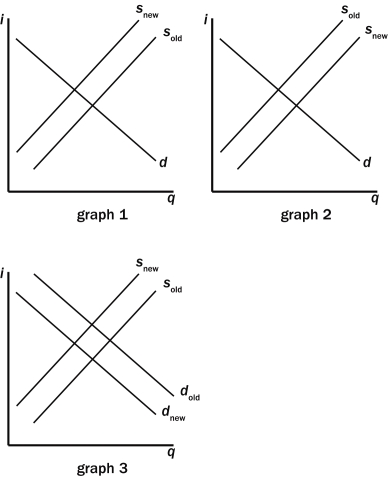 -Refer to Figure 26-2.Which of the graphs in the figure above shows the effects of the government moving from a budget deficit to a budget surplus while also lowering tax rates on interest earnings?
 (Multiple Choice)
4.8/5 (69)
(69) Which of the following is not always correct in a closed economy?
(Multiple Choice)
4.9/5 (78)
(78) Interest rates and investment rise.Which of the following could explain these changes?
(Multiple Choice)
4.8/5 (75)
(75) Use the following table to answer the following questions.
Table 26-1
 -Refer to Table 26-1.Assume that the closing price was also the average price at which each stock transaction took place.What was the total dollar volume of Gillette stock traded that day?
 (Multiple Choice)
4.9/5 (83)
(83) In the small closed economy of San Lucretia,the currency is the denar.Statistics for last year show that private saving was 60 billion denars,taxes were 70 billion denars,government purchases of goods and services were 80 billion denars,there were no transfer payments by the government,and GDP was 400 billion denars.What were consumption and investment in San Lucretia?
(Multiple Choice)
4.9/5 (84)
(84) 
Filters
- Essay(0)
- Multiple Choice(0)
- Short Answer(0)
- True False(0)
- Matching(0)