



 Chat with AI
Exam 36: Plant Growth and Reproduction

Exam 1: The Nature of Science and the Characteristics of Life82 Questions
Exam 2: Biological Diversity, Bacteria, and Archaea101 Questions
Exam 3: Protista, Plantae, and Fungi83 Questions
Exam 4: Animalia81 Questions
Exam 5: The Chemistry of Life92 Questions
Exam 6: Cell Structure and Internal Compartments87 Questions
Exam 7: Cell Membranes, Transport, and Communication85 Questions
Exam 8: Energy, Metabolism, and Enzymes81 Questions
Exam 9: Photosynthesis and Cellular Respiration84 Questions
Exam 10: Cell Division89 Questions
Exam 11: Stem Cells, Cancer, and Human Health93 Questions
Exam 12: Patterns of Inheritance75 Questions
Exam 13: Chromosomes and Human Genetics75 Questions
Exam 14: Dna and Genes105 Questions
Exam 15: From Gene to Protein80 Questions
Exam 16: Dna Technology80 Questions
Exam 17: How Evolution Works80 Questions
Exam 18: Evolution of Populations80 Questions
Exam 19: Speciation and the Origins of Biological Diversity80 Questions
Exam 20: The Evolutionary History of Life100 Questions
Exam 21: The Biosphere89 Questions
Exam 22: Growth of Populations69 Questions
Exam 23: Ecological Communities133 Questions
Exam 24: Ecosystems75 Questions
Exam 25: Global Change70 Questions
Exam 26: Internal Organization and Homeostasis79 Questions
Exam 27: Nutrition and Digestion80 Questions
Exam 28: Circulation and Gas Exchange77 Questions
Exam 29: Animal Hormones78 Questions
Exam 30: Nervous and Sensory Systems78 Questions
Exam 31: Skeletons, Muscles, and Movement78 Questions
Exam 32: Defenses Against Disease78 Questions
Exam 33: Reproduction and Development76 Questions
Exam 34: Animal Behavior76 Questions
Exam 35: Plant Structure, Nutrition, and Transport80 Questions
Exam 36: Plant Growth and Reproduction80 Questions
Select questions type


The typical conifer growth pattern of narrow tops and broad bases is strongly associated with the action of
(Multiple Choice)
4.7/5  (74)
(74) Double fertilization results in the formation of a(n)____________________ and a(n)____________________.
(Short Answer)
4.7/5 (67)
(67) Which of the layers shown in the diagram below of a tree trunk were most recently produced by the vascular cambium? 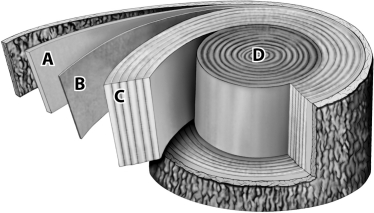
(Multiple Choice)
4.8/5 (72)
(72) The figure below illustrates the results of a laboratory experiment that simulates potted irises being exposed to differing lengths of darkness. 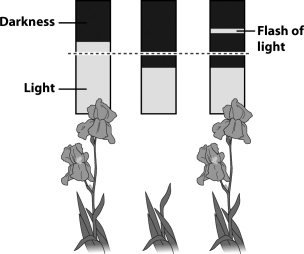 How would flowering in these irises be affected by disrupting the length of their light exposure?
 (Multiple Choice)
4.9/5 (79)
(79) Groups of perpetually young, undifferentiated cells from which new cells arise are called
(Multiple Choice)
4.8/5 (89)
(89) The line through the center of the diagram below separates the haploid and diploid life stages of the plant life cycle. The part of the cycle that exists below the line consists of plants that are ____________________.
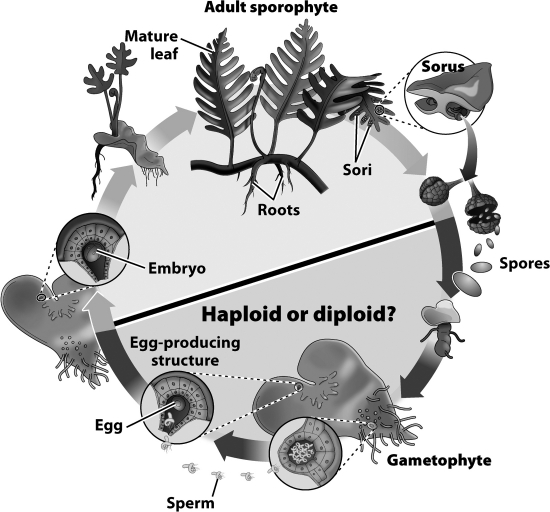
(Short Answer)
4.8/5 (70)
(70) In the alternation of generations, plants have a diploid life stage that produces haploid spores through the process of mitosis.
(True/False)
4.9/5 (81)
(81) Which of the following components is correctly matched with its location?
(Multiple Choice)
4.7/5 (83)
(83) Which of the following animals would be least likely to disperse seeds?
(Multiple Choice)
4.8/5 (77)
(77) The structure labeled A in this figure is usually designed to attract pollinators.
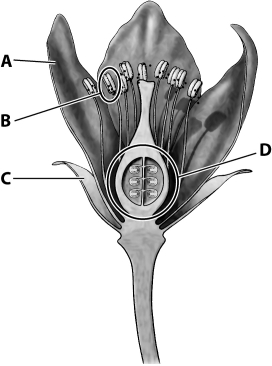
(True/False)
4.8/5 (94)
(94) Increases in length due to cell divisions at apical meristems are called ____________________ growth.
(Short Answer)
4.9/5 (82)
(82) The flower is an organ found on the _____ of a flowering plant.
(Multiple Choice)
4.9/5 (94)
(94) The structure indicated by the arrow in this diagram of a fruit developed from the 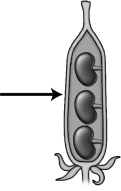
(Multiple Choice)
5.0/5 (65)
(65) At the tip of a filament within a flower you would find a(n)
(Multiple Choice)
4.7/5 (79)
(79) Why are the structures indicated by the arrow in the diagram below of a seedling somewhat shriveled at this stage in germination? 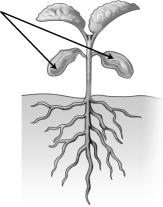
(Multiple Choice)
4.8/5 (78)
(78) Which of the following is not a concern about the assisted migration of trees to Canada?
(Multiple Choice)
4.8/5 (76)
(76) Which of the labeled structures in the figure below is where the embryo sac would be found? 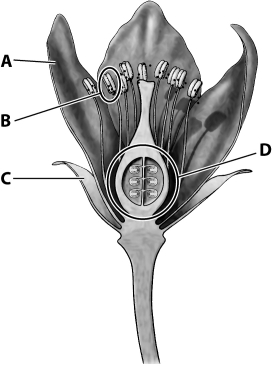
(Multiple Choice)
4.9/5 (78)
(78) 
Filters
- Essay(0)
- Multiple Choice(0)
- Short Answer(0)
- True False(0)
- Matching(0)