



 Chat with AI
Exam 35: Plant Structure, Nutrition, and Transport

Exam 1: The Nature of Science and the Characteristics of Life82 Questions
Exam 2: Biological Diversity, Bacteria, and Archaea101 Questions
Exam 3: Protista, Plantae, and Fungi83 Questions
Exam 4: Animalia81 Questions
Exam 5: The Chemistry of Life92 Questions
Exam 6: Cell Structure and Internal Compartments87 Questions
Exam 7: Cell Membranes, Transport, and Communication85 Questions
Exam 8: Energy, Metabolism, and Enzymes81 Questions
Exam 9: Photosynthesis and Cellular Respiration84 Questions
Exam 10: Cell Division89 Questions
Exam 11: Stem Cells, Cancer, and Human Health93 Questions
Exam 12: Patterns of Inheritance75 Questions
Exam 13: Chromosomes and Human Genetics75 Questions
Exam 14: Dna and Genes105 Questions
Exam 15: From Gene to Protein80 Questions
Exam 16: Dna Technology80 Questions
Exam 17: How Evolution Works80 Questions
Exam 18: Evolution of Populations80 Questions
Exam 19: Speciation and the Origins of Biological Diversity80 Questions
Exam 20: The Evolutionary History of Life100 Questions
Exam 21: The Biosphere89 Questions
Exam 22: Growth of Populations69 Questions
Exam 23: Ecological Communities133 Questions
Exam 24: Ecosystems75 Questions
Exam 25: Global Change70 Questions
Exam 26: Internal Organization and Homeostasis79 Questions
Exam 27: Nutrition and Digestion80 Questions
Exam 28: Circulation and Gas Exchange77 Questions
Exam 29: Animal Hormones78 Questions
Exam 30: Nervous and Sensory Systems78 Questions
Exam 31: Skeletons, Muscles, and Movement78 Questions
Exam 32: Defenses Against Disease78 Questions
Exam 33: Reproduction and Development76 Questions
Exam 34: Animal Behavior76 Questions
Exam 35: Plant Structure, Nutrition, and Transport80 Questions
Exam 36: Plant Growth and Reproduction80 Questions
Select questions type


Worldwide, humans obtain more than 80 percent of their calories from
(Multiple Choice)
4.9/5  (91)
(91) Like other organisms, plants are composed of proteins, lipids, carbohydrates, and nucleic acids. Based on this, which of the following would be a micronutrient?
(Multiple Choice)
4.9/5 (75)
(75) Most carnivorous plants obtain energy through photosynthesis; they consume insects to obtain ____________________.
(Short Answer)
4.9/5 (79)
(79) The difference in ____________________ between the sugar-loading zone and the sugar-unloading zone drives the long-distance transport of sugars through the phloem.
(Short Answer)
4.9/5 (85)
(85) Plants have two types of vascular tissue: xylem, which transports ____________________, and phloem, which transports ____________________.
(Short Answer)
4.7/5 (70)
(70) Many plants and animals move water and nutrients within internal vessels. Animals use the energy of muscle contraction; however, no metabolic energy is expended when water and minerals move within a plant's xylem.
(True/False)
4.9/5 (90)
(90) Chemicals that dissolve away a plant's cuticle typically result in the death of the plant as it loses its ability to
(Multiple Choice)
4.9/5 (87)
(87) Like other organisms, plants are composed of proteins, lipids, carbohydrates, and nucleic acids. Based on this, which of the following would be a macronutrient?
(Multiple Choice)
4.8/5 (72)
(72) The cells of the xylem are dead at functional maturity. This allows
(Multiple Choice)
4.9/5 (76)
(76) Once sugars have been actively transported into the phloem,
(Multiple Choice)
4.8/5 (92)
(92) The figure below illustrates how food is transported in phloem tissue. 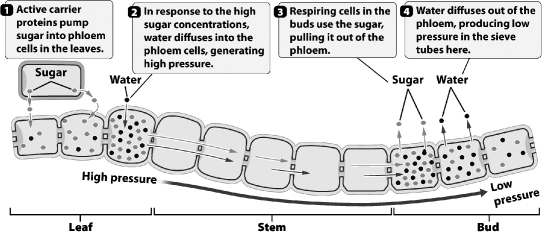 At what step(s)during the movement of sugar does the plant provide metabolic energy?
 (Multiple Choice)
4.7/5 (88)
(88) A high-quality soil provides everything needed for plant growth.
(True/False)
4.8/5 (74)
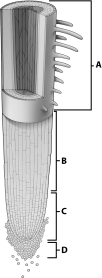
(74) The presence of root hairs in the region of this root tip labeled with the letter A suggests that we are looking at the zone of ____________________.
(Short Answer)
4.8/5 (79)
(79) Most aboveground plant growth occurs with the repeated addition of ____________________ units.
(Short Answer)
4.9/5 (82)
(82) ____________________ are secondary plant compounds that evolved in plants to protect them from attack by fungi, bacteria, and insects and might enhance the human immune system.
(Short Answer)
4.8/5 (68)
(68) In terms of their energy needs, solar energy is converted to chemical energy primarily within the plant's
(Multiple Choice)
5.0/5 (79)
(79) 
Filters
- Essay(0)
- Multiple Choice(0)
- Short Answer(0)
- True False(0)
- Matching(0)