



 Chat with AI
Exam 33: Reproduction and Development

Exam 1: The Nature of Science and the Characteristics of Life82 Questions
Exam 2: Biological Diversity, Bacteria, and Archaea101 Questions
Exam 3: Protista, Plantae, and Fungi83 Questions
Exam 4: Animalia81 Questions
Exam 5: The Chemistry of Life92 Questions
Exam 6: Cell Structure and Internal Compartments87 Questions
Exam 7: Cell Membranes, Transport, and Communication85 Questions
Exam 8: Energy, Metabolism, and Enzymes81 Questions
Exam 9: Photosynthesis and Cellular Respiration84 Questions
Exam 10: Cell Division89 Questions
Exam 11: Stem Cells, Cancer, and Human Health93 Questions
Exam 12: Patterns of Inheritance75 Questions
Exam 13: Chromosomes and Human Genetics75 Questions
Exam 14: Dna and Genes105 Questions
Exam 15: From Gene to Protein80 Questions
Exam 16: Dna Technology80 Questions
Exam 17: How Evolution Works80 Questions
Exam 18: Evolution of Populations80 Questions
Exam 19: Speciation and the Origins of Biological Diversity80 Questions
Exam 20: The Evolutionary History of Life100 Questions
Exam 21: The Biosphere89 Questions
Exam 22: Growth of Populations69 Questions
Exam 23: Ecological Communities133 Questions
Exam 24: Ecosystems75 Questions
Exam 25: Global Change70 Questions
Exam 26: Internal Organization and Homeostasis79 Questions
Exam 27: Nutrition and Digestion80 Questions
Exam 28: Circulation and Gas Exchange77 Questions
Exam 29: Animal Hormones78 Questions
Exam 30: Nervous and Sensory Systems78 Questions
Exam 31: Skeletons, Muscles, and Movement78 Questions
Exam 32: Defenses Against Disease78 Questions
Exam 33: Reproduction and Development76 Questions
Exam 34: Animal Behavior76 Questions
Exam 35: Plant Structure, Nutrition, and Transport80 Questions
Exam 36: Plant Growth and Reproduction80 Questions
Select questions type


The graph below shows the normal concentration of morphogens A and B throughout a Drosophila embryo. 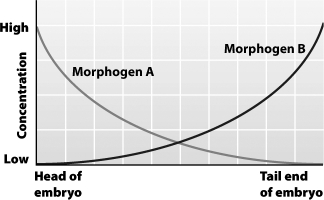 If morphogen B is injected into the head end of an embryo, the embryo is likely to develop
 (Multiple Choice)
4.7/5  (78)
(78) The skulls of newborn humans and chimpanzees closely resemble each other.
(True/False)
4.9/5 (76)
(76) Human females probably evolved the ability to live beyond their reproductive years because
(Multiple Choice)
4.8/5 (80)
(80) The "quality" of human eggs and sperm declines as people age. One possible reason for this is
(Multiple Choice)
4.8/5 (77)
(77) The four sperm produced by spermatogenesis is identical to the sequence of the sperm precursor cell.
(True/False)
4.9/5 (92)
(92) Which of the following statements about animal sperm and eggs is false?
(Multiple Choice)
4.8/5 (75)
(75) Sperm are packed with mitochondria because mitochondria produce the
(Multiple Choice)
4.9/5 (79)
(79) Humans complete their development in a protected environment inside their mother's body, in the
(Multiple Choice)
4.8/5 (80)
(80) Hermaphrodites are able to fertilize their own eggs with their own sperm.
(True/False)
4.8/5 (74)
(74) In humans, the exchanges of materials between the embryo and its mother occur through the
(Multiple Choice)
4.8/5 (73)
(73) Which of the following statements about sexual and asexual reproduction is true?
(Multiple Choice)
4.8/5 (96)
(96) The second meiotic division in a secondary oocyte is completed
(Multiple Choice)
4.7/5 (67)
(67) Spermatogenesis results in the production of ____________________ sperm, whereas oogenesis produces just one egg.
(Short Answer)
4.8/5 (83)
(83) Study the diagram below. Which of the following sentences is true? 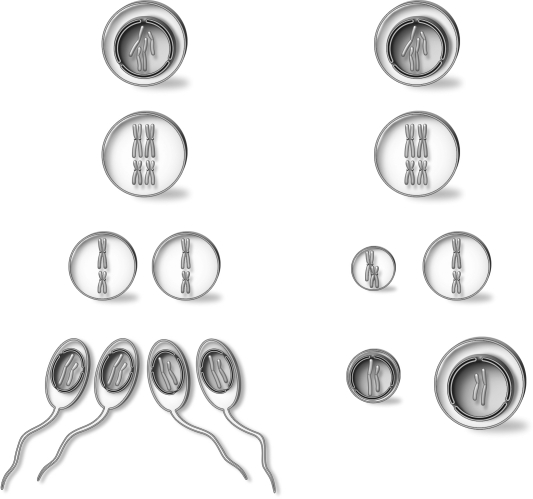
(Multiple Choice)
4.9/5 (93)
(93) Examine this close-up of the placenta (on the left of the figure below). 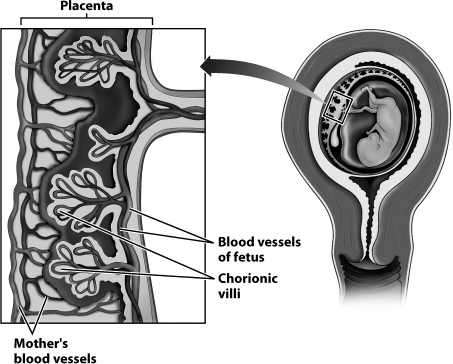 Why do the chorionic villi have the shape of a tree?
 (Multiple Choice)
4.8/5 (80)
(80) When a human embryo is approximately 7 days old, it embeds in the ____________________ of its mother's uterus, where it is nourished by the surrounding blood supply until the placenta is functional.
(Short Answer)
4.8/5 (83)
(83) 
Filters
- Essay(0)
- Multiple Choice(0)
- Short Answer(0)
- True False(0)
- Matching(0)