



 Chat with AI
Exam 28: Circulation and Gas Exchange

Exam 1: The Nature of Science and the Characteristics of Life82 Questions
Exam 2: Biological Diversity, Bacteria, and Archaea101 Questions
Exam 3: Protista, Plantae, and Fungi83 Questions
Exam 4: Animalia81 Questions
Exam 5: The Chemistry of Life92 Questions
Exam 6: Cell Structure and Internal Compartments87 Questions
Exam 7: Cell Membranes, Transport, and Communication85 Questions
Exam 8: Energy, Metabolism, and Enzymes81 Questions
Exam 9: Photosynthesis and Cellular Respiration84 Questions
Exam 10: Cell Division89 Questions
Exam 11: Stem Cells, Cancer, and Human Health93 Questions
Exam 12: Patterns of Inheritance75 Questions
Exam 13: Chromosomes and Human Genetics75 Questions
Exam 14: Dna and Genes105 Questions
Exam 15: From Gene to Protein80 Questions
Exam 16: Dna Technology80 Questions
Exam 17: How Evolution Works80 Questions
Exam 18: Evolution of Populations80 Questions
Exam 19: Speciation and the Origins of Biological Diversity80 Questions
Exam 20: The Evolutionary History of Life100 Questions
Exam 21: The Biosphere89 Questions
Exam 22: Growth of Populations69 Questions
Exam 23: Ecological Communities133 Questions
Exam 24: Ecosystems75 Questions
Exam 25: Global Change70 Questions
Exam 26: Internal Organization and Homeostasis79 Questions
Exam 27: Nutrition and Digestion80 Questions
Exam 28: Circulation and Gas Exchange77 Questions
Exam 29: Animal Hormones78 Questions
Exam 30: Nervous and Sensory Systems78 Questions
Exam 31: Skeletons, Muscles, and Movement78 Questions
Exam 32: Defenses Against Disease78 Questions
Exam 33: Reproduction and Development76 Questions
Exam 34: Animal Behavior76 Questions
Exam 35: Plant Structure, Nutrition, and Transport80 Questions
Exam 36: Plant Growth and Reproduction80 Questions
Select questions type


If an individual has bronchitis, it may also be accurately referred to as an upper-respiratory infection.
(True/False)
4.7/5  (72)
(72) Erythropoietin (EPO), which is made by the kidneys, is involved in the production of white blood cells that carry oxygen throughout the body.
(True/False)
4.9/5 (94)
(94) ____________________ is the process of expelling carbon dioxide from the lungs and taking oxygen into the lungs.
(Short Answer)
4.8/5 (74)
(74) The thickening of heart muscle over time helps it to pump blood more efficiently throughout the body.
(True/False)
4.9/5 (77)
(77) Once oxygen has entered the blood stream, its ultimate destination is the
(Multiple Choice)
4.7/5 (74)
(74) In cystic fibrosis, parts of the respiratory tract can be clogged with mucus and inhibit gas exchange. The areas of the respiratory tract where gases are directly exchanged are the
(Multiple Choice)
5.0/5 (75)
(75) Which of the following statements about the size of an organism's gas exchange surface is true?
(Multiple Choice)
4.9/5 (83)
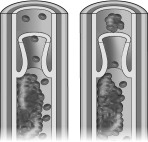
(83) In the figure of veins below, the blood clot could move to the lungs and cause a ____________________.
(Short Answer)
4.8/5 (71)
(71) The human ____________________ system is used for the internal transport of oxygen and carbon dioxide.
(Short Answer)
4.9/5 (73)
(73) The higher the gas concentration in the environment relative to the gas concentration inside an organism, the more quickly the gas will passively enter the organism.
(True/False)
5.0/5 (81)
(81) Which of the following would contain the lowest concentration of oxygen?
(Multiple Choice)
4.7/5 (78)
(78) The figure below illustrates body size and diffusion time. 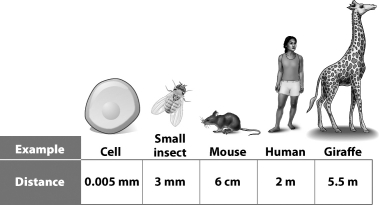 Which of the following examples represents the quickest diffusion time?
 (Multiple Choice)
4.7/5 (81)
(81) Unlike aquatic organisms, humans have their gas exchange surfaces on the inside rather than the outside. This adaptation evolved to
(Multiple Choice)
4.8/5 (87)
(87) Human red blood cells contain the red pigment ____________________.
(Short Answer)
4.8/5 (73)
(73) 
Filters
- Essay(0)
- Multiple Choice(0)
- Short Answer(0)
- True False(0)
- Matching(0)