



 Chat with AI
Exam 22: Growth of Populations

Exam 1: The Nature of Science and the Characteristics of Life82 Questions
Exam 2: Biological Diversity, Bacteria, and Archaea101 Questions
Exam 3: Protista, Plantae, and Fungi83 Questions
Exam 4: Animalia81 Questions
Exam 5: The Chemistry of Life92 Questions
Exam 6: Cell Structure and Internal Compartments87 Questions
Exam 7: Cell Membranes, Transport, and Communication85 Questions
Exam 8: Energy, Metabolism, and Enzymes81 Questions
Exam 9: Photosynthesis and Cellular Respiration84 Questions
Exam 10: Cell Division89 Questions
Exam 11: Stem Cells, Cancer, and Human Health93 Questions
Exam 12: Patterns of Inheritance75 Questions
Exam 13: Chromosomes and Human Genetics75 Questions
Exam 14: Dna and Genes105 Questions
Exam 15: From Gene to Protein80 Questions
Exam 16: Dna Technology80 Questions
Exam 17: How Evolution Works80 Questions
Exam 18: Evolution of Populations80 Questions
Exam 19: Speciation and the Origins of Biological Diversity80 Questions
Exam 20: The Evolutionary History of Life100 Questions
Exam 21: The Biosphere89 Questions
Exam 22: Growth of Populations69 Questions
Exam 23: Ecological Communities133 Questions
Exam 24: Ecosystems75 Questions
Exam 25: Global Change70 Questions
Exam 26: Internal Organization and Homeostasis79 Questions
Exam 27: Nutrition and Digestion80 Questions
Exam 28: Circulation and Gas Exchange77 Questions
Exam 29: Animal Hormones78 Questions
Exam 30: Nervous and Sensory Systems78 Questions
Exam 31: Skeletons, Muscles, and Movement78 Questions
Exam 32: Defenses Against Disease78 Questions
Exam 33: Reproduction and Development76 Questions
Exam 34: Animal Behavior76 Questions
Exam 35: Plant Structure, Nutrition, and Transport80 Questions
Exam 36: Plant Growth and Reproduction80 Questions
Select questions type


The maximum population size that can be supported by its habitat is known as
(Multiple Choice)
4.8/5  (88)
(88) Overall, when there are more individuals in a population, birth rates ____________________.
(Short Answer)
4.9/5 (81)
(81) The change in size of a given population of organisms may have a direct impact on humans. The 1993 outbreak of hantavirus in the southwestern United States was partly due to a(n)
(Multiple Choice)
4.8/5 (72)
(72) Which of the following has the smallest contribution to annual changes in the size of a population?
(Multiple Choice)
4.8/5 (72)
(72) Use of the environment that can continue indefinitely without depleting all our resources or causing environmental damage is defined as being ____________________.
(Short Answer)
4.8/5 (97)
(97) Humans are the only species not subject to limits on the size of its population.
(True/False)
5.0/5 (66)
(66) A population of 100 individuals is undergoing exponential growth, with a constant growth rate of 0.2 per year. What size will this population be in 2 years?
(Multiple Choice)
4.9/5 (84)
(84) If we humans do not limit our population growth rate, we will exceed the ____________________ of our environment, leading to a larger population than the environment can support.
(Short Answer)
4.9/5 (67)
(67) The carrying capacity of owls in an Alaskan forest is 8 per square kilometer. What will happen if 12 owls are confined to a 1-square-kilometer area?
(Multiple Choice)
4.9/5 (81)
(81) The graph below shows the growth of a Paramecium population. 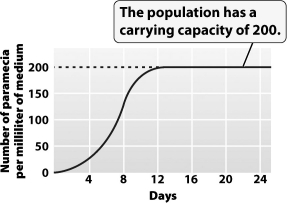 The greatest amount of daily growth occurred when the population was at approximately _____ percent of its carrying capacity
 (Multiple Choice)
4.9/5 (81)
(81) The population explosion that occurred shortly after the Opuntia cactus was introduced to Australia is an example of
(Multiple Choice)
4.9/5 (67)
(67) The top of the "S"in an S-shaped curve indicates that the population
(Multiple Choice)
4.8/5 (74)
(74) Which of the following situations illustrates a link between the effects of density-dependent and density-independent factors?
(Multiple Choice)
4.8/5 (80)
(80) China's ____________________ policy has slowed the growth of the population in that country to 0.57 percent currently from 1.07 percent during the 1990s.
(Short Answer)
4.8/5 (91)
(91) A population is counted at 100 individuals in 1998. In 2006, a new count found 1,600 individuals. What is the doubling time for the population?
(Multiple Choice)
4.8/5 (90)
(90) 
Filters
- Essay(0)
- Multiple Choice(0)
- Short Answer(0)
- True False(0)
- Matching(0)