



 Chat with AI
Exam 10: Cell Division

Exam 1: The Nature of Science and the Characteristics of Life82 Questions
Exam 2: Biological Diversity, Bacteria, and Archaea101 Questions
Exam 3: Protista, Plantae, and Fungi83 Questions
Exam 4: Animalia81 Questions
Exam 5: The Chemistry of Life92 Questions
Exam 6: Cell Structure and Internal Compartments87 Questions
Exam 7: Cell Membranes, Transport, and Communication85 Questions
Exam 8: Energy, Metabolism, and Enzymes81 Questions
Exam 9: Photosynthesis and Cellular Respiration84 Questions
Exam 10: Cell Division89 Questions
Exam 11: Stem Cells, Cancer, and Human Health93 Questions
Exam 12: Patterns of Inheritance75 Questions
Exam 13: Chromosomes and Human Genetics75 Questions
Exam 14: Dna and Genes105 Questions
Exam 15: From Gene to Protein80 Questions
Exam 16: Dna Technology80 Questions
Exam 17: How Evolution Works80 Questions
Exam 18: Evolution of Populations80 Questions
Exam 19: Speciation and the Origins of Biological Diversity80 Questions
Exam 20: The Evolutionary History of Life100 Questions
Exam 21: The Biosphere89 Questions
Exam 22: Growth of Populations69 Questions
Exam 23: Ecological Communities133 Questions
Exam 24: Ecosystems75 Questions
Exam 25: Global Change70 Questions
Exam 26: Internal Organization and Homeostasis79 Questions
Exam 27: Nutrition and Digestion80 Questions
Exam 28: Circulation and Gas Exchange77 Questions
Exam 29: Animal Hormones78 Questions
Exam 30: Nervous and Sensory Systems78 Questions
Exam 31: Skeletons, Muscles, and Movement78 Questions
Exam 32: Defenses Against Disease78 Questions
Exam 33: Reproduction and Development76 Questions
Exam 34: Animal Behavior76 Questions
Exam 35: Plant Structure, Nutrition, and Transport80 Questions
Exam 36: Plant Growth and Reproduction80 Questions
Select questions type


Which of the following statements about cell division is correct?
(Multiple Choice)
5.0/5  (76)
(76) Sexual reproduction results in many benefits for a population, but not without some inconvenience; for example,
(Multiple Choice)
4.9/5 (83)
(83) At the completion of mitosis, the nucleus of a human somatic cell has _____ chromosomes.
(Multiple Choice)
4.8/5 (80)
(80) Which of the following choices states a correct reason why the process of cell division is different for prokaryotic than for eukaryotic cells?
(Multiple Choice)
4.7/5 (74)
(74) The spindle microtubules break down and new nuclear envelopes form during the ____________________ portion of mitosis.
(Short Answer)
4.7/5 (80)
(80) The cell depicted below has a diploid number of 4 (2n = 4).  Assuming cell division started with a diploid cell, in what stage of what type of cell division is the cell?
 (Multiple Choice)
4.7/5 (67)
(67) During mitosis, the number and shape of an organism's chromosomes become obvious. This set of identifiable chromosomes can be arranged into a diagram, or ____________________, of that organism.
(Short Answer)
4.8/5 (80)
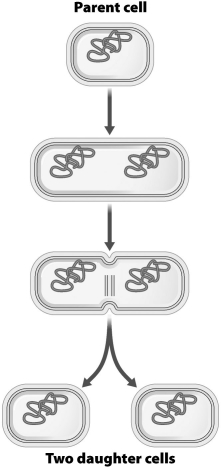
(80) With the possible exception of mutation, the two daughter cells produced in the illustration below are identical to one another.
(True/False)
4.8/5 (78)
(78) Chromosomes become visible during the ____________________ stage of mitosis.
(Short Answer)
4.8/5 (97)
(97) If the skin cell of an organism has 24 chromosomes, its gametes must also have 24 chromosomes.
(True/False)
4.9/5 (66)
(66) The old saying that everyone has a double is likely to be Correct; except for genetic mutation, the number of meiotically possible recombinations of human DNA are much smaller than the total number of individuals alive today.
(True/False)
4.8/5 (93)
(93) The four cells that result from meiosis are ____________________ rather than diploid.
(Short Answer)
4.7/5 (83)
(83) A single cell grows into a multicellular organism by the process of
(Multiple Choice)
4.7/5 (65)
(65) Interphase is an uneventful resting stage of the cell division cycle.
(True/False)
4.8/5 (78)
(78) Gametes contain _____ the genetic material that a generalized body cell contains.
(Multiple Choice)
4.9/5 (92)
(92) The process of mitosis is thought to have evolved from binary fission. What similarities exist between these processes?
(Multiple Choice)
4.8/5 (75)
(75) 
Filters
- Essay(0)
- Multiple Choice(0)
- Short Answer(0)
- True False(0)
- Matching(0)