



 Chat with AI
Exam 12: The Nomadic Frontiers: the Islamic World, Byzantium, and China, Ca 1000-1200


How was China like Western Europe during the ninth to tenth centuries C.E.?

 (77)
 Verified
D
What were the reasons behind the crusading movement that arose in Western Christendom?
(70)  Answered by Examlex AI Copilot
The crusading movement that arose in Western Christendom was driven by a combination of religious, economic, and political factors.
One of the main reasons behind the crusades was the desire to reclaim the Holy Land, particularly Jerusalem, which was considered a sacred site for Christians. The Byzantine Emperor Alexius I had requested assistance from the Pope to help defend the Byzantine Empire from Muslim attacks, and this call for aid sparked the First Crusade in 1096.
Additionally, the crusades provided an opportunity for knights and nobles to gain wealth, land, and power through conquest and plunder. Many participants were motivated by the promise of material rewards and the chance to expand their territories.
The crusading movement also served as a way for the papacy to assert its authority and unite Western Christendom under a common cause. By promoting the idea of a holy war against the infidels, the Church was able to consolidate its power and influence over the ruling classes and the general population.
Furthermore, the crusades provided an outlet for the restless and aggressive energies of the feudal nobility, who were often engaged in internal conflicts and power struggles. Participation in the crusades offered them a chance to channel their martial spirit towards a common enemy and gain prestige and honor in the process.
In conclusion, the crusading movement was driven by a complex mix of religious fervor, economic incentives, political ambitions, and the desire for adventure and glory. It had a profound impact on the history of Western Christendom and the broader world, shaping the relationships between different cultures and religions for centuries to come.
What was the early relationship between the Islamic world and the Turks of Central Asia? How did they interrelate with one another?
(72) Answered by Examlex AI CopilotThe early relationship between the Islamic world and the Turks of Central Asia was complex and multifaceted. The Turks of Central Asia were originally a nomadic people who practiced shamanism and other indigenous belief systems. However, with the spread of Islam in the 7th and 8th centuries, many Turks began to convert to the new religion.
The Islamic world, particularly the Abbasid Caliphate, saw the Turks as valuable allies and potential soldiers. As a result, many Turks were recruited into the Abbasid military and eventually rose to prominent positions within the caliphate. This led to a significant intermingling of Turkish and Islamic cultures, as well as the spread of Islam among the Turkic peoples.
At the same time, the Turks of Central Asia also had a significant impact on the Islamic world. They brought with them their own cultural practices, languages, and traditions, which influenced the development of Islamic art, architecture, and literature. Additionally, the Turks played a key role in the spread of Islam to other parts of the world, including South Asia and the Balkans.
Overall, the relationship between the Islamic world and the Turks of Central Asia was one of mutual influence and interdependence. The Turks adopted Islam and contributed to the development of Islamic civilization, while also maintaining their own cultural identity and shaping the course of Islamic history. This early relationship laid the foundation for the enduring connection between the Islamic world and the Turkic peoples.
The Chinese and Muslim states were often successful in dealing with nomadic peoples by
(81) What were the basic movements that lay behind the development of the crusades in Western Christendom?
(77) What factors created the revulsion that many settled peoples had for the lifestyles of the steppelanders?
(71) One of the key reasons for the success of the First Crusade was
(76) One nomadic people of the steppe that were successfully integrated into Europe was the
(72) What elements from the elite became a severe threat to imperial rule during the late Tang dynasty?
(70) The Almoravid religious zealots seized much of the Iberian Peninsula from
(84) What was the appeal of Sufism for many Muslims? Why was it rejected by much of the elite in the Islamic Empire?
(68) Assess which society felt the most significant impact from the Crusades: the Byzantine Empire or the Islamic world? Your answer should discuss the motives of the crusaders, the needs of the Byzantine empire, and the response of Islamic kingdoms in the eastern Mediterranean.
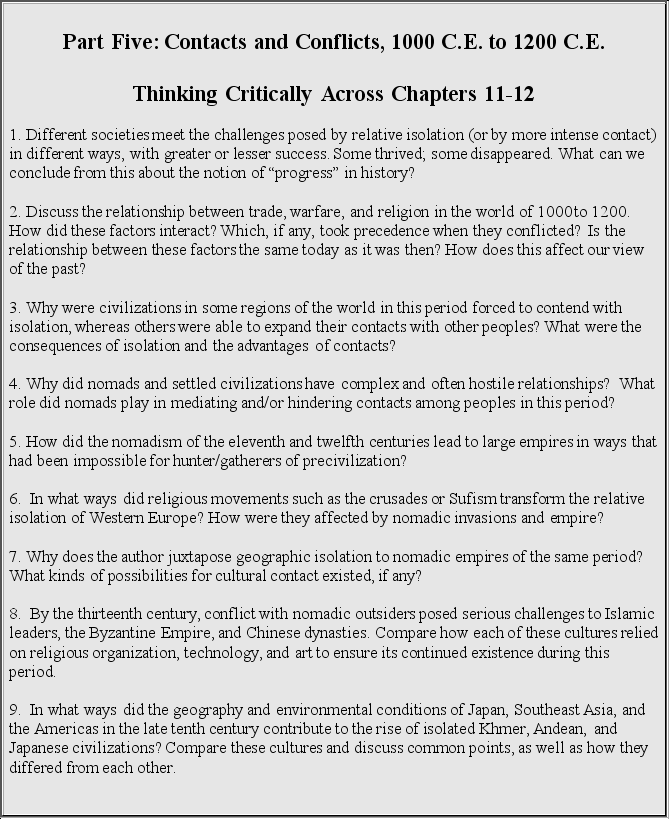
How were the Central Asian Turks integrated into the Islamic Empire, and what role did they play?
(90) The role that Turkic peoples played within the Islamic Empire was that of
(87) Unlike those in many urban populations, pastoralist diets often include
(77) The majority of the wealth of the Byzantine Empire was based on
(81) The most effective way that China accommodated itself to nomadic invaders was through
(70) The first Turkic people to convert to Islam were the Karkhanids, who became Muslims in
(90) 
Filters
- Essay(0)
- Multiple Choice(0)
- Short Answer(0)
- True False(0)
- Matching(0)