



 Chat with AI
Exam 6: Risk and Return

Exam 1: An Overview of Financial Management and the Financial Environment46 Questions
Exam 2: Financial Statements, cash Flow, and Taxes77 Questions
Exam 3: Analysis of Financial Statements104 Questions
Exam 4: Time Value of Money168 Questions
Exam 5: Bonds, bond Valuation, and Interest Rates100 Questions
Exam 6: Risk and Return146 Questions
Exam 7: Valuation of Stocks and Corporations80 Questions
Exam 8: Financial Options and Applications in Corporate Finance28 Questions
Exam 9: The Cost of Capital92 Questions
Exam 10: The Basics of Capital Budgeting: Evaluating Cash Flows108 Questions
Exam 11: Cash Flow Estimation and Risk Analysis78 Questions
Exam 12: Corporate Valuation and Financial Planning41 Questions
Exam 13: Agency Conflicts and Corporate Governance6 Questions
Exam 14: Distributions to Shareholders: Dividends and Repurchases58 Questions
Exam 15: Capital Structure Decisions59 Questions
Exam 16: Supply Chains and Working Capital Management135 Questions
Exam 17: Multinational Financial Management49 Questions
Exam 18: Public and Private Financing: Initial Offerings, seasoned Offerings, and Investment Banks22 Questions
Exam 18: Extension 18 A: Rights Offerings4 Questions
Exam 19: Lease Financing23 Questions
Exam 20: Hybrid Financing: Preferred Stock, warrants, and Convertibles26 Questions
Exam 21: Dynamic Capital Structures22 Questions
Exam 22: Mergers and Corporate Control46 Questions
Exam 23: Enterprise Risk Management14 Questions
Exam 24: Bankruptcy, reorganization, and Liquidation12 Questions
Exam 25: Portfolio Theory and Asset Pricing Models35 Questions
Exam 26: Real Options11 Questions
Exam 27: Providing and Obtaining Credit29 Questions
Exam 28: Advanced Issues in Cash Management and Inventory Control17 Questions
Exam 29: Pension Plan Management10 Questions
Exam 30: Financial Management in Not For Profit Businesses10 Questions
Select questions type


You are considering investing in one of the these three stocks: Stock Standard Deviation Beta 20\% 0.59 10\% 0.61 12\% 1.29
If you are a strict risk minimizer,you would choose Stock ____ if it is to be held in isolation and Stock ____ if it is to be held as part of a well-diversified portfolio.
(Multiple Choice)
5.0/5  (79)
(79) Diversification will normally reduce the riskiness of a portfolio of stocks.
(True/False)
4.9/5 (86)
(86) Shirley Paul's 2-stock portfolio has a total value of $100,000.$37,500 is invested in Stock A with a beta of 0.75 and the remainder is invested in Stock B with a beta of 1.42.What is her portfolio's beta?
(Multiple Choice)
4.7/5 (86)
(86) In historical data,we see that investments with the highest average annual returns also tend to have the highest standard deviations of annual returns.This observation supports the notion that there is a positive correlation between risk and return.Which of the following answers correctly ranks investments from highest to lowest risk (and return),where the security with the highest risk is shown first,the one with the lowest risk last?
(Multiple Choice)
5.0/5 (81)
(81) Assume that your cousin holds just one stock,Eastman Chemical Bonding (ECB),which he thinks has very little risk.You agree that the stock is relatively safe,but you want to demonstrate that his risk would be even lower if he were more diversified.You obtain the following returns data for Wilder's Creations and Buildings (WCB).Both companies have had less variability than most other stocks over the past 5 years.Measured by the standard deviation of returns,by how much would your cousin's risk have been reduced if he had held a portfolio consisting of 60% in ECB and the remainder in WCB? (Hint: Use the sample standard deviation formula.) Year ECB WCB 2007 40.00\% 40.00\% 2008 -10.00\% 15.00\% 2009 35.00\% -5.00\% 2010 -5.00\% -10.00\% 2011 15.00\% 35.00\% Average return = 15.00\% 15.00\% Standard derriation = 22.64\% 22.64\%
(Multiple Choice)
4.9/5 (83)
(83) The CAPM is built on historic conditions,although in most cases we use expected future data in applying it.Because betas used in the CAPM are calculated using expected future data,they are not subject to changes in future volatility.This is one of the strengths of the CAPM.
(True/False)
4.8/5 (87)
(87) Bad managerial judgments or unforeseen negative events that happen to a firm are defined as "company-specific," or "unsystematic," events,and their effects on investment risk can in theory be diversified away.
(True/False)
4.9/5 (93)
(93) A portfolio's risk is measured by the weighted average of the standard deviations of the securities in the portfolio.It is this aspect of portfolios that allows investors to combine stocks and thus reduce the riskiness of their portfolios.
(True/False)
4.9/5 (75)
(75) An individual stock's diversifiable risk,which is measured by its beta,can be lowered by adding more stocks to the portfolio in which the stock is held.
(True/False)
4.8/5 (82)
(82) Stock X has a beta of 0.6,while Stock Y has a beta of 1.4.Which of the following statements is CORRECT?
(Multiple Choice)
4.9/5 (85)
(85) Donald Gilmore has $100,000 invested in a 2-stock portfolio.$35,000 is invested in Stock X and the remainder is invested in Stock Y.X's beta is 1.50 and Y's beta is 0.70.What is the portfolio's beta?
(Multiple Choice)
4.8/5 (72)
(72) Megan Ross holds the following portfolio: 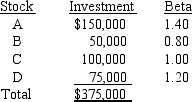 What is the portfolio's beta?
 (Multiple Choice)
5.0/5 (80)
(80) Stocks A and B each have an expected return of 15%,a standard deviation of 20%,and a beta of 1.2.The returns on the two stocks have a correlation coefficient of +0.6.Your portfolio consists of 50% A and 50% B.Which of the following statements is CORRECT?
(Multiple Choice)
4.8/5 (70)
(70) Stock A's beta is 1.7 and Stock B's beta is 0.7.Which of the following statements must be true,assuming the CAPM is correct.
(Multiple Choice)
4.9/5 (99)
(99) Assume that the risk-free rate remains constant,but the market risk premium declines.Which of the following is most likely to occur?
(Multiple Choice)
4.8/5 (85)
(85) 
Filters
- Essay(0)
- Multiple Choice(0)
- Short Answer(0)
- True False(0)
- Matching(0)