



 Chat with AI
Exam 10: Strategic Trade Policy

Exam 1: Introduction to Game Theory35 Questions
Exam 2: Noncooperative, One-Time, Static Games86 Questions
Exam 3: Focal-Point and Evolutionary Equilibria32 Questions
Exam 4: Infinitely-Repeated, Static Games37 Questions
Exam 5: Finitely-Repeated, Static Games40 Questions
Exam 6: Mixing Pure Strategies51 Questions
Exam 7: Static Games With Continuous Strategies24 Questions
Exam 8: Imperfect Competition52 Questions
Exam 9: Perfect Competition and Monopoly33 Questions
Exam 10: Strategic Trade Policy35 Questions
Exam 11: Dynamic Games With Complete47 Questions
Exam 12: Bargaining54 Questions
Exam 13: Pure Strategies With Uncertain Payoffs65 Questions
Exam 14: Torts and Contracts45 Questions
Exam 15: Auctions44 Questions
Exam 16: Dynamic Games With Incomplete Information34 Questions
Select questions type


A U.S. company and a Japanese company sells an identical product in the Japanese market. The inverse demand equation for this product is PJ = 10 !0.5(QJUS + QJ J). Suppose that the best-response functions of the U.S. and Japanese companies are QJUS = 6 !0.5QJ J and QJ J = 9 !0.5QJUS, respectively. The Cournot-Nash equilibrium {QJUS, QJ J } in the Japanese market is:
(Multiple Choice)
4.8/5  (105)
(105) A U.S. company and a Japanese company sells an identical product in the U.S. market. The inverse demand equation for this product is PUS = 5 !0.2(QUSUS + QUS J). Suppose that the best-response functions of the U.S. and Japanese companies are QUSUS = 10 !0.5QUS J and QUS J = 7.5 !0.5QUSUS, respectively. Consumer surplus in the U.S. market is:
(Multiple Choice)
4.7/5 (81)
(81) A U.S. company and a Japanese company sells an identical product in the U.S. market. The inverse demand equation for this product is PUS = 5 !0.2(QUSUS + QUS J). Suppose that the best-response functions of the U.S. and Japanese companies are QUSUS = 10 !0.5QUS J and QUS J = 7.5 !0.5QUSUS, respectively. The price of this product in the U.S. market is:
(Multiple Choice)
4.8/5 (70)
(70) 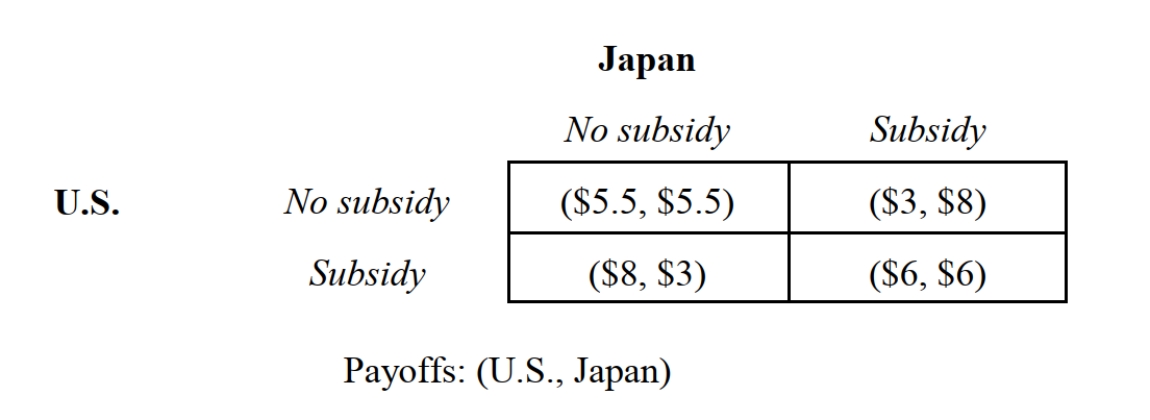 -Consider the static game depicted in Figures 10.3, which summarizes producer surpluses in billions of dollars from alternative export-subsidy strategies by the U.S. and Japan. If the export subsidies are intended to benefit producers, the Cournot-Nash equilibrium strategy profile is:
 (Multiple Choice)
4.9/5 (66)
(66) A U.S. company and a Japanese company sells an identical product in the U.S. market. The inverse demand equation for this product is PUS = 8 !0.4(QUSUS + QUS J). Suppose that the best-response functions of the U.S. and Japanese companies are QUSUS = 7.5 !0.5QUS J and QUS J = 9.375 !0.5QUSUS, respectively. The price of this product in the U.S. market is:
(Multiple Choice)
4.9/5 (85)
(85) Suppose that the demand for a product produced and sold by a single U.S. firm in the U.S. market is QUSUS = 10 !2PUS, where output is in million of units. If the marginal cost of production is $2 per unit, the market price per unit is:
(Multiple Choice)
4.8/5 (82)
(82) A U.S. company and a Japanese company sells an identical product in the Japanese market. The inverse demand equation for this product is PJ = 10 !0.5(QJUS + QJ J). Suppose that the best-response functions of the U.S. and Japanese companies are QJUS = 6 !0.5QJ J and QJ J = 9 !0.5QJUS, respectively. The price of this product in the Japanese market is:
(Multiple Choice)
4.8/5 (65)
(65) A U.S. company and a Japanese company sells an identical product in the Japanese market. The inverse demand equation for this product is PJ = 5 !0.2(QJUS + QJ J). Suppose that the best-response functions of the U.S. and Japanese companies are QJUS = 5 !0.5QJ J and QJ J = 7.5 !0.5QJUS, respectively. The Cournot-Nash equilibrium {QJ US, QJJ} in the Japanese market is:
(Multiple Choice)
4.9/5 (77)
(77) A U.S. company and a Japanese company sells an identical product in the Japanesemarket. The inverse demand equation for this product is PJ = 5 !0.2(QJUS + QJ J).Suppose that the best-response functions of the U.S. and Japanese companies are QJUS = 5 !0.5QJ J and QJ J = 7.5 !0.5QJUS, respectively. The price of this product in the Japanese market is:
(Multiple Choice)
4.8/5 (71)
(71) 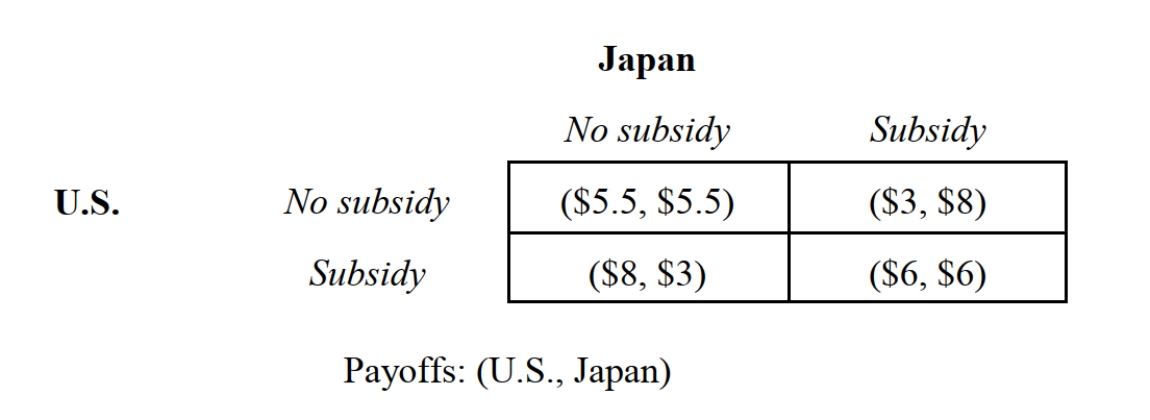 -Consider the static games depicted in Figures 10.3 and 10.4 which summarize in billions of dollars producer and consumer surpluses from alternative export-subsidy strategies by the U.S. and Japan. If this game is played a finite number of times with a certain end, maximizing national welfare:
 (Multiple Choice)
4.9/5 (101)
(101) A U.S. company and a Japanese company sells an identical product in the U.S. market. The inverse demand equation for this product is PUS = 5 !0.2(QUSUS + QUS J). Suppose that the best-response functions of the U.S. and Japanese companies are QUSUS = 10 !0.5QUS J and QUS J = 7.5 !0.5QUSUS, respectively. The Cournot-Nash equilibrium {QUSUS, QUS J } in the U.S. market is:
(Multiple Choice)
4.7/5 (80)
(80) The benefits of an export subsidy to a domestic producer are:
(Multiple Choice)
4.9/5 (77)
(77) 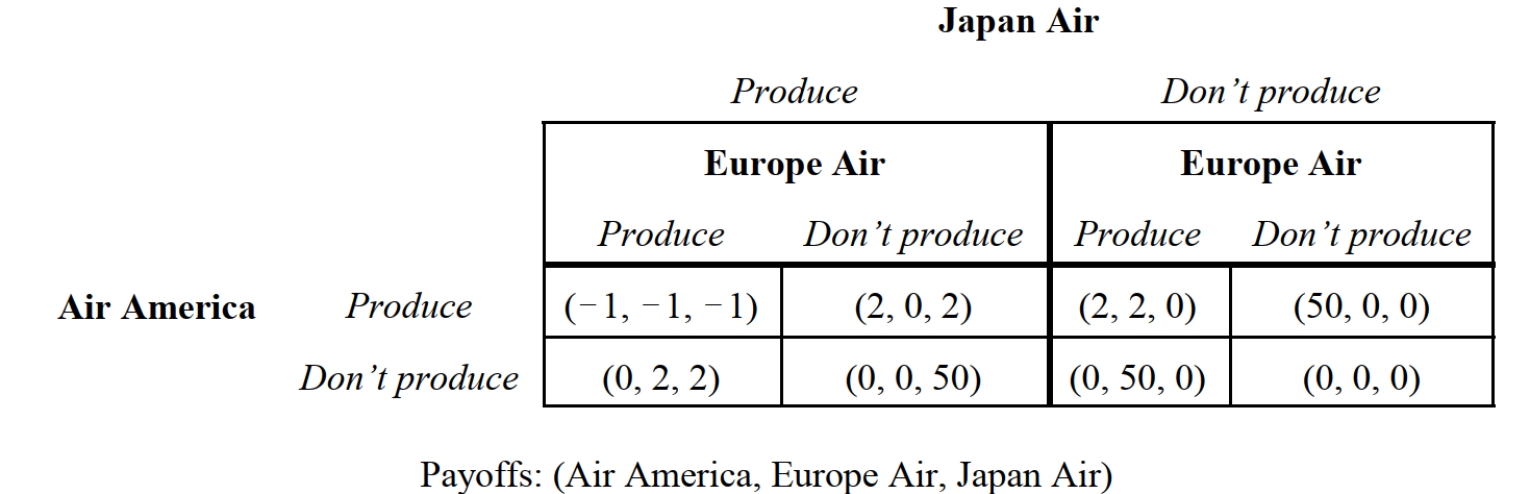 -Refer to Figure 10.2, which summarizes the payoffs to three aerospace companies that are considering investing $20 billion to develop a new, technologically advanced, commercial jumbo jet airliner for sale in the global marketplace. Payoffs are in billions of dollars. If larger payoffs are preferred, the Nash equilibrium strategy profile for this game is:
I. {Produce, Produce, Produce}.
II. {Don't produce, Produce, Produce}.
III. {Don't produce, Don't produce, Don't produce}.
IV. {Produce, Don't produce, Produce}.
V. {Produce, Produce, Don't produce}.
Which of the following is correct?
-Refer to Figure 10.2, which summarizes the payoffs to three aerospace companies that are considering investing $20 billion to develop a new, technologically advanced, commercial jumbo jet airliner for sale in the global marketplace. Payoffs are in billions of dollars. If larger payoffs are preferred, the Nash equilibrium strategy profile for this game is:
I. {Produce, Produce, Produce}.
II. {Don't produce, Produce, Produce}.
III. {Don't produce, Don't produce, Don't produce}.
IV. {Produce, Don't produce, Produce}.
V. {Produce, Produce, Don't produce}.
Which of the following is correct? (Multiple Choice)
4.8/5 (81)
(81) A U.S. company and a Japanese company sells an identical product in the U.S. market. The inverse demand equation for this product is PUS = 8 !0.4(QUSUS + QUS J). Suppose that the best-response functions of the U.S. and Japanese companies are QUSUS = 7.5 !0.5QUS J and QUS J = 9.375 !0.5QUSUS, respectively. The Cournot-Nash equilibrium {QUSUS, QUS J } in the U.S. market is:
(Multiple Choice)
4.7/5 (87)
(87)
-Refer to Figure 10.2, which summarizes the payoffs to three aerospace companies that are considering investing $20 billion to develop a new, technologically advanced, commercial jumbo jet airliner for sale in the global marketplace. Payoffs are in billions of dollars. Suppose that all three countries offer $2 billion in production subsidies. If larger payoffs are preferred, the Nash equilibrium strategy profile for this game is:
I. {Produce, Produce, Produce}.
II. {Don't produce, Produce, Produce}.
III. {Don't produce, Don't produce, Don't produce}.
IV. {Produce, Don't produce, Produce}.
V. {Produce, Produce, Don't produce}.
Which of the following is correct?
-Refer to Figure 10.2, which summarizes the payoffs to three aerospace companies that are considering investing $20 billion to develop a new, technologically advanced, commercial jumbo jet airliner for sale in the global marketplace. Payoffs are in billions of dollars. Suppose that all three countries offer $2 billion in production subsidies. If larger payoffs are preferred, the Nash equilibrium strategy profile for this game is:
I. {Produce, Produce, Produce}.
II. {Don't produce, Produce, Produce}.
III. {Don't produce, Don't produce, Don't produce}.
IV. {Produce, Don't produce, Produce}.
V. {Produce, Produce, Don't produce}.
Which of the following is correct? (Multiple Choice)
4.9/5 (70)
(70) 
Filters
- Essay(0)
- Multiple Choice(0)
- Short Answer(0)
- True False(0)
- Matching(0)