



 Chat with AI
Exam 9: Perfect Competition and Monopoly

Exam 1: Introduction to Game Theory35 Questions
Exam 2: Noncooperative, One-Time, Static Games86 Questions
Exam 3: Focal-Point and Evolutionary Equilibria32 Questions
Exam 4: Infinitely-Repeated, Static Games37 Questions
Exam 5: Finitely-Repeated, Static Games40 Questions
Exam 6: Mixing Pure Strategies51 Questions
Exam 7: Static Games With Continuous Strategies24 Questions
Exam 8: Imperfect Competition52 Questions
Exam 9: Perfect Competition and Monopoly33 Questions
Exam 10: Strategic Trade Policy35 Questions
Exam 11: Dynamic Games With Complete47 Questions
Exam 12: Bargaining54 Questions
Exam 13: Pure Strategies With Uncertain Payoffs65 Questions
Exam 14: Torts and Contracts45 Questions
Exam 15: Auctions44 Questions
Exam 16: Dynamic Games With Incomplete Information34 Questions
Select questions type


The demand for the output of a multi-firm industry is QT = 50 !2.5P. The total cost of production of an individual profit-maximizing firm in this industry is TC1= 4Q1. If this industry is comprised of 2 firms, the Cournot-Nash equilibrium output for firm 1 is:
(Multiple Choice)
4.9/5  (74)
(74) A perfectly-competitive, profit-maximizing firm's total cost equation is TC = 1,500 + 5Q + 0.0025Q2. The market-clearing price is $25. The firm's profit-maximizing level of output is:
(Multiple Choice)
4.8/5 (69)
(69) The demand for the output of a multi-firm industry is QT = 50 !2.5P. The total cost of production of an individual profit-maximizing firm in this industry is TC1= 4Q1. If this industry is comprised of 4 firms, firm 1's profit is about:
(Multiple Choice)
4.8/5 (94)
(94) According to the standard model of perfect competition, a firm will always shut down if:
(Multiple Choice)
4.8/5 (79)
(79) The demand for the output of a multi-firm industry is QT = 50 !2.5P. The total cost of production of an individual profit-maximizing firm in this industry is TC1= 4Q1. If this industry is comprised of 7 firms, firm 1's profit is about:
(Multiple Choice)
5.0/5 (71)
(71) The demand for the output of a multi-firm industry is QT = 10 !P. The total cost of production of an individual profit-maximizing firm in this industry is TC1= 2Q1. The reaction function of the remaining T !1 firms is:
(Multiple Choice)
4.9/5 (69)
(69) The demand for the output of a multi-firm industry is QT = 50 !2.5P. The total cost of production of an individual profit-maximizing firm in this industry is TC1= 4Q1. The reaction function of the remaining T !1 firms is:
(Multiple Choice)
4.8/5 (90)
(90) The demand for the output of a multi-firm industry is QT = 50 !2.5P. The total cost of production of an individual profit-maximizing firm in this industry is TC1= 4Q1. If this industry is comprised of 20 firms, firm 1's profit is about:
(Multiple Choice)
4.9/5 (81)
(81) 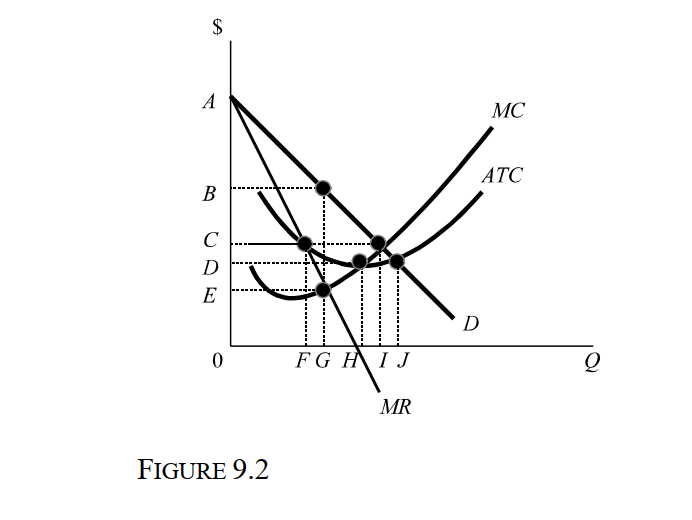 -Consider Figure 9.2, which depicts a profit-maximizing monopolist. The profit- maximizing level of output is:
 (Multiple Choice)
4.7/5 (64)
(64) The demand for the output of a multi-firm industry is QT = 50 !2.5P. The total cost of production of an individual profit-maximizing firm in this industry is TC1= 4Q1. If this industry is comprised of 19 firms, the Cournot-Nash equilibrium output for firm 1 is:
(Multiple Choice)
4.9/5 (68)
(68) Game theory cannot be used to enhance our understanding of:
(Multiple Choice)
4.9/5 (67)
(67) The demand for the output of a multi-firm industry is QT = 50 !2.5P. The total cost of production of an individual profit-maximizing firm in this industry is TC1= 4Q1. If this industry is comprised of 2 firms, firm 1's profit is about:
(Multiple Choice)
4.7/5 (85)
(85) The demand for the output of a multi-firm industry is QT = 50 !2.5P. The total cost of production of an individual profit-maximizing firm in this industry is TC1= 4Q1. If this industry is comprised of 7 firms, the Cournot-Nash equilibrium output for firm 1 is:
(Multiple Choice)
4.8/5 (76)
(76) 
Filters
- Essay(0)
- Multiple Choice(0)
- Short Answer(0)
- True False(0)
- Matching(0)