



 Chat with AI
Exam 6: Mixing Pure Strategies

Exam 1: Introduction to Game Theory35 Questions
Exam 2: Noncooperative, One-Time, Static Games86 Questions
Exam 3: Focal-Point and Evolutionary Equilibria32 Questions
Exam 4: Infinitely-Repeated, Static Games37 Questions
Exam 5: Finitely-Repeated, Static Games40 Questions
Exam 6: Mixing Pure Strategies51 Questions
Exam 7: Static Games With Continuous Strategies24 Questions
Exam 8: Imperfect Competition52 Questions
Exam 9: Perfect Competition and Monopoly33 Questions
Exam 10: Strategic Trade Policy35 Questions
Exam 11: Dynamic Games With Complete47 Questions
Exam 12: Bargaining54 Questions
Exam 13: Pure Strategies With Uncertain Payoffs65 Questions
Exam 14: Torts and Contracts45 Questions
Exam 15: Auctions44 Questions
Exam 16: Dynamic Games With Incomplete Information34 Questions
Select questions type


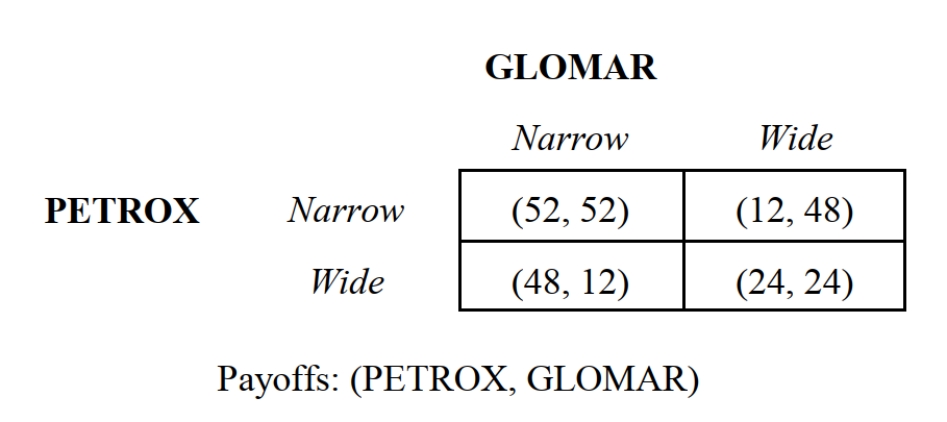 -Consider the oil-drilling game in Figure 6.6. Payoffs are in millions of dollars. If both oil-drilling companies adopt its optimal mixing rule, PETROX's expected payoff is:
 (Multiple Choice)
5.0/5  (82)
(82) Frans asked his mother, Greta, to bake him an apple pie. After baking the pie, Greta tells Frans to slice the pie any way he likes, but that he must give his brother, Hans, the first choice of slices. The only other condition is that the slices must be divided into quarters. The most likely guiding principle for determining the Nash equilibrium strategy profile for this game is the:
(Multiple Choice)
4.9/5 (80)
(80) 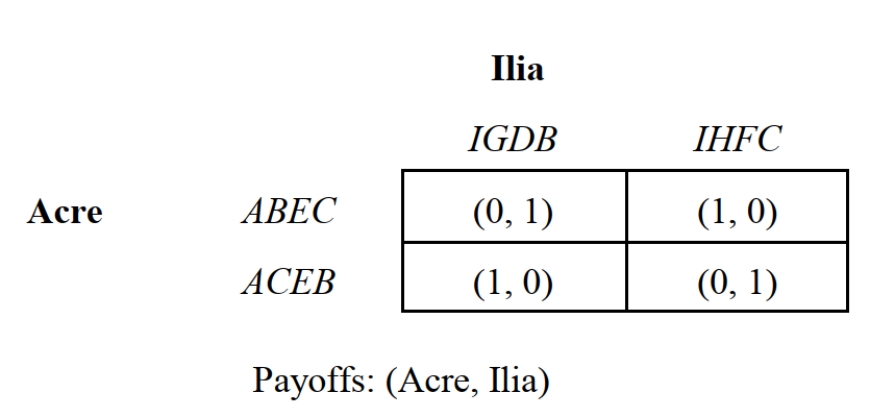 -Consider the reduced form of the Sink-the-Battleship Game depicted in Figure 6.4 where 1 designates a "hit" and 0 designates a "miss." The pure-strategy Nash equilibrium for this game is:
I. {ABEC, IGDB}.
II. {ACEB, IHFC}.
III. {ABEC, IHFC}.
IV. {ACEB, IHFC}.
Which of the following is correct?
-Consider the reduced form of the Sink-the-Battleship Game depicted in Figure 6.4 where 1 designates a "hit" and 0 designates a "miss." The pure-strategy Nash equilibrium for this game is:
I. {ABEC, IGDB}.
II. {ACEB, IHFC}.
III. {ABEC, IHFC}.
IV. {ACEB, IHFC}.
Which of the following is correct? (Multiple Choice)
4.9/5 (76)
(76) 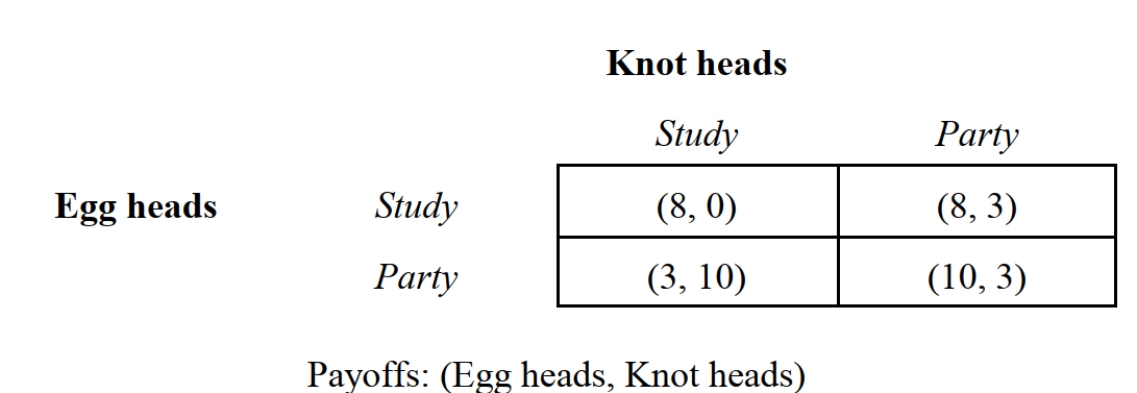 -Professor Nash teaches game theory at Gigantic State University (GSU). Just prior to the final exam, Professor Nash announces that students who score in the top half of the class will receive an A, while students who score in the bottom half will receive an F. There are just two types of students at GSU: Egg heads and knot heads. The students must decide whether to study for the final exam or not study and party. The payoffs for this game are summarized in Figure 6.7. If larger payoffs are preferred, which group has a dominant mixed strategy?
 (Multiple Choice)
4.7/5 (83)
(83)
-Professor Nash teaches game theory at Gigantic State University (GSU). Just prior to the final exam, Professor Nash announces that students who score in the top half of the class will receive an A, while students who score in the bottom half will receive an F. There are just two types of students at GSU: Egg heads and knot heads. The students must decide whether to study for the final exam or not study and party. The payoffs for this game are summarized in Figure 6.7. If larger payoffs are preferred, the mixed-strategy Nash equilibrium strategy profile for this game is:
-Professor Nash teaches game theory at Gigantic State University (GSU). Just prior to the final exam, Professor Nash announces that students who score in the top half of the class will receive an A, while students who score in the bottom half will receive an F. There are just two types of students at GSU: Egg heads and knot heads. The students must decide whether to study for the final exam or not study and party. The payoffs for this game are summarized in Figure 6.7. If larger payoffs are preferred, the mixed-strategy Nash equilibrium strategy profile for this game is: (Multiple Choice)
4.8/5 (70)
(70) 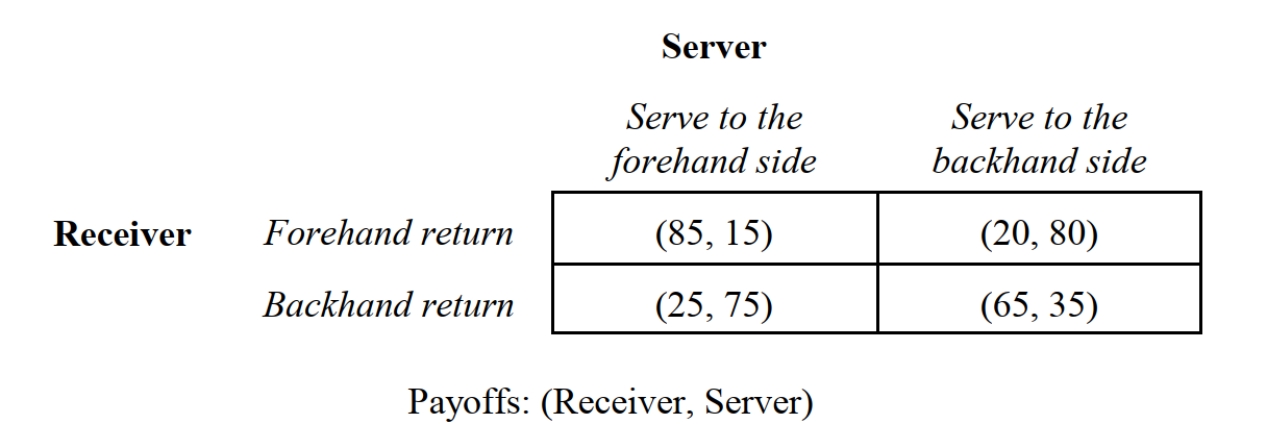 -Suppose that two individuals play a game of tennis. The situation depicted in Figure 6.5 summarizes the probabilities that the receiver will successfully return a serve that is directed to his backhand or forehand. The receiver's optimal mixing rule is:
 (Multiple Choice)
4.8/5 (84)
(84) 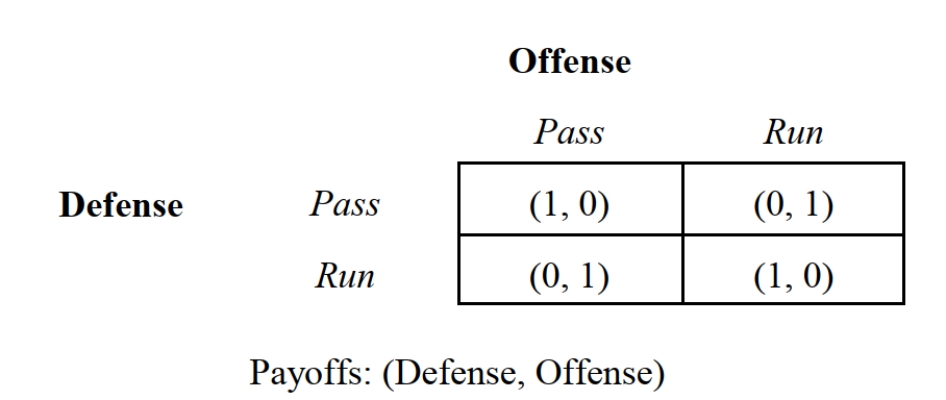 -Consider the game in Figure 6.1. What is the success rate of the defense if the offense adopts its optimal mixing rule?
 (Multiple Choice)
4.8/5 (82)
(82)
-Suppose that two individuals play a game of tennis. The situation depicted in Figure 6.5 summarizes the probabilities that the receiver will successfully return a serve that is directed to his backhand or forehand. Suppose that both players adopt his or her optimal mixing rule. The receiver's success rate will be:
-Suppose that two individuals play a game of tennis. The situation depicted in Figure 6.5 summarizes the probabilities that the receiver will successfully return a serve that is directed to his backhand or forehand. Suppose that both players adopt his or her optimal mixing rule. The receiver's success rate will be: (Multiple Choice)
4.7/5 (70)
(70)
-Consider the reduced form of the Sink-the-Battleship Game depicted in Figure 6.4 where 1 designates a "hit" and 0 designates a "miss." Suppose that Acre adopts its optimal mixing rule. Its success rate will be:
-Consider the reduced form of the Sink-the-Battleship Game depicted in Figure 6.4 where 1 designates a "hit" and 0 designates a "miss." Suppose that Acre adopts its optimal mixing rule. Its success rate will be: (Multiple Choice)
4.8/5 (66)
(66) 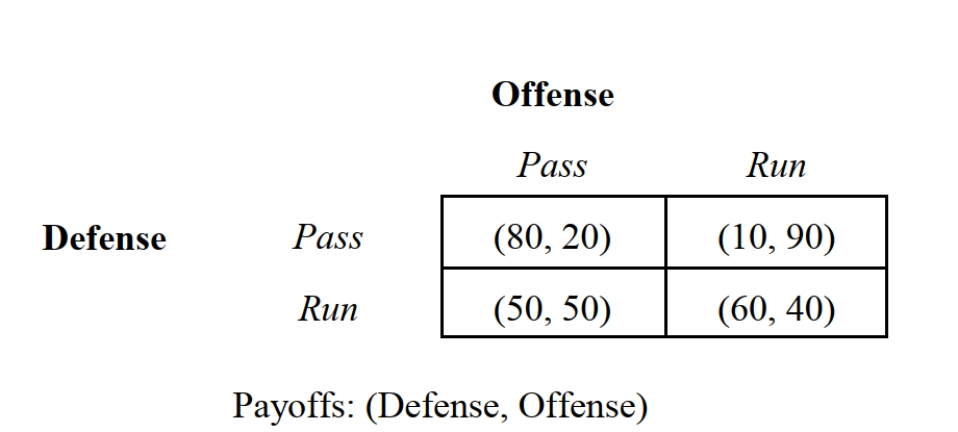 -Suppose that a football team is down by 5 points and faces a 4th down with 1 yard to go and 1 second left on the clock. The offense can either run or pass the ball. The defense can either defend against the run or the pass. Refer to Figure 6.2 summarizes the probabilities of each team winning the game. The optimal mixing rule for the defense is:
 (Multiple Choice)
4.8/5 (87)
(87)
-Suppose that a football team is down by 5 points and faces a 4th down with 1 yard to go and 1 second left on the clock. The offense can either run or pass the ball. The defense can either defend against the run or the pass. Refer to Figure 6.2 summarizes the probabilities of each team winning the game. The mixed-strategy Nash equilibrium for this game is:
-Suppose that a football team is down by 5 points and faces a 4th down with 1 yard to go and 1 second left on the clock. The offense can either run or pass the ball. The defense can either defend against the run or the pass. Refer to Figure 6.2 summarizes the probabilities of each team winning the game. The mixed-strategy Nash equilibrium for this game is: (Multiple Choice)
4.8/5 (73)
(73)
-Consider the game in Figure 6.1. The dominant strategy for the offense is to:
-Consider the game in Figure 6.1. The dominant strategy for the offense is to: (Multiple Choice)
4.8/5 (62)
(62) Frans asked his mother, Greta, to bake him an apple pie. After baking the pie, Greta tells Frans to slice the pie any way he likes, but that he must give his brother, Hans, the first choice of slices. The only other condition is that the slices must be divided into quarters. The most likely Nash equilibrium strategy profile for this game is:
(Multiple Choice)
4.8/5 (75)
(75) 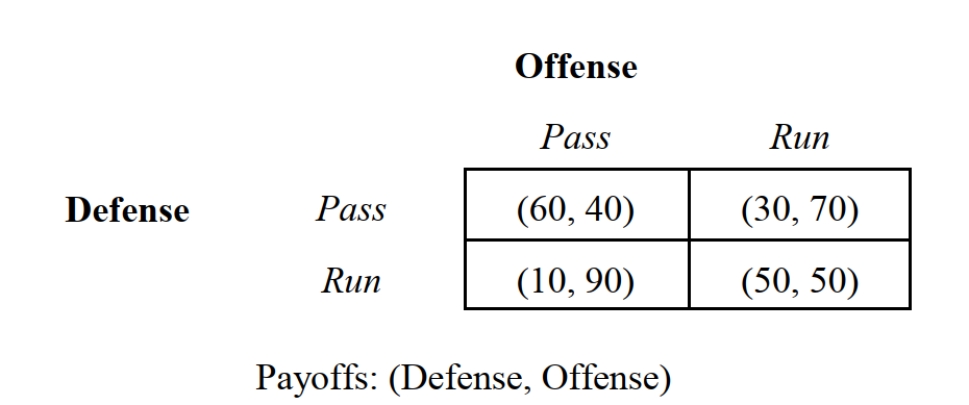 -Suppose that a football team is down by 5 points and faces a 4th down with 1 yard to go and 1 second left on the clock. The offense can either run or pass the ball. The defense can either defend against the run or the pass. Refer to Figure 6.3 summarizes the probabilities of each team winning the game. The dominant pure strategy for the defense is:
 (Multiple Choice)
4.7/5 (82)
(82)
-Suppose that two individuals play a game of tennis. The situation depicted in Figure 6.5summarizes the probabilities that the receiver will successfully return a serve that isdirected to his backhand or forehand. The mixed-strategy Nash equilibrium for this game is:
-Suppose that two individuals play a game of tennis. The situation depicted in Figure 6.5summarizes the probabilities that the receiver will successfully return a serve that isdirected to his backhand or forehand. The mixed-strategy Nash equilibrium for this game is: (Multiple Choice)
4.7/5 (73)
(73)
-Suppose that a football team is down by 5 points and faces a 4th down with 1 yard to go and 1 second left on the clock. The offense can either run or pass the ball. The defense can either defend against the run or the pass. Refer to Figure 6.3 summarizes the probabilities of each team winning the game. The mixed-strategy Nash equilibrium for this game is:
-Suppose that a football team is down by 5 points and faces a 4th down with 1 yard to go and 1 second left on the clock. The offense can either run or pass the ball. The defense can either defend against the run or the pass. Refer to Figure 6.3 summarizes the probabilities of each team winning the game. The mixed-strategy Nash equilibrium for this game is: (Multiple Choice)
4.9/5 (87)
(87)
-Suppose that a football team is down by 5 points and faces a 4th down with 1 yard to go and 1 second left on the clock. The offense can either run or pass the ball. The defense can either defend against the run or the pass. Refer to Figure 6.3 summarizes the probabilities of each team winning the game. Suppose that both players adopts its optimal mixing rule. What is the success rate of the offense?
-Suppose that a football team is down by 5 points and faces a 4th down with 1 yard to go and 1 second left on the clock. The offense can either run or pass the ball. The defense can either defend against the run or the pass. Refer to Figure 6.3 summarizes the probabilities of each team winning the game. Suppose that both players adopts its optimal mixing rule. What is the success rate of the offense? (Multiple Choice)
4.8/5 (94)
(94)
-Consider the reduced form of the Sink-the-Battleship Game depicted in Figure 6.4 where 1 designates a "hit" and 0 designates a "miss." Suppose that Ilia adopts its optimal mixing rule. Its success rate will be:
-Consider the reduced form of the Sink-the-Battleship Game depicted in Figure 6.4 where 1 designates a "hit" and 0 designates a "miss." Suppose that Ilia adopts its optimal mixing rule. Its success rate will be: (Multiple Choice)
4.8/5 (78)
(78) 
Filters
- Essay(0)
- Multiple Choice(0)
- Short Answer(0)
- True False(0)
- Matching(0)