



 Chat with AI
Exam 3: Focal-Point and Evolutionary Equilibria

Exam 1: Introduction to Game Theory35 Questions
Exam 2: Noncooperative, One-Time, Static Games86 Questions
Exam 3: Focal-Point and Evolutionary Equilibria32 Questions
Exam 4: Infinitely-Repeated, Static Games37 Questions
Exam 5: Finitely-Repeated, Static Games40 Questions
Exam 6: Mixing Pure Strategies51 Questions
Exam 7: Static Games With Continuous Strategies24 Questions
Exam 8: Imperfect Competition52 Questions
Exam 9: Perfect Competition and Monopoly33 Questions
Exam 10: Strategic Trade Policy35 Questions
Exam 11: Dynamic Games With Complete47 Questions
Exam 12: Bargaining54 Questions
Exam 13: Pure Strategies With Uncertain Payoffs65 Questions
Exam 14: Torts and Contracts45 Questions
Exam 15: Auctions44 Questions
Exam 16: Dynamic Games With Incomplete Information34 Questions
Select questions type


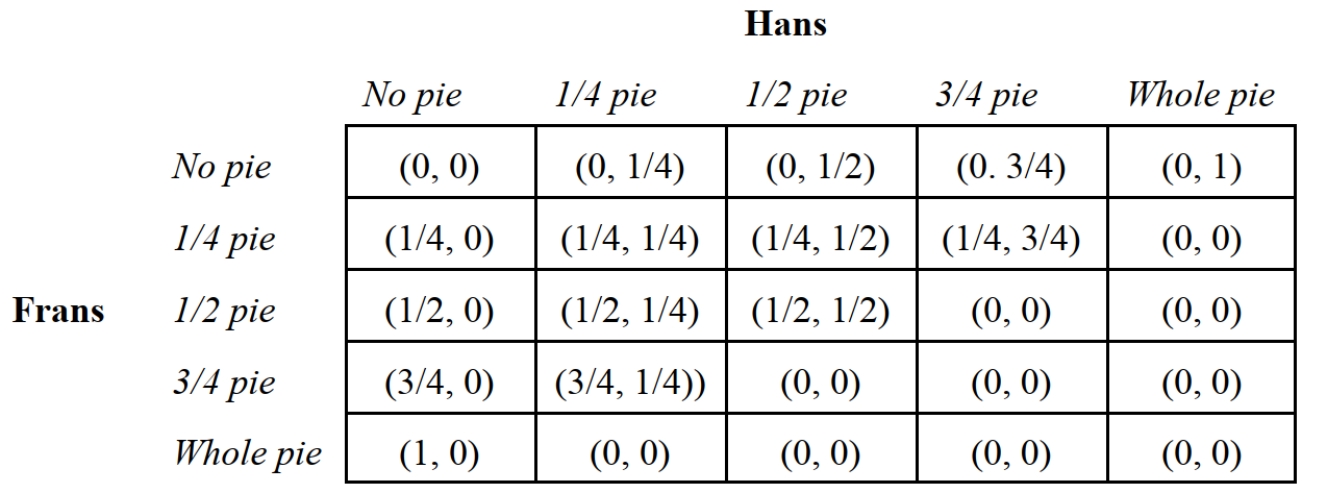 -Consider the pie-sharing game depicted in Figure 3.3. Greta has baked an apple pie for her two sons Hans and Frans. Hans and Frans simultaneously ask for a slice of the pie. Greta tells her sons that they can have any size slice they want as long as their slices do not exceed the entire pie. On the other hand, if their combined requests exceed the size of the pie then they each get nothing. The most likely focal-point equilibrium for this game is:
 (Multiple Choice)
4.8/5  (94)
(94) The qualitative factors that help to explain the existence of a focal-point equilibrium include:
(Multiple Choice)
4.7/5 (77)
(77) 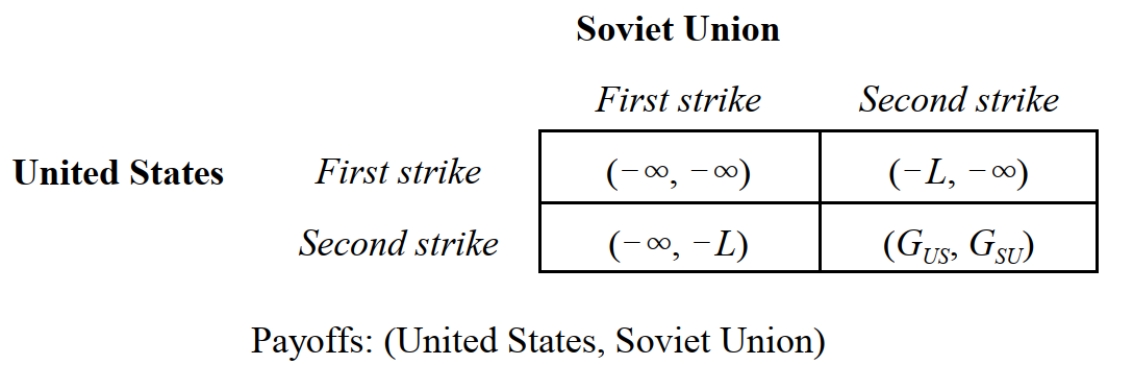 -Consider the Cold War game depicted in Figure 3.6 involving a first and second strike nuclear strategies where !4 represents total annihilation, !L represents significant but "acceptable" losses, and GUS and GSU represent positive gains to the U.S. and the Soviet Union, respectively. Both players have:
 (Multiple Choice)
4.8/5 (91)
(91) 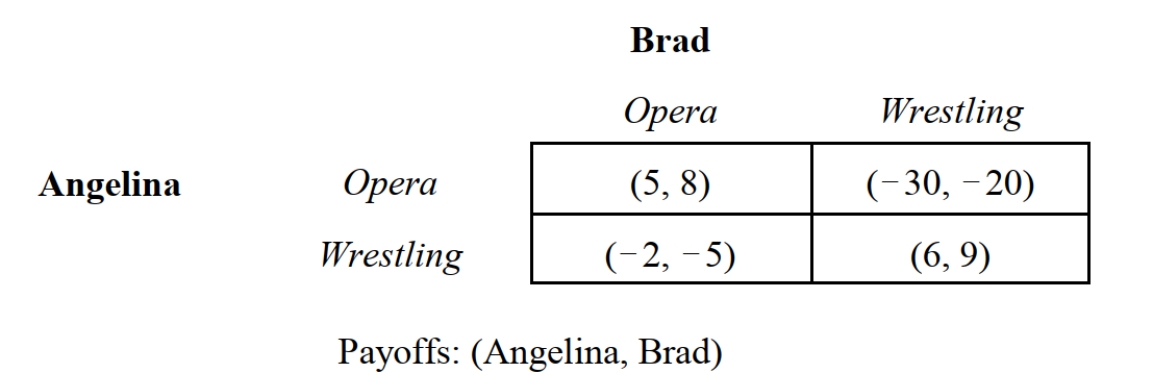 -Brad and Angelina are trying to decide how to spend an evening. Brad would prefer to spend an evening at the opera. Angelina would spend the evening attending a professional wrestling match. They could, of course, go their separate ways, but would rather spend the evening together. Figure 3.4 summarizes the payoffs from alternative strategy profiles. The most likely focal-point equilibrium strategy profile for this game is:
 (Multiple Choice)
4.9/5 (88)
(88)
-Brad and Angelina are trying to decide how to spend an evening. Brad would prefer to spend an evening at the opera. Angelina would spend the evening attending a professional wrestling match. They could, of course, go their separate ways, but would rather spend the evening together. Figure 3.4 summarizes the payoffs from alternative strategy profiles. What is the strategy profile for this game if Brad and Angelina adopt a minimax regret strategy?
-Brad and Angelina are trying to decide how to spend an evening. Brad would prefer to spend an evening at the opera. Angelina would spend the evening attending a professional wrestling match. They could, of course, go their separate ways, but would rather spend the evening together. Figure 3.4 summarizes the payoffs from alternative strategy profiles. What is the strategy profile for this game if Brad and Angelina adopt a minimax regret strategy? (Multiple Choice)
4.9/5 (86)
(86) 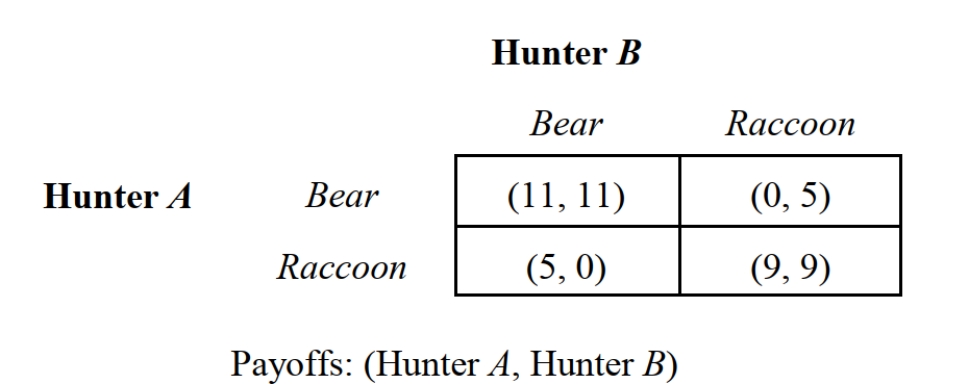 -Consider the noncooperative, static game depicted in Figure 3.1. Two hunters are stalking bear or raccoon. Each could hunt raccoon alone, or they can coordinate their efforts by hunting bear. Sharing a bear is preferred to sharing a raccoon. The payoffs in this game are measured in units of satisfaction. If larger payoffs are preferred, the most likely focal-point equilibrium for this game is:
I. {Bear, Bear}.
II. {Raccoon, Raccoon}.
III. {Bear, Raccoon}.
IV. {Raccoon, Bear}.
Which of the following is correct?
-Consider the noncooperative, static game depicted in Figure 3.1. Two hunters are stalking bear or raccoon. Each could hunt raccoon alone, or they can coordinate their efforts by hunting bear. Sharing a bear is preferred to sharing a raccoon. The payoffs in this game are measured in units of satisfaction. If larger payoffs are preferred, the most likely focal-point equilibrium for this game is:
I. {Bear, Bear}.
II. {Raccoon, Raccoon}.
III. {Bear, Raccoon}.
IV. {Raccoon, Bear}.
Which of the following is correct? (Multiple Choice)
4.9/5 (66)
(66) 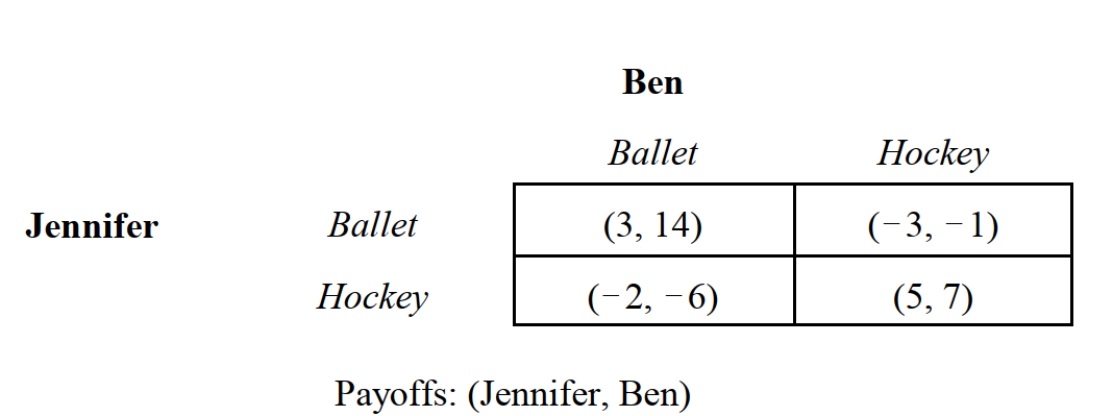 -Ben and Jennifer are trying to decide how to spend an evening. Ben would like to attend a ballet performance. Jennifer would like to go to a hockey game. While they could spend the evening apart, they would prefer to spend the evening together. Figure 3.5 summarizes the payoffs from alternative choices. The most likely focal-point equilibrium strategy profile for this game is:
 (Multiple Choice)
4.8/5 (82)
(82) In games involving multiple Nash equilibria, several qualitative factors appear to be important in explaining the existence of a focal-point equilibrium, including:
I. Distribution of payoffs.
II. Equity. III. Diversity.
IV. Fairness.
V. Uniqueness.
Which of the following is correct?
(Multiple Choice)
4.8/5 (75)
(75) When attempting to identify a unique focal-point equilibrium in static games:
(Multiple Choice)
4.9/5 (63)
(63)
-Brad and Angelina are trying to decide how to spend an evening. Brad would prefer to spend an evening at the opera. Angelina would spend the evening attending a professional wrestling match. They could, of course, go their separate ways, but would rather spend the evening together. Figure 3.4 summarizes the payoffs from alternative strategy profiles. This game has _____ Nash equilibrium strategy profiles.
-Brad and Angelina are trying to decide how to spend an evening. Brad would prefer to spend an evening at the opera. Angelina would spend the evening attending a professional wrestling match. They could, of course, go their separate ways, but would rather spend the evening together. Figure 3.4 summarizes the payoffs from alternative strategy profiles. This game has _____ Nash equilibrium strategy profiles. (Multiple Choice)
4.9/5 (94)
(94) 
Filters
- Essay(0)
- Multiple Choice(0)
- Short Answer(0)
- True False(0)
- Matching(0)