



 Chat with AI
Exam 2: Noncooperative, One-Time, Static Games

Exam 1: Introduction to Game Theory35 Questions
Exam 2: Noncooperative, One-Time, Static Games86 Questions
Exam 3: Focal-Point and Evolutionary Equilibria32 Questions
Exam 4: Infinitely-Repeated, Static Games37 Questions
Exam 5: Finitely-Repeated, Static Games40 Questions
Exam 6: Mixing Pure Strategies51 Questions
Exam 7: Static Games With Continuous Strategies24 Questions
Exam 8: Imperfect Competition52 Questions
Exam 9: Perfect Competition and Monopoly33 Questions
Exam 10: Strategic Trade Policy35 Questions
Exam 11: Dynamic Games With Complete47 Questions
Exam 12: Bargaining54 Questions
Exam 13: Pure Strategies With Uncertain Payoffs65 Questions
Exam 14: Torts and Contracts45 Questions
Exam 15: Auctions44 Questions
Exam 16: Dynamic Games With Incomplete Information34 Questions
Select questions type


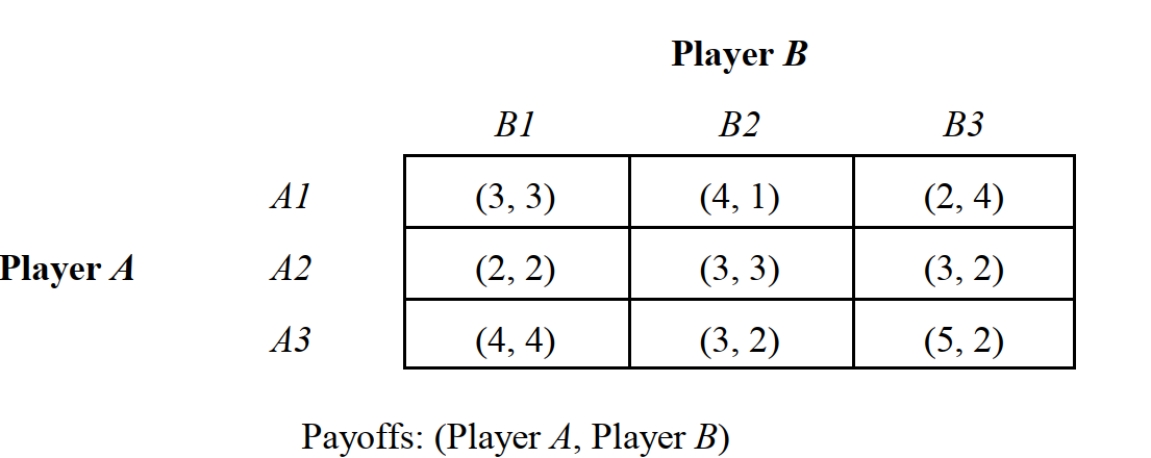 -Consider the game depicted in Figure 2.18. Which player has a dominant strategy:
 (Multiple Choice)
4.9/5  (70)
(70) 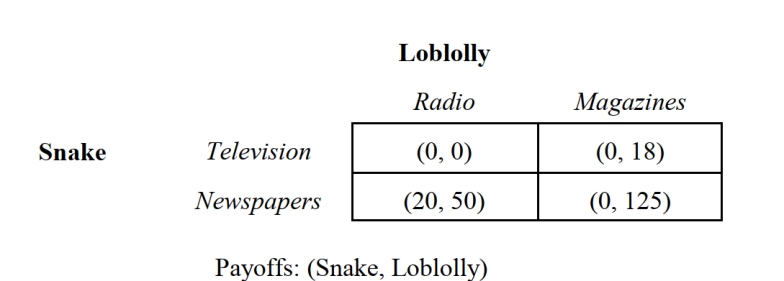 -The Snake River Company and the Loblolly River Company are considering their respective advertising campaigns. Figure 2.10 summarizes the possible payoffs (in thousands of dollars) to each company from each combination of advertising strategies. The Nash equilibrium strategy profile for this game is:
 (Multiple Choice)
4.8/5 (87)
(87) 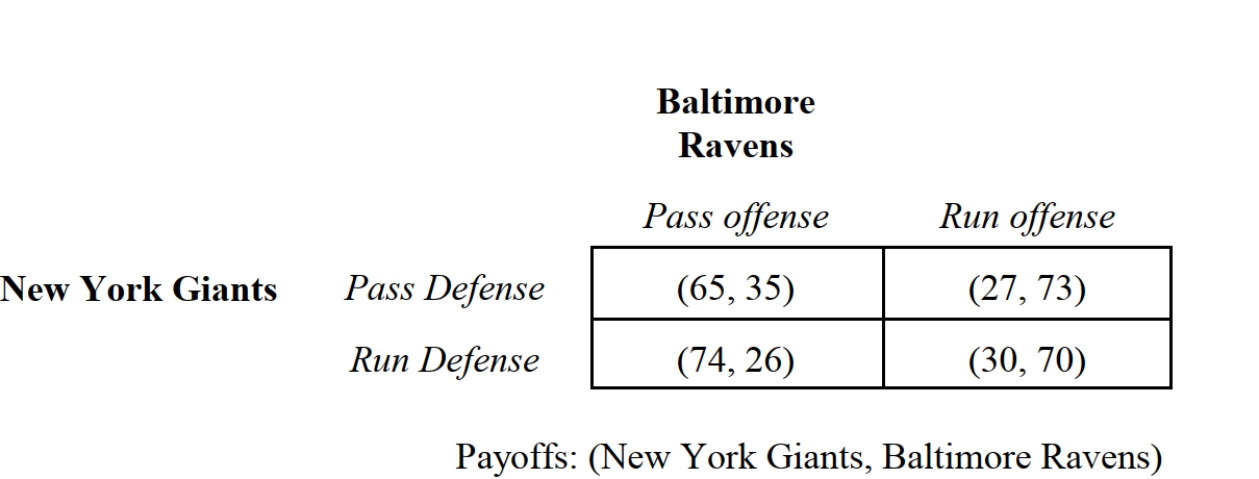 -Consider the simultaneous-move game depicted in Figure 2.20. Which team has a dominant strategy?
 (Multiple Choice)
4.8/5 (86)
(86)
-The Snake River Company and the Loblolly River Company are considering their respective advertising campaigns. Figure 2.10 summarizes the possible payoffs (in thousands of dollars) to each company from each combination of advertising strategies. The Snake River Company has a:
-The Snake River Company and the Loblolly River Company are considering their respective advertising campaigns. Figure 2.10 summarizes the possible payoffs (in thousands of dollars) to each company from each combination of advertising strategies. The Snake River Company has a: (Multiple Choice)
4.8/5 (74)
(74) 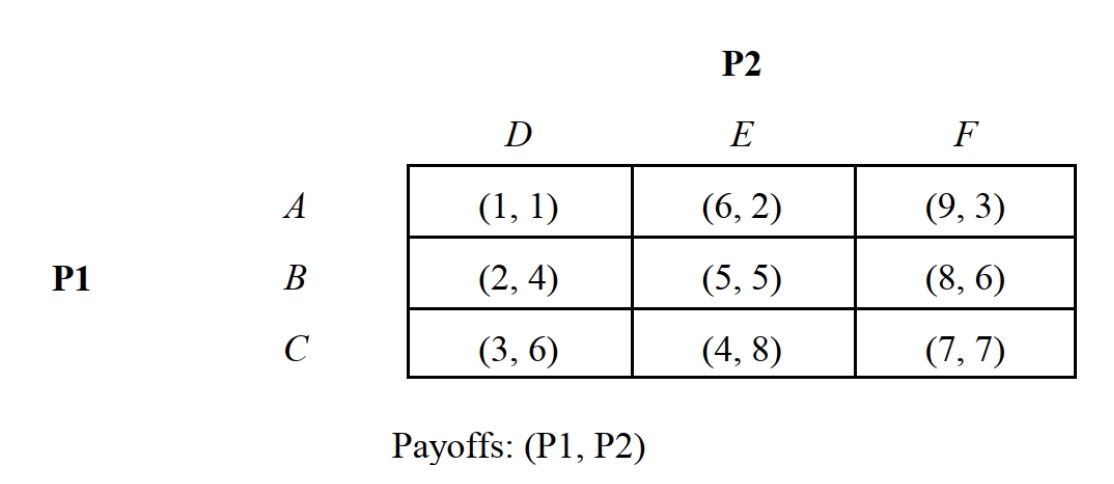 -Consider the noncooperative, one-time, static game depicted in Figure 2.17. The Nash equilibrium strategy profile(s) for this game is(are):
I. {A, F}.
II. {B, E}.
III. {C, F}.
IV. {B, D}.
V. {B, F}.
Which of the following is correct?
-Consider the noncooperative, one-time, static game depicted in Figure 2.17. The Nash equilibrium strategy profile(s) for this game is(are):
I. {A, F}.
II. {B, E}.
III. {C, F}.
IV. {B, D}.
V. {B, F}.
Which of the following is correct? (Multiple Choice)
4.8/5 (80)
(80)
-Consider the static game depicted in Figure 2.18. The Nash equilibrium strategy profile(s) for this game is (are):
I. {A1, B1}.
II. {A2, B1}.
III. {A2, B2}.
IV. {A3, B3}.
V. {A3, B1}.
Which of the following is correct?
-Consider the static game depicted in Figure 2.18. The Nash equilibrium strategy profile(s) for this game is (are):
I. {A1, B1}.
II. {A2, B1}.
III. {A2, B2}.
IV. {A3, B3}.
V. {A3, B1}.
Which of the following is correct? (Multiple Choice)
4.8/5 (65)
(65)
-Consider the noncooperative, one-time, static game depicted in Figure 2.17. P2 has _____ dominated strategy or strategies.
-Consider the noncooperative, one-time, static game depicted in Figure 2.17. P2 has _____ dominated strategy or strategies. (Multiple Choice)
4.8/5 (84)
(84) Fred and Ethel are contestants on the game show Truth or Consequences. Fred and Ethel were introduced to each other moments before the show began. The game begins with the two contestants answering a trivia question. If they answer correctly, they are sent to separate isolation chambers where they must choose Truth or Consequences. They are told that if they both choose Truth then they will share equally a $10,000 prize. If one chooses Truth and the other chooses Consequences, the player choosing Consequences gets the entire $10,000 while the player choosing Truth gets nothing. If they both choose Consequences, they each get $100 as a parting gift. In this game, who has a dominant strategy?
(Multiple Choice)
4.8/5 (69)
(69) 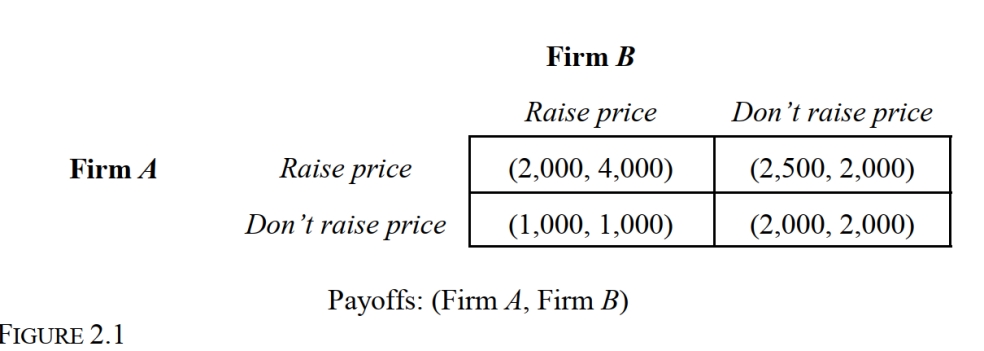 -Refer to Figure 2.1, which represents the normal form of a noncooperative, one-time, static game. A Nash equilibrium occurs at the strategy profile:
 (Multiple Choice)
4.9/5 (78)
(78) 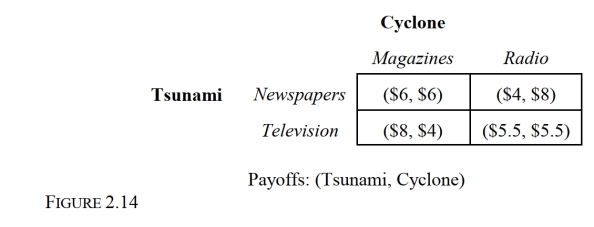 -Consider the noncooperative, one-time, static game depicted in Figure 2.14 in which the payoffs are in millions of dollars. Suppose that Tsunami Corporation and Cyclone Company contemplating a change in their advertising strategies. If both players adopt a maximin decision rule, the resulting strategy profile is:
 (Multiple Choice)
4.7/5 (77)
(77) 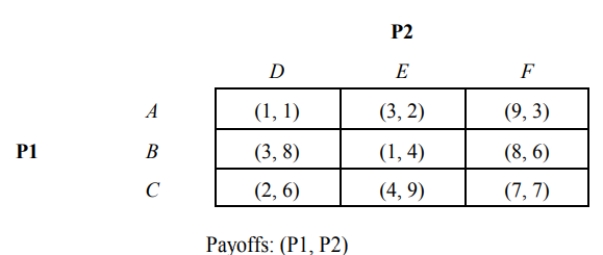 -Consider the static game depicted in Figure 2.19. P1 has _____ dominated strategy or strategies.
 (Multiple Choice)
4.9/5 (65)
(65) Firm A is considering entering a market in which firm B is a monopolist. Firm B must decide how to respond to this challenge. If firm A decides to enter, firm B can either adopt an aggressive pricing strategy or a passive pricing strategy. If firm B adopts an aggressive pricing strategy, firm A will lose $5 million, although firm B will only earn $1 million. If firm B adopts a passive pricing strategy, firm A will earn $3 million and firm B will earn $7 million. Finally, if firm A decides to stay out of the market, firm B will earn $14 million regardless of its pricing strategy. The Nash equilibrium strategy profile for this game is:
(Multiple Choice)
4.9/5 (74)
(74) 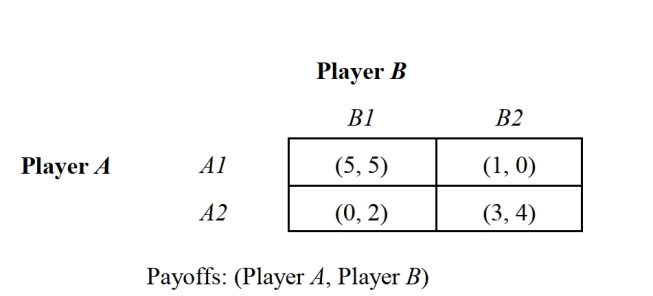 -Refer to Figure 2.15, which represents a simultaneous-move, noncooperative, one-time game in which larger payoffs are preferred. If both players adopt a minimax regret decision rule, the resulting strategy profile for this game is:
 (Multiple Choice)
4.7/5 (89)
(89) 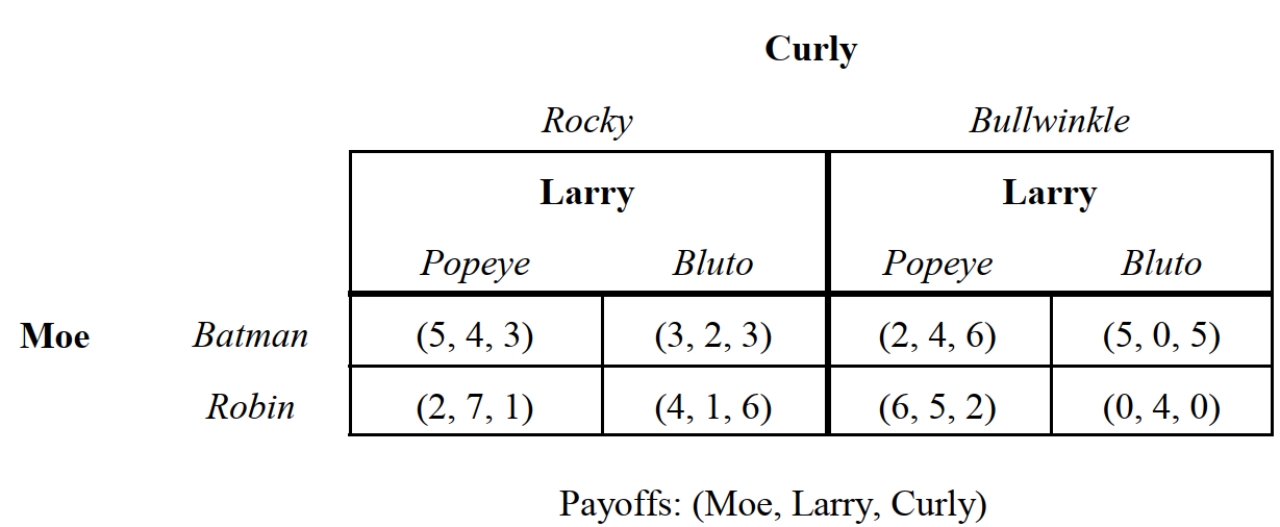 -Consider the noncooperative, one-time, static game depicted in depicted in Figure 2.22. Which player has a dominant strategy?
 (Multiple Choice)
4.8/5 (76)
(76) 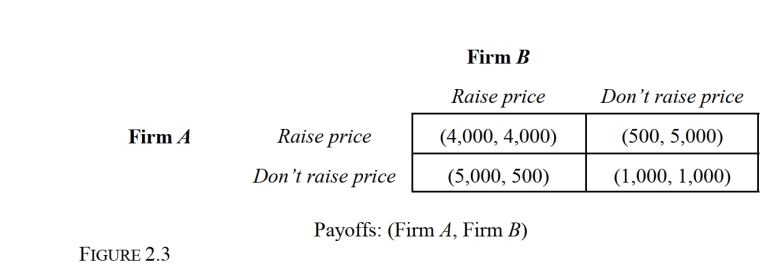 -Refer to Figure 2.3, which represents a noncooperative, one-time, static game. If larger payoffs are preferred, which firm has a strictly dominant strategy?
 (Multiple Choice)
4.7/5 (81)
(81) 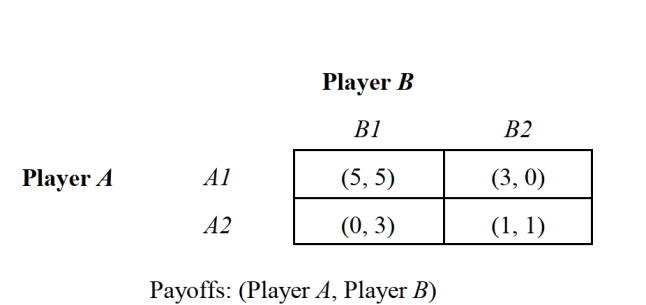 -Consider the noncooperative, one-time, static game depicted in Figure 2.13 in which larger payoffs are preferred. If both players adopt a minimax regret decision rule, the resulting strategy profile for this game is:
 (Multiple Choice)
4.7/5 (80)
(80) In the text application "A Beautiful Mind," the Nash equilibrium is for the classmates to:
(Multiple Choice)
4.8/5 (73)
(73) 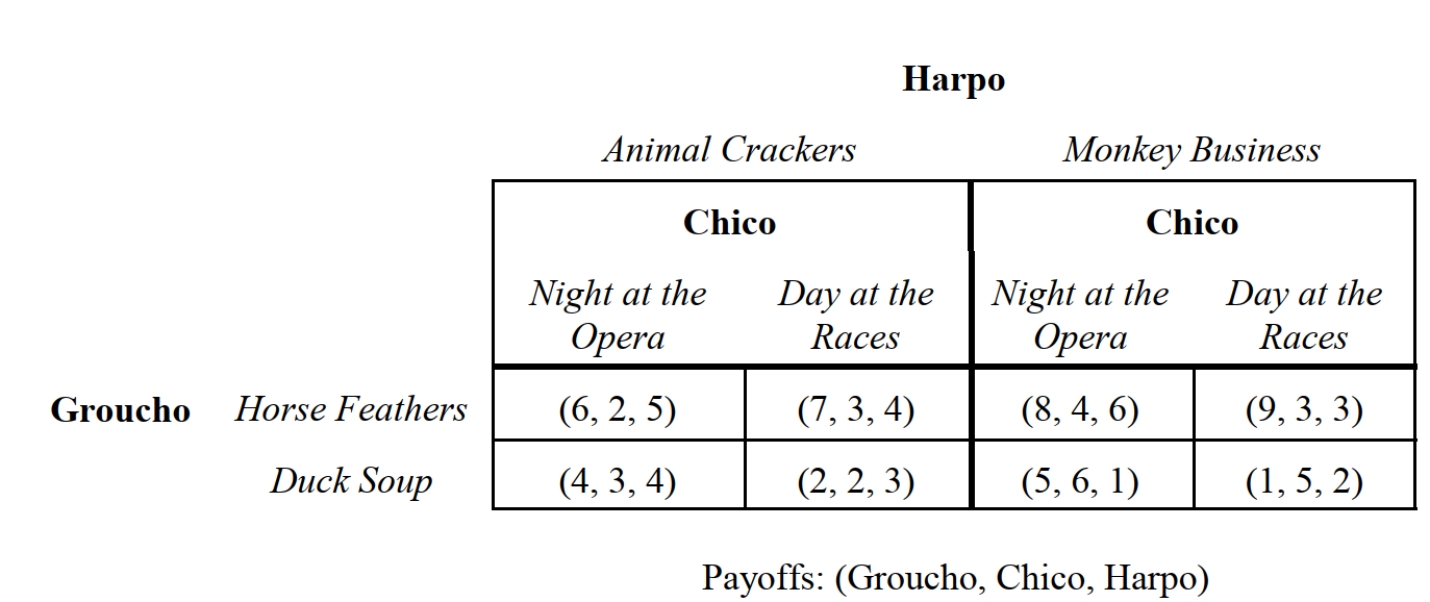 -Consider the noncooperative, one-time, static game depicted in Figure 2.23. The Nash equilibrium strategy profile(s) for this game is(are):
I. {Horse Feathers, Night at the Opera, Animal Crackers}.
II. {Horse Feathers, Day at the Races, Animal Crackers}
III. {Duck Soup, Night at the Opera, Monkey Business}
IV. {Horse Feathers, Night at the Opera, Monkey Business}
V. {Duck Soup, Day at the Races, Monkey Business}
Which of the following is correct?
-Consider the noncooperative, one-time, static game depicted in Figure 2.23. The Nash equilibrium strategy profile(s) for this game is(are):
I. {Horse Feathers, Night at the Opera, Animal Crackers}.
II. {Horse Feathers, Day at the Races, Animal Crackers}
III. {Duck Soup, Night at the Opera, Monkey Business}
IV. {Horse Feathers, Night at the Opera, Monkey Business}
V. {Duck Soup, Day at the Races, Monkey Business}
Which of the following is correct? (Multiple Choice)
4.9/5 (71)
(71) 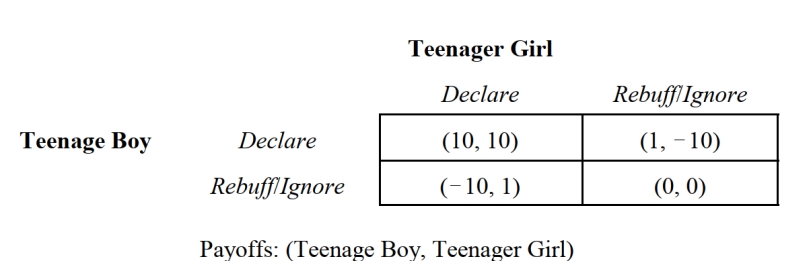 -Use Figure 2.5 to answer this question. Suppose that two teenagers have a crush on each other, but neither know's the other's feelings. At a school dance both have to decide whether or not to "declare" their feelings for the other. If both "declare" they get significant positive utility, but if they are rebuffed they face humiliation in front of their friends, which results in significant negative utility. Finally, if they choose to ignore each other they will maximize their worst outcome, that is, they will avoid humiliation. Social convention dictates that the teenage boy makes the first move. His dominant strategy is to:
 (Multiple Choice)
4.8/5 (72)
(72) Fred and Ethel are contestants on the game show Truth or Consequences. Fred and Ethel were introduced to each other moments before the show began. The game begins with the two contestants answering a trivia question. If they answer correctly, they are sent to separate isolation chambers where they must choose Truth or Consequences. They are told that if they both choose Truth then they will share equally a $10,000 prize. If one chooses Truth and the other chooses Consequences, the player choosing Consequences gets the entire $10,000 while the player choosing Truth gets nothing. If they both choose Consequences, they each get $100 as a parting gift. If both players use a maximin decision rule, the strategy profile for this game is:
(Multiple Choice)
4.8/5 (87)
(87) 
Filters
- Essay(0)
- Multiple Choice(0)
- Short Answer(0)
- True False(0)
- Matching(0)