



 Chat with AI
Exam 1: Introduction to Game Theory

Exam 1: Introduction to Game Theory35 Questions
Exam 2: Noncooperative, One-Time, Static Games86 Questions
Exam 3: Focal-Point and Evolutionary Equilibria32 Questions
Exam 4: Infinitely-Repeated, Static Games37 Questions
Exam 5: Finitely-Repeated, Static Games40 Questions
Exam 6: Mixing Pure Strategies51 Questions
Exam 7: Static Games With Continuous Strategies24 Questions
Exam 8: Imperfect Competition52 Questions
Exam 9: Perfect Competition and Monopoly33 Questions
Exam 10: Strategic Trade Policy35 Questions
Exam 11: Dynamic Games With Complete47 Questions
Exam 12: Bargaining54 Questions
Exam 13: Pure Strategies With Uncertain Payoffs65 Questions
Exam 14: Torts and Contracts45 Questions
Exam 15: Auctions44 Questions
Exam 16: Dynamic Games With Incomplete Information34 Questions
Select questions type


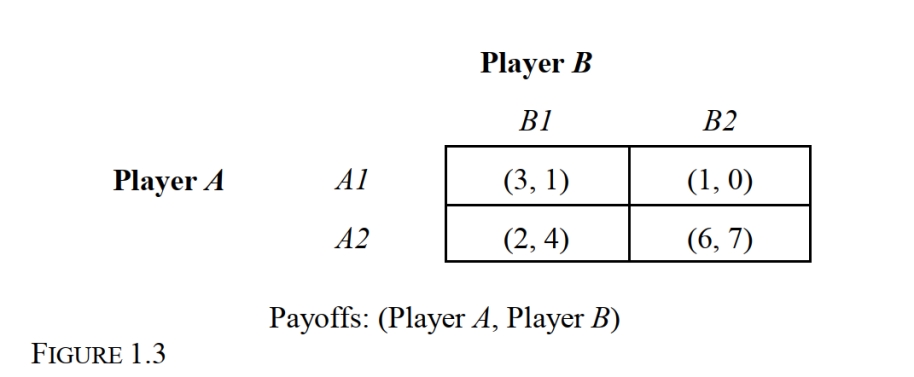 -Refer to noncooperative, one-time, static game depicted in Figure 1.3. The Nash equilibrium strategy profile for this game is:
I. {A1, B1}.
II. {A1, B2}.
III. {A2, B1}.
IV. {A2, B2}.
Which of the following is correct?
-Refer to noncooperative, one-time, static game depicted in Figure 1.3. The Nash equilibrium strategy profile for this game is:
I. {A1, B1}.
II. {A1, B2}.
III. {A2, B1}.
IV. {A2, B2}.
Which of the following is correct? (Multiple Choice)
5.0/5  (94)
(94) A two-player, static game is one in which the players move:
(Multiple Choice)
4.8/5 (74)
(74) Which of the following assumptions about static games with complete information is incorrect:
(Multiple Choice)
4.8/5 (89)
(89) 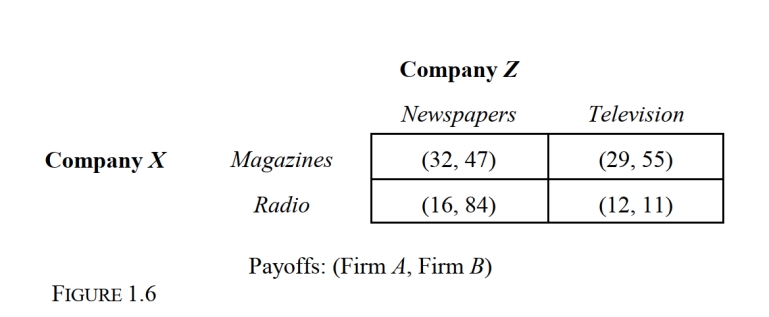 -Consider the advertising game depicted in Figure 1.6 in which payoffs are in thousands of dollars. If larger payoffs are preferred, this is an example of a:
I. Game in which both players have a strictly dominant strategy.
II. Prisoner's dilemma.
III. Two-player, noncooperative, static game.
Which of the following is correct?
-Consider the advertising game depicted in Figure 1.6 in which payoffs are in thousands of dollars. If larger payoffs are preferred, this is an example of a:
I. Game in which both players have a strictly dominant strategy.
II. Prisoner's dilemma.
III. Two-player, noncooperative, static game.
Which of the following is correct? (Multiple Choice)
4.9/5 (79)
(79) 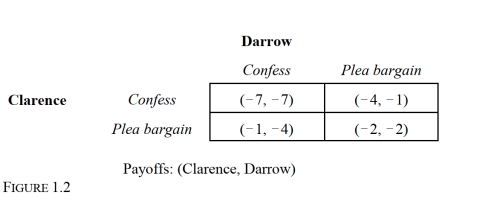 -Consider the one-time, noncooperative, static game depicted in Figure 1.2. The Nash equilibrium strategy profile for this game is:
 (Multiple Choice)
4.7/5 (81)
(81) The modern version of game theory can be traced to the groundbreaking work of:
(Multiple Choice)
4.9/5 (78)
(78) 
Filters
- Essay(0)
- Multiple Choice(0)
- Short Answer(0)
- True False(0)
- Matching(0)