



 Chat with AI
Exam 14: How Do Researchers Develop Deductive Findings Quantitative Data Analysis

Exam 1: What Is Social Research a Particular Way of Knowing90 Questions
Exam 2: What Principles and Standards Guide Research Research Ethics84 Questions
Exam 3: How Do Researchers Identify and Evaluate Social Concepts Measurement94 Questions
Exam 4: How Do Researchers Select the People, Places, and Things to Study Sampling94 Questions
Exam 5: How Can Researchers Understand Meaning, Process, and Experience in the Social World Qualitative Research95 Questions
Exam 6: How Can Researchers Enumerate and Examine Broad Patterns in Social Life Quantitative Research94 Questions
Exam 7: Where Do Principles and Practice Meet in Research Study Design93 Questions
Exam 8: How Do Researchers Study Patterns That Span Populations and Categories of Experience Questionnaires and Structured Interviews93 Questions
Exam 9: How Do Researchers Learn About Peoples Perspectives and Lives Qualitative Interviewing94 Questions
Exam 10: How Can Researchers Study the Patterns of Peoples Lives Participant Observation and Ethnography95 Questions
Exam 11: How Do Researchers Study the Ways Meanings Are Communicated in Everyday Life Content Analysis95 Questions
Exam 12: How Can Researchers Learn From Information Collected by Others Existing Data91 Questions
Exam 13: How Do Researchers Develop Inductive Findings Qualitative Data Analysis94 Questions
Exam 14: How Do Researchers Develop Deductive Findings Quantitative Data Analysis90 Questions
Exam 15: How Do Researchers Record and Share Their Work Writing and Dissemination92 Questions
Select questions type


Which of the following is not a finding from Chetty et al.'s research on how parental income affects the income levels of black and white children?
(Multiple Choice)
4.9/5  (63)
(63) What are the limitations in using bivariate analysis to test a hypothesis? How do multivariate analyses offer more information? Compare the bivariate findings from Perry or Elder and Greene to their multivariate findings?
(Essay)
4.9/5 (87)
(87) When researchers analyze the relationship or differences between two variables, they are conducting a(n) _____________.
(Multiple Choice)
4.9/5 (94)
(94) What is the median in this set of scores: 3 5 6 8 11 2 1 0 0 10 4 7 7
(Multiple Choice)
4.9/5 (82)
(82) A standard deviation of 0 would indicate that there was no difference between the individual scores in a distribution and the mean.
(True/False)
4.8/5 (74)
(74) Religion measured by denomination is an example of an ordinal variable.
(True/False)
4.9/5 (83)
(83) In order for a researcher to calculate an average, the variable must be at the __________ level.
(Multiple Choice)
4.9/5 (83)
(83) What is the advantage to displaying data visually? What methods of visual representation do researchers often use?
(Essay)
4.8/5 (67)
(67) What main factors determine what statistical tools a researcher can use?
(Essay)
4.8/5 (80)
(80) In the following distribution, the median is 45 :
27, 31, 55, 45, 76, 12, 41
(True/False)
4.9/5 (72)
(72) In the following hypothesis, what is the dependent variable: Men are more likely to oppose marijuana legalization than women
(Multiple Choice)
4.8/5 (70)
(70) Raw data is data that has been collected and processed for analysis.
(True/False)
4.9/5 (77)
(77) Multivariate analysis refers to a non-causal relationship between variables that can be attributed to the impact of a third variable.
(True/False)
4.8/5 (82)
(82) An attribute or characteristic that may vary over time or from case to case is called a(n) _________________.
(Multiple Choice)
4.7/5 (66)
(66) Bunch and team found that people who had been victimized engaged in higher-risk behaviors. This was a _________ relationship.
(Multiple Choice)
4.8/5 (81)
(81) Based on your data analysis, you find that 33% of whites in your sample have never had an interaction with the police compared to 10% of Latinx respondents. Why would it be misleading to end the analysis with this information?
(Multiple Choice)
4.9/5 (82)
(82) Describe D'Anna and teams' study of community health needs. How did they gather their data? What were the major findings? Why was a mixed methods approach important?
(Essay)
4.9/5 (87)
(87) Quantitative researchers use _______ data to explain complex social phenomenon.
(Multiple Choice)
4.9/5 (81)
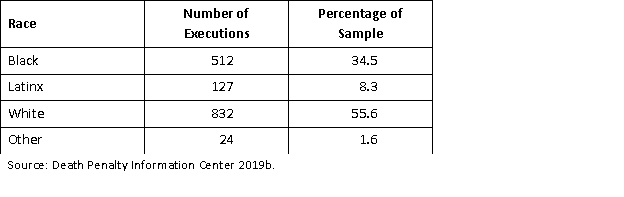
(81) 

Filters
- Essay(0)
- Multiple Choice(0)
- Short Answer(0)
- True False(0)
- Matching(0)