



 Chat with AI
Exam 13: Repeated-Measures and Two-Factor Analysis of Variance

Exam 1: Introduction to Statistics.83 Questions
Exam 2: Frequency Distributions.83 Questions
Exam 3: Central Tendency.88 Questions
Exam 4: Variability.85 Questions
Exam 5: z-Scores: Location of Scores and Standardized Distributions.86 Questions
Exam 6: Probability.84 Questions
Exam 7: Probability and Samples: The Distribution of Sample Means.84 Questions
Exam 8: Introduction to Hypothesis Testing.84 Questions
Exam 9: Introduction to the t Statistic85 Questions
Exam 10: The t Test for Two Independent Samples84 Questions
Exam 11: The t Test for Two Related Samples85 Questions
Exam 12: Introduction to Analysis of Variance84 Questions
Exam 13: Repeated-Measures and Two-Factor Analysis of Variance85 Questions
Exam 14: Correlation and Regression.85 Questions
Exam 15: The Chi-Square Statistic: Tests for Goodness of Fit and Independence84 Questions
Select questions type


A two-factor analysis of variance produces an F-ratio for factor A that has df = 3,36.This analysis is comparing three different levels of factor A.
(True/False)
4.8/5  (79)
(79) The following data represent the means for each treatment condition in a two-factor experiment.Note that one mean is not given.What value for the missing mean would result in no AxB interaction?
B1 B2

(Multiple Choice)
4.9/5 (84)
(84) The following table summarizes the results of a two-factor ANOVA evaluating an independent-measures experiment with 2 levels of factor A,3 levels of factor B,and n = 8 participants in each treatment condition.
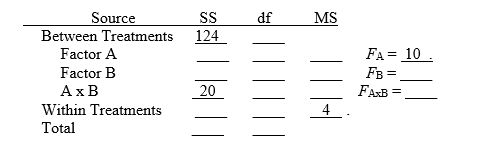 a.Fill in all missing values in the table.(Hint: start with the df column.)
b. Compute η² (the percentage of variance accounted for) for each of the main effects and for the interaction.
a.Fill in all missing values in the table.(Hint: start with the df column.)
b. Compute η² (the percentage of variance accounted for) for each of the main effects and for the interaction. (Essay)
4.9/5 (79)
(79) The repeated-measures ANOVA is a two-stage process.Which of the following accurately describes what happens during this process?
(Multiple Choice)
4.8/5 (84)
(84) 
The following data were obtained from a two-factor independent-measures experiment with n = 5 participants in each treatment condition.
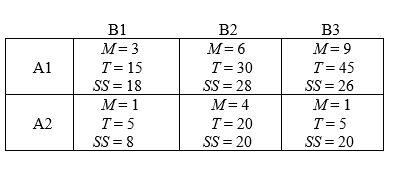 a. State the hypotheses for each of the three separate tests included in the two-factor ANOVA.
b. Calculate degrees of freedom and locate the critical region for each of the three tests.
c.Calculate the three F-ratios.
d.State a conclusion for each test.
a. State the hypotheses for each of the three separate tests included in the two-factor ANOVA.
b. Calculate degrees of freedom and locate the critical region for each of the three tests.
c.Calculate the three F-ratios.
d.State a conclusion for each test. (Essay)
4.9/5 (74)
(74) If the mean and variance are computed for each sample in an independent-measures,two-factor experiment,which of the following types of sample data will tend to produce large F-ratios for the two-factor ANOVA?
(Multiple Choice)
4.8/5 (86)
(86) The F-ratio for a repeated-measures ANOVA has df = 2,16.The research study compared 3 treatments with a sample of n = 8 participants.
(True/False)
4.8/5 (81)
(81) The following table shows the results of a repeated-measures ANOVA.Based on this table,what is the value for n²,the percentage of variance accounted for by the treatments? Source SS df MS Between 22 2 11 F=5.50 Within 58 21 Bet. Sub. 30 7 Error 28 14 2 Total 80 23
(Multiple Choice)
4.9/5 (87)
(87) A repeated-measures analysis of variance for a study comparing three treatment conditions with a sample of n = 10 participants,produces an F-ratio of F = 5.40.For this result,which of the following is the correct statistical decision?
(Multiple Choice)
4.7/5 (77)
(77) A researcher reports an F-ratio with df = 2,40 from a repeated-measures ANOVA.How many treatment conditions were compared in this experiment?
(Multiple Choice)
4.7/5 (93)
(93) For an experiment involving 2 levels of factor A and 3 levels of factor B with a sample of n = 5 in each treatment condition,what is the value for dfwᵢthᵢn?
(Multiple Choice)
4.8/5 (82)
(82) A two-factor study with two levels of factor A and three levels of factor B uses a separate group of n = 5 participants in each treatment condition.How many participants are needed for the entire study?
(Multiple Choice)
4.9/5 (83)
(83) Because the repeated-measures ANOVA removes variance caused by individual differences,it usually is more likely to detect a treatment effect than the independent-measures ANOVA is.
(True/False)
4.8/5 (83)
(83) The following table shows the results of a two-factor ANOVA.Based on this table,what is the value for  ² for factor A?
Source SS df MS Between 36 3 A 12 1 12 F=4.00 B 3 1 3 F=1.00 AxB 21 1 21 F=7.00 Within 84 28 3 Total 120 31
² for factor A?
Source SS df MS Between 36 3 A 12 1 12 F=4.00 B 3 1 3 F=1.00 AxB 21 1 21 F=7.00 Within 84 28 3 Total 120 31 (Multiple Choice)
4.8/5 (85)
(85) The analysis of total variability into between-treatments and within-treatments variability is the same for a repeated-measures ANOVA and an independent-measures ANOVA.
(True/False)
4.8/5 (77)
(77) In the second stage of the repeated-measures ANOVA,individual differences are removed from the denominator of the F-ratio.
(True/False)
4.9/5 (74)
(74) The results of a two-factor analysis of variance produce df = 2,36 for the F-ratio for factor A and df = 2,36 for the F-ratio for factor B.What are the df values for the AxB interaction?
(Multiple Choice)
4.9/5 (85)
(85) For a repeated-measures study,df between treatment= 3 and dfₜₒₜₐₗ = 27.This means that there were n = 7 participants in the study.
(True/False)
4.7/5 (78)
(78) A two-factor research study has 2 levels of factor A and three 3 of factor B with n = 8 participants in each treatment condition.For this study,what is the value for df between treatment?
(Multiple Choice)
4.9/5 (74)
(74) 
Filters
- Essay(0)
- Multiple Choice(0)
- Short Answer(0)
- True False(0)
- Matching(0)