



 Chat with AI
Exam 1: Environmental Economics and Natural Resource Management

Exam 1: Environmental Economics and Natural Resource Management51 Questions
Select questions type


Wild American ginseng roots can be sold legally if they are harvested from plants over 5 years old in appropriate places during a designated season. Poachers of American ginseng break these rules and threaten the species' existence. Possible policies to address the problem include:
A) a program that increases the supply of legal ginseng
B) a complete ban on ginseng production
C) a campaign to discourage ginseng purchases
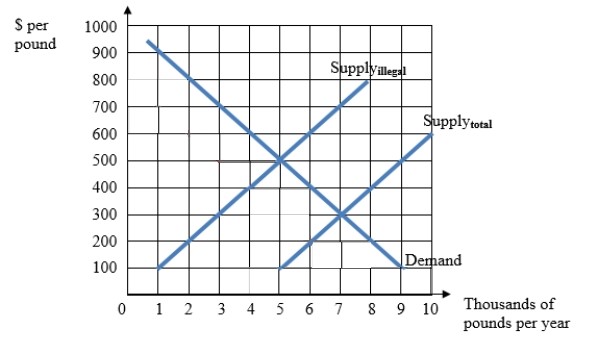
The graph below shows the illegal supply, the total (illegal plus legal) supply, and the demand for wild American ginseng. Assume that none of the policies affect the illegal supply curve.
How many thousands of pounds of illegal ginseng will be supplied per year if
a) none of the policies is implemented. _____
b) only plan (A) is implemented, and it increases the legal supply by 2 thousand pounds per year at each price but has no effect on the demand curve. _____
c) only plan (B) is implemented, which eliminates the legal supply of ginseng but has no effect on the demand curve. _____
Suppose only plan (C) is implemented. Draw the new demand curve such that the resulting quantity of illegal ginseng supplied is 2 thousand pounds per year.
(Essay)
4.8/5  (80)
(80) Which of the following is particularly vulnerable to starting-point bias?
(Multiple Choice)
4.9/5 (78)
(78) What is the optimal harvest condition for a tree? (Either version is fine.)
Explain why this equation makes sense in common sense terms
(Essay)
4.8/5 (69)
(69) The environmental Kuznets curve suggest that to reduce pollution we should
(Multiple Choice)
4.8/5 (64)
(64) a. If someone doesn't care about future generations, does this makes their rate of time preference (discount rate) higher or lower (circle one)?
b. If you are willing to accept no less than $1200 in one year in exchange for providing a loan of $1000 now, what is your discount rate? ________
c. For someone with a discount rate of 15%, what is the present value of saving wildlife that would be worth $500 million in 120 years? ________ Show your work
(Essay)
4.9/5 (85)
(85) Light, noise, and heat are provided in the reading as examples of what type of pollutant?
(Multiple Choice)
4.7/5 (79)
(79) According to the textbook, shortages, such as the shortage of food that Thomas Malthus predicted would cause starvation, can be reduced or avoided by all of the following EXCEPT
(Multiple Choice)
4.7/5 (89)
(89) Under the Gordon fisheries model, without intervention, fishers keep entering until … (you might want to draw the graph as a reminder)
(Multiple Choice)
4.8/5 (88)
(88) Market prices are more accurate measures of the value received from products when demand curves are
(Multiple Choice)
4.9/5 (75)
(75) Briefly define the following :
-precautionary polluter pays principle
(Essay)
4.8/5 (87)
(87) Briefly define each of the following terms:
-Front Page of the Newspaper Test
(Essay)
4.8/5 (73)
(73) Suppose each year of education a student receives provides $1000 worth of external benefits to society because students share their wisdom, support better policies, and serve as more productive workers. On the graph to the right, draw typical-looking curves for the private marginal benefit and the private marginal cost (just like the ones for beehives and airline flights among other goods in the textbook). Add the social marginal benefit curve as appropriate for this particular situation. Label the socially optimal quantity of years of education "Qs" and label the quantity that will actually be purchased (in the absence of government intervention) "Qp".
Using a specific number in your response, indicate one approach the government could take to achieve the socially optimal quantity of education.
(Essay)
4.9/5 (87)
(87) Suppose tourists spend $8 billion annually to visit wilderness areas in Utah. This information alone could be used to estimate the value of Utah's wilderness areas using what method?
Identify two types of value that this method fails to capture.
(Essay)
4.9/5 (82)
(82) Suppose expanded use of nuclear power would involve a 5% chance of problems causing the release of enough radiation to kill 10 people and an additional 1% chance of the release of enough radiation to kill 500 people. Assume unidentified humans such as those who might die as the result of nuclear disasters are found to be worth $9 million each. If the discount rate is zero, what is the expected value of the human loss from nuclear expansion?
Suppose instead that the discount rate is 10% and the expanded use of nuclear power would certainly kill 100 people in 20 years. What is the present value of the human loss due to nuclear expansion?
(Essay)
4.9/5 (76)
(76) 
Filters
- Essay(0)
- Multiple Choice(0)
- Short Answer(0)
- True False(0)
- Matching(0)