



 Chat with AI
Exam 1: Environmental Economics and Natural Resource Management

Exam 1: Environmental Economics and Natural Resource Management51 Questions
Select questions type


Which of these solutions to the tragedy of the commons did Hardin advocate?

Free
(Multiple Choice)
4.9/5  (72)
(72) Correct Answer: Verified
C
Recently 695 residents filed a lawsuit against a nearby slaughterhouse that sprayed wastewater on fields, allegedly tainting wells and causing illness. Suppose that, if the lawsuit continues to trial, both sides expect the residents to receive a jury award of $2 million. The additional legal fees if the case proceeds to trial will be $300,000 for the residents (the plaintiffs) and $400,000 for the slaughterhouse (the defendant). On the number line below, label and specify the dollar amount of the expected jury award (J), each side's threat point (Tp and Td), and the settlement range. Assume both sides are risk-neutral and seek to maximize their money.
a. What is the bargaining rent in this case? ______
b. If the slaughterhouse can make a credible (non-Sincerity Rule) final offer, what should it be? ______
c. If the residents make a Sincerity Rule offer, what should it be? ______
d. Identify one alternative dispute resolution technique discussed in the textbook that involves a third party who makes a binding decision.
Free
(Essay)
4.8/5 (93)
(93) Correct Answer:Verified
Verified a. $700,000
b. $1.7 million + ϵ (Where ϵ represents an arbitrarily small amount. Common acceptable answers include $1.8 million and $1,700,001.)
c. $2 million - ϵ (Where ϵ represents an arbitrarily small amount. Common acceptable answers include $1.9 million and $1,999,999.)
d. Acceptable answers: conventional arbitration, final-offer arbitration, night-time baseball arbitration, Med-Arb.
Suppose there are 1 billion tons of titanium dioxide in the world and two periods: sooner and later. What we use sooner, we can't use later. Titanium is sometimes used to build rocket ships and road bikes among other light and durable products. With Q representing the quantity of titanium used sooner, the marginal benefit (net of any costs) from titanium used sooner is MBsooner = .6 billion - Q. The (net) marginal benefit from titanium used later, MBlater, is constant at .6 billion. That is, every unit of titanium used later has a marginal benefit of .6 billion.
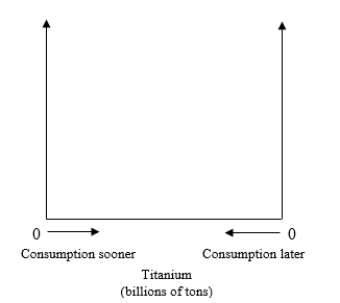 a) Illustrate this situation with a two-period model (as shown in the textbook) that includes both marginal benefit curves, labeled MBsooner and MBlater.
b) If we don't discount benefits received later, what is the dynamically efficient quantity to use sooner? _______.
c) If the present value of benefits received later is one-half of their value later, what is the dynamically efficient quantity to use in each period? Sooner ________ Later ________
d) If we have an infinite discount rate for benefits received later, what is the dynamically efficient quantity to use in each period? Sooner ________ Later ________
a) Illustrate this situation with a two-period model (as shown in the textbook) that includes both marginal benefit curves, labeled MBsooner and MBlater.
b) If we don't discount benefits received later, what is the dynamically efficient quantity to use sooner? _______.
c) If the present value of benefits received later is one-half of their value later, what is the dynamically efficient quantity to use in each period? Sooner ________ Later ________
d) If we have an infinite discount rate for benefits received later, what is the dynamically efficient quantity to use in each period? Sooner ________ Later ________Free
(Essay)
4.8/5 (81)
(81) Correct Answer:Verified
Verifieda.
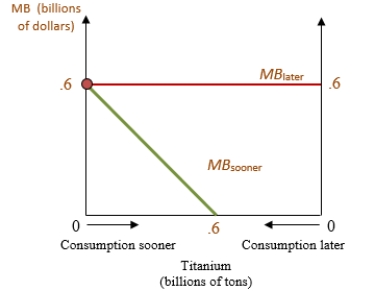 b. 0
c. Sooner 3 Later 7(Found at the intersection of MBsooner and 1/2 MBlater.)
d. Sooner 6 Later 4 (Found at the intersection of MBsooner and the infinitely discounted MBlater, which lies along the horizontal axis.)
Suppose that goldfish in the local pond live for 2 years. At the end of their first year they reproduce with a TFR of 4; in their second year they just swim around, and then die when the period is over. There are equal numbers of males and females at each goldfish age level. Indicate the total number of fish after 1 and 2 years under the following scenarios:
a) In the beginning there are 2 fish in their first year of life and none in their second year of life.
after 1 yr. _____ after 2 yrs. _____
b) In the beginning there are 10 fish in their second year of life and no fish in their first year of life.
after 1 yr. _____ after 2 yrs. _____
(Short Answer)
4.8/5 (93)
(93) The following table shows the net annual profits (in millions of dollars) for two clothing companies, Street 21 and American Beagle, depending on whether they choose to make their jeans with organic cotton or cotton grown using pesticides. Within each square, the number on the left indicates Street 21's profit and the number on the right represents American Beagle's profit.
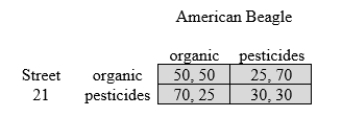 -the firms could not trust each other enough to collude, is there a dominant strategy for either or both firms? If so, what it is?
American Beagle:
Street 21:
-the firms could not trust each other enough to collude, is there a dominant strategy for either or both firms? If so, what it is?
American Beagle:
Street 21: (Essay)
4.9/5 (84)
(84) Your roommate wants you to be happy, but not too happy, which would make your roommate jealous. If you have 0 utils, your roommate feels bad for you and has 0 utils. For the 1st 6 utils you gain, your roommate gains 1 util for every 2 that you gain. After that, more utils for you make your roommate resentful and less happy. Your roommate losses 1 util for every 2 utils you gain beyond 6. Draw a utility distribution curve by plotting the relationships described above. Label the points representing the Rawlsian, utilitarian, and egalitarian solutions "R," "U," and "E," respectively. The dotted 45-degree line and numbers are provided as guides that you might find useful. 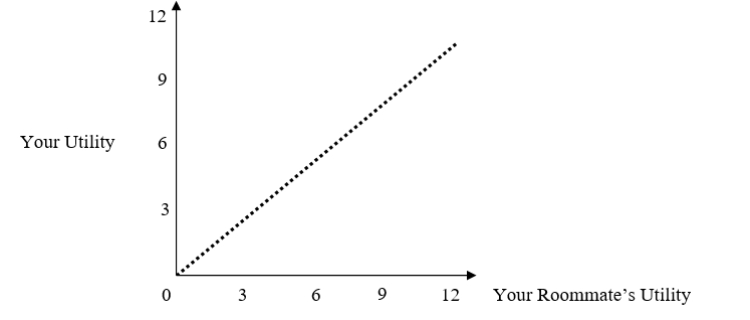
(Essay)
4.8/5 (85)
(85) Suppose Appalachia has 200 tons of coal to allocate between this period and next period. The net marginal benefit curve for coal this period is a straight line with a vertical intercept of 200 and a horizontal intercept of 200. The net marginal benefit curve for coal next period is a straight line with a vertical intercept of 200 and a horizontal intercept of 100.
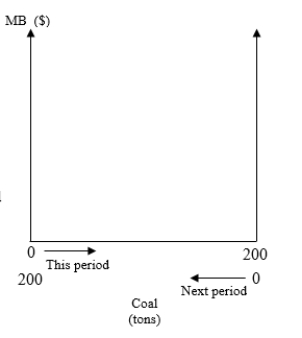 a) Draw the net MB curves for each period on the graph.
b) If the discount rate for benefits next period is infinity, what is the dynamically efficient quantity of coal to use in the present period? ______
c) Use a dotted line to draw the discounted net marginal benefit curve if the discount rate for benefits next period is 300%.
d) Assuming the discount rate for future benefits is 300%, label the dynamically efficient quantity of coal to use this period as Q1.
a) Draw the net MB curves for each period on the graph.
b) If the discount rate for benefits next period is infinity, what is the dynamically efficient quantity of coal to use in the present period? ______
c) Use a dotted line to draw the discounted net marginal benefit curve if the discount rate for benefits next period is 300%.
d) Assuming the discount rate for future benefits is 300%, label the dynamically efficient quantity of coal to use this period as Q1. (Essay)
4.8/5 (82)
(82) 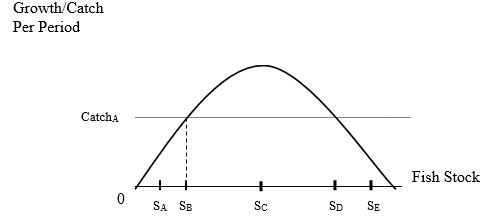 -Consider a fishery with annual growth as shown by the curved line in the figure. For each of the five possible starting stock levels, indicate what the fish stock level would be in the long run (that is, after many periods) if there were a continued annual catch of CatchA.
SA : , SB : , SC : , SD : , SE :
-Consider a fishery with annual growth as shown by the curved line in the figure. For each of the five possible starting stock levels, indicate what the fish stock level would be in the long run (that is, after many periods) if there were a continued annual catch of CatchA.
SA : , SB : , SC : , SD : , SE : (Essay)
4.9/5 (70)
(70) The following table shows the net annual profits (in millions of dollars) for two clothing companies, Street 21 and American Beagle, depending on whether they choose to make their jeans with organic cotton or cotton grown using pesticides. Within each square, the number on the left indicates Street 21's profit and the number on the right represents American Beagle's profit.
-the firms could cooperate on their strategy selection, trust each other, and divide their combined profits equally, what set of strategies would they choose?
American Beagle:
Street 21:
-the firms could cooperate on their strategy selection, trust each other, and divide their combined profits equally, what set of strategies would they choose?
American Beagle:
Street 21: (Essay)
4.8/5 (77)
(77) Identify a specific method described in the textbook other than the CVM for placing a value on each of the following assets and briefly describe how exactly the value would be obtained using that method. Do not apply the same method more than once.
a) A national park Method: __________________
b) Safe tap water Method: __________________
c) Human life Method: __________________
(Essay)
4.9/5 (87)
(87) Which of the following is the most likely to prevent Coasian solutions from solving externality problems?
(Multiple Choice)
4.7/5 (72)
(72) Suppose you own a t-shirt factory that can save money by illegally dumping dye into a nearby river rather than disposing of it safely. If you illegally dump the dye, there is a 10% chance that it will cause minor environmental damage for which you will have to pay a $10 million fine. There is also a 15% chance that it will cause health damage to citizens for which you will have to pay a $100 million fine.
a. What is the expected value of the amount you will have to pay in fines? ________
Show your work.
b. If you would be willing to pay $20 million for insurance that would cover the cost of these fines if imposed, what is your risk burden associated with illegal dumping? _________
c. Is this firm risk loving, risk neutral, or risk averse (circle one).
(Essay)
4.8/5 (65)
(65) Suppose Kevin and Sara are the only inhabitants of an island with no butterfly species. Butterfly species are a public good that can be purchased for the island. Kevin would pay up to $90 for the first butterfly species, $40 for the second butterfly species, and nothing for any additional butterfly species. Sara would pay up to $60 for each butterfly species up to a quantity of five.
On the graphs below, draw the demand curves for butterfly species for Kevin, Sara, and the market. Label each axis and the (specific numerical) height of each demand curve for each quantity up to 5 butterfly species.
If butterfly species cost $95 each, what is the socially optimal quantity of butterfly species? __________
(Essay)
4.8/5 (69)
(69) Command-and-control environmental policies differ from market-based environmental policies.
a. What is one distinguishing characteristic of command-and-control environmental policies?
b. Provide one example of a command-and-control policy.
c. What is one distinguishing characteristic of market-based environmental policies.
d. Provide one example of a market-based policy.
(Essay)
4.9/5 (84)
(84) 
Filters
- Essay(0)
- Multiple Choice(0)
- Short Answer(0)
- True False(0)
- Matching(0)