



 Chat with AI
Exam 10: Bivariate Measures of Association

Exam 1: Introduction9 Questions
Exam 2: Data Representation7 Questions
Exam 3: Univariate Population Parameters and Sample Statistics8 Questions
Exam 4: The Normal Distribution and Standard Scores5 Questions
Exam 5: Introduction to Probability and Sample Statistics4 Questions
Exam 6: Introduction to Hypothesis Testing: Inferences About a Single Mean7 Questions
Exam 7: Inferences About the Difference Between Two Means7 Questions
Exam 8: Inferences About Proportions6 Questions
Exam 9: Inferences About Variances8 Questions
Exam 10: Bivariate Measures of Association5 Questions
Exam 11: One-Factor Anova: Fixed-Effects Mode8 Questions
Exam 12: Multiple Comparison Procedures13 Questions
Exam 13: Factorial Anova: Fixed-Effects Mode16 Questions
Exam 14: One Factor Fixed-Effects Ancova With Single Covariate19 Questions
Exam 15: Random- and Mixed-Effects Analysis of Variance Models7 Questions
Exam 16: Hierarchical and Randomized Block Analysis of Variance Models12 Questions
Exam 17: Simple Linear Regression8 Questions
Exam 18: Multiple Linear Regression10 Questions
Exam 19: Logistic Regression15 Questions
Exam 20: Mediation and Moderation33 Questions
Select questions type


You are given the following pairs of sample scores on X and Y. Determine the Pearson correlation coefficient using SPSS.
X Y 20 400 30 300 25 250 40 500 50 100

Free
(Essay)
4.9/5  (78)
(78) Correct Answer: Verified
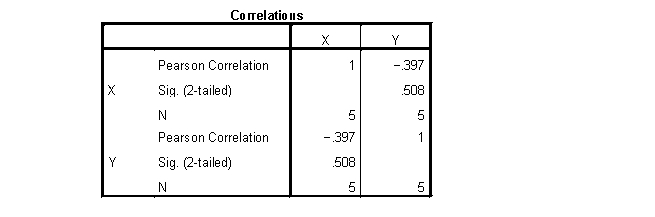
 You are given the following pairs of sample scores on X and Y. Determine the Pearson correlation coefficient using SPSS.
Using SPSS, we compute the Pearson correlation to be ?.397.
The rank biserial is a variation of which of the following correlation coefficients?
Free
(Multiple Choice)
4.8/5 (75)
(75) Correct Answer:Verified
VerifiedE
You are given the following pairs of sample scores on X and Y. Determine the Pearson correlation coefficient.
X Y 8 7 6 6 6 8 9 6 1 5
Free
(Essay)
4.9/5 (87)
(87) Correct Answer:Verified
Verified You are given the following pairs of sample scores on X and Y. Determine the Pearson correlation coefficient.
The Pearson product-moment correlation coefficient is computed as follows.
A researcher has three variables and is computing three correlation coefficient hypothesis tests using those variables. The researcher was originally testing at an alpha of .05. If the researcher makes a Bonferroni adjustment, what will the alpha level be? Round to three decimal places.
(Multiple Choice)
4.9/5 (78)
(78) A researcher has five variables and is computing ten correlation coefficient hypothesis tests using those variables. The researcher was originally testing at an alpha of .05. If the researcher makes a Bonferroni adjustment, what will the alpha level be? Round to three decimal places.
(Multiple Choice)
4.8/5 (79)
(79) 
Filters
- Essay(0)
- Multiple Choice(0)
- Short Answer(0)
- True False(0)
- Matching(0)