



 Chat with AI
Exam 7: Inferences About the Difference Between Two Means

Exam 1: Introduction9 Questions
Exam 2: Data Representation7 Questions
Exam 3: Univariate Population Parameters and Sample Statistics8 Questions
Exam 4: The Normal Distribution and Standard Scores5 Questions
Exam 5: Introduction to Probability and Sample Statistics4 Questions
Exam 6: Introduction to Hypothesis Testing: Inferences About a Single Mean7 Questions
Exam 7: Inferences About the Difference Between Two Means7 Questions
Exam 8: Inferences About Proportions6 Questions
Exam 9: Inferences About Variances8 Questions
Exam 10: Bivariate Measures of Association5 Questions
Exam 11: One-Factor Anova: Fixed-Effects Mode8 Questions
Exam 12: Multiple Comparison Procedures13 Questions
Exam 13: Factorial Anova: Fixed-Effects Mode16 Questions
Exam 14: One Factor Fixed-Effects Ancova With Single Covariate19 Questions
Exam 15: Random- and Mixed-Effects Analysis of Variance Models7 Questions
Exam 16: Hierarchical and Randomized Block Analysis of Variance Models12 Questions
Exam 17: Simple Linear Regression8 Questions
Exam 18: Multiple Linear Regression10 Questions
Exam 19: Logistic Regression15 Questions
Exam 20: Mediation and Moderation33 Questions
Select questions type


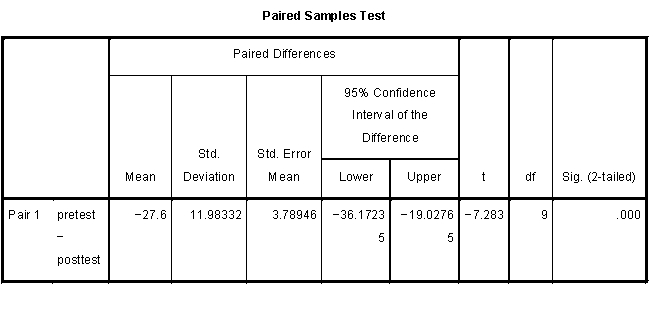
Review the following SPSS output. Interpret the output including identifying the specific statistical procedure that has been used and reporting the extent to which the test is statistically significant. Include appropriate evidence (e.g., test statistic value, degrees of freedom, and p value).

Free
(Essay)
4.8/5  (79)
(79) Correct Answer: Verified
A dependent t test (i.e., paired samples test) was conducted. The test is statistically significant, t = -7.283, df = 9, p = .000.
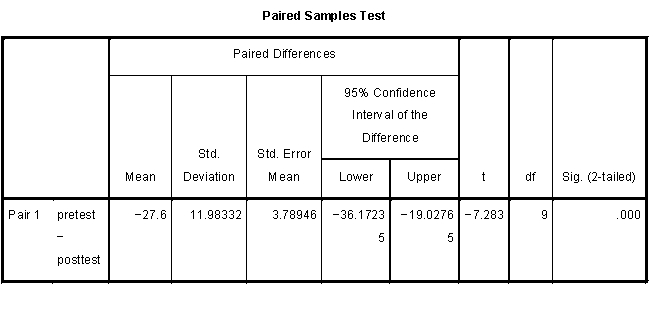
Calculate and interpret Cohen's d using the following output.
Free
(Essay)
4.8/5 (95)
(95) Correct Answer:Verified
Verified The effect size is computed to be the following:
which is interpreted as there is approximately two and one-third standard deviation unit difference between the pretest and posttest means (with the posttest having the larger mean), a very large effect size according to Cohen's subjective standard.
A researcher randomly assigns individuals to two groups, one in which calming instrumental music is played softly and another in which no music is played. The researcher collects time on task, measured in minutes. The research question is: Is there a greater average time on task for individuals who had music as compared to individuals who did not have music? Which one of the following represents how the ALTERNATIVE hypothesis will be written?
Free
(Multiple Choice)
5.0/5 (87)
(87) Correct Answer:Verified
VerifiedD
A researcher randomly assigns individuals to two groups, one in which calming instrumental music is played softly and another in which no music is played. The researcher collects time on task, measured in minutes. The research question is: Is there a greater average time on task for individuals who had music as compared to individuals who did not have music? Which one of the following represents how the NULL hypothesis will be written?
(Multiple Choice)
4.8/5 (71)
(71) A research article reports the following for an independent t test: = .05, t (6) = −4.40, p .005, d = −3.11. Which of the following reflects the interpretation for the hypothesis test?
(Multiple Choice)
4.7/5 (77)
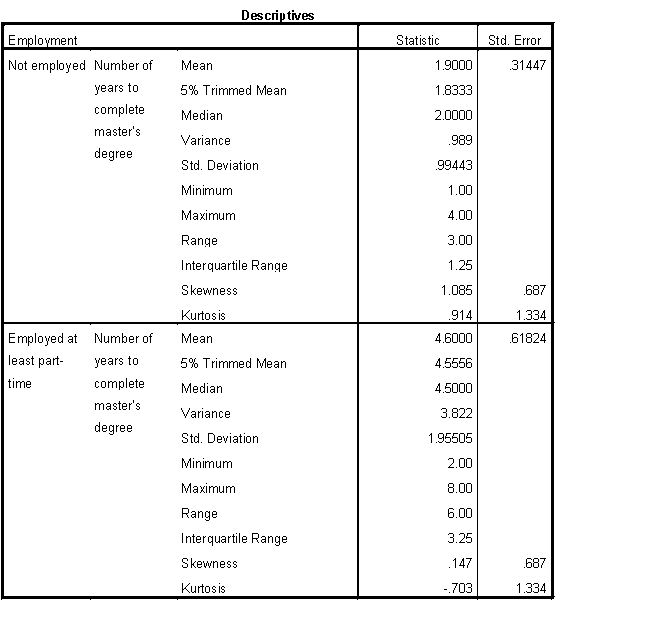
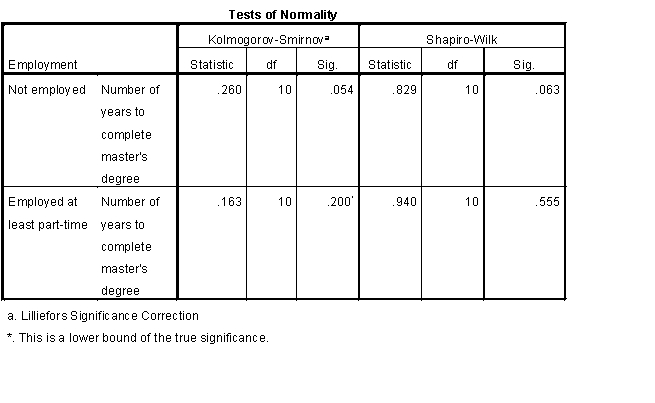
(77) Interpret the following SPSS output in terms of the extent to which the assumption of normality has been met. Include appropriate evidence (e.g., statistical values from the output).
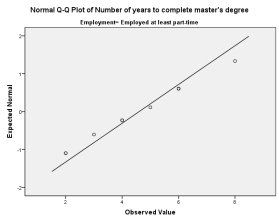
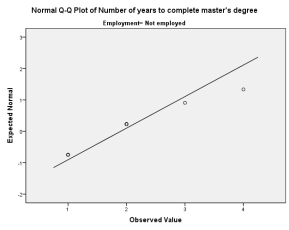
(Essay)
4.9/5 (76)
(76) Review the following SPSS output. Interpret the output including identifying the specific statistical procedure that has been used and reporting the extent to which the test is statistically significant. Include appropriate evidence (e.g., values from the output).
t-test for Equality of M eans 95\% Confidence Interval of the Difference Sig. Mean Std. Error t (2-tailed) Difference Difference Lower Upper Years to Equal complete variances master's assumed -3.893 18 .001 -2.7 .69362 -4.15725 -1.24275
(Essay)
4.8/5 (81)
(81) 
Filters
- Essay(0)
- Multiple Choice(0)
- Short Answer(0)
- True False(0)
- Matching(0)