



 Chat with AI
Exam 18: International Finance.

Exam 1: The Art and Science of Economic Analysis.203 Questions
Exam 2: Economic Tools and Economic Systems.209 Questions
Exam 3: Economic Decision Makers.225 Questions
Exam 4: Demand, Supply, and Markets.205 Questions
Exam 5: Introduction to Macroeconomics.201 Questions
Exam 6: Tracking the U. S. Economy.211 Questions
Exam 7: Unemployment and Inflation.199 Questions
Exam 8: Productivity and Growth.200 Questions
Exam 9: Aggregate Demand.200 Questions
Exam 10: Aggregate Supply.202 Questions
Exam 11: Fiscal Policy.202 Questions
Exam 12: Federal Budgets and Public Policy.203 Questions
Exam 13: Money and the Financial System.201 Questions
Exam 14: Banking and the Money Supply.200 Questions
Exam 15: Monetary Theory and Policy.200 Questions
Exam 16: Macro Policy Debate: Active or Passive?198 Questions
Exam 17: International Trade.200 Questions
Exam 18: International Finance.195 Questions
Exam 19: Economic Development.200 Questions
Select questions type


Any increase in the supply for foreign exchange, other things constant, will _____
(Multiple Choice)
4.9/5  (77)
(77) Table 18.a
Table 18.a Current Account (\ ) Merchandise exports 500 Merchandise imports 200 Merchandise trade balance Service exports 400 Service imports 600 Goods and services balance Net investment income from abroad 50 Net unilateral transfers -90 Current account balance
-Refer to Table 18.a, which shows a balance-of-payments account. What is the current account balance?
(Multiple Choice)
4.8/5 (83)
(83) In 2016, the U.S. merchandise trade deficit with Canada was _____
(Multiple Choice)
4.8/5 (70)
(70) Suppose a basket of goods costs $400 in the United States and £200 in Britain. If the exchange rate is $1 per pound, which of the following statements is true according to the purchasing power parity theory?
(Multiple Choice)
4.8/5 (74)
(74) If the exchange rate changes from 75 cents per euro to $1 per euro, the euro has _____
(Multiple Choice)
5.0/5 (93)
(93) Which of the following is a credit item in the U.S. balance of payments?
(Multiple Choice)
4.8/5 (91)
(91) Which of the following is true about the U.S. trade balance during the 1960s?
(Multiple Choice)
4.8/5 (70)
(70) The theory of _____ states that changes in the exchange rate reflect only changes in the price levels of two countries.
(Multiple Choice)
4.8/5 (74)
(74) In the balance-of-payments account, the receipts from the rest of the world are entered as _____.
(Multiple Choice)
4.7/5 (76)
(76) The balance of payments always balances because each of the specific accounts must, by definition, be in balance.
(True/False)
4.8/5 (81)
(81) A more descriptive phrase for the balance-of-payments account would be _____
(Multiple Choice)
4.9/5 (67)
(67) Exhibit 18.1
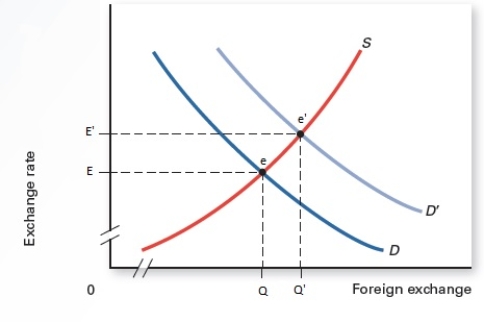 -Refer to Exhibit 18.1. A shift of the demand curve from D to D' will _____
 (Multiple Choice)
4.8/5 (88)
(88) Under the gold standard, each country had little control over its own monetary policies.
(True/False)
4.9/5 (76)
(76) Which of the following best describes the circumstances surrounding the breakdown of the Bretton Woods system?
(Multiple Choice)
4.8/5 (90)
(90) 
Filters
- Essay(0)
- Multiple Choice(0)
- Short Answer(0)
- True False(0)
- Matching(0)