



 Chat with AI
Exam 2: Economic Tools and Economic Systems.

Exam 1: The Art and Science of Economic Analysis.203 Questions
Exam 2: Economic Tools and Economic Systems.209 Questions
Exam 3: Economic Decision Makers.225 Questions
Exam 4: Demand, Supply, and Markets.205 Questions
Exam 5: Introduction to Macroeconomics.201 Questions
Exam 6: Tracking the U. S. Economy.211 Questions
Exam 7: Unemployment and Inflation.199 Questions
Exam 8: Productivity and Growth.200 Questions
Exam 9: Aggregate Demand.200 Questions
Exam 10: Aggregate Supply.202 Questions
Exam 11: Fiscal Policy.202 Questions
Exam 12: Federal Budgets and Public Policy.203 Questions
Exam 13: Money and the Financial System.201 Questions
Exam 14: Banking and the Money Supply.200 Questions
Exam 15: Monetary Theory and Policy.200 Questions
Exam 16: Macro Policy Debate: Active or Passive?198 Questions
Exam 17: International Trade.200 Questions
Exam 18: International Finance.195 Questions
Exam 19: Economic Development.200 Questions
Select questions type


If all resources are used efficiently to produce goods and services, a nation will find itself producing _____
(Multiple Choice)
5.0/5  (74)
(74) Which system is characterized by the private ownership of some resources and the public ownership of other resources and where some markets are regulated by government?
(Multiple Choice)
4.9/5 (86)
(86) Bill trades a gingersnap for a chocolate chip cookie. This is an example of _____
(Multiple Choice)
4.9/5 (73)
(73) A cost that has already been incurred and cannot be recovered is known as a(n)_____
(Multiple Choice)
4.8/5 (71)
(71) A curve showing alternative combinations of goods that can be produced when available resources are used efficiently is known as the _____
(Multiple Choice)
4.7/5 (84)
(84) Exhibit 2.1
 -Refer to Exhibit 2.1, which shows the production for rice and t-shirts for two countries: Costa Rica and the United States. Assume exactly country produces half of its total production in each good and they are the only producers of T-shirts and rice. What is the total production of T-shirts and rice?
 (Multiple Choice)
4.8/5 (74)
(74) The bowed-out shape of the production possibilities frontier indicates increasing opportunity costs.
(True/False)
4.9/5 (83)
(83) Janis mows a lawn in 1 hour and types a paper in 1 hour. Kristen mows a lawn in 2 hours and types a paper in 1 hour. Which of the following statements is true?
(Multiple Choice)
4.8/5 (78)
(78) Hans can do 4 loads of laundry and type 6 pages per hour. Heidi can do 12 loads of laundry and type 8 pages per hour. Heidi's opportunity cost of doing one load of laundry is _____
(Multiple Choice)
4.9/5 (91)
(91) A system characterized by the private ownership of some resources and the public ownership of other resources and where some markets are regulated by government is known as a(n)_____.
(Multiple Choice)
4.9/5 (83)
(83) Exhibit 2.2
 -Refer to Exhibit 2.2, which shows the production possibilities frontier for Good A and Good B. Point e represents _____
 (Multiple Choice)
4.8/5 (79)
(79) The law of comparative advantage says that a person should produce a good if he or she _____
(Multiple Choice)
4.9/5 (73)
(73) Exhibit 2.4
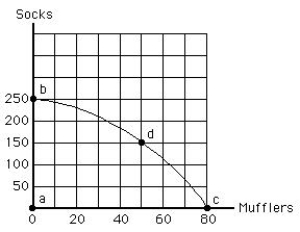 -Refer to Exhibit 2.4, which shows the production possibilities frontier for mufflers and socks. The opportunity cost of moving from point b to d is _____
 (Multiple Choice)
4.8/5 (74)
(74) Which of the following is an example of the division of labor?
(Multiple Choice)
4.8/5 (71)
(71) The ability to make something using fewer resources than other producers use is known as _____
(Multiple Choice)
4.9/5 (79)
(79) If labor in the United States is more productive than England, then _____
(Multiple Choice)
4.8/5 (79)
(79) 
Filters
- Essay(0)
- Multiple Choice(0)
- Short Answer(0)
- True False(0)
- Matching(0)