



 Chat with AI
Exam 8: The Sun

Exam 1: The Night Sky88 Questions
Exam 2: Light and Telescopes111 Questions
Exam 3: The Solar System109 Questions
Exam 4: Earth and Its Moon108 Questions
Exam 5: The Eight Planets112 Questions
Exam 6: Small Bodies in the Solar System108 Questions
Exam 7: Formation of Planetary Systems84 Questions
Exam 8: The Sun95 Questions
Exam 9: Measuring the Stars86 Questions
Exam 10: Star Formation and Evolution85 Questions
Exam 11: Stellar Explosions101 Questions
Exam 12: Black Holes77 Questions
Exam 13: The Milky Way Galaxy82 Questions
Exam 14: Galaxies98 Questions
Exam 15: Cosmology and the Universe98 Questions
Select questions type


The numbers of sunspots and their activity peak about every
(Multiple Choice)
4.8/5  (73)
(73) The percentage (by number of atoms) of the Sun that is hydrogen is about
(Multiple Choice)
4.9/5 (74)
(74) Energy produced in the solar core is transferred by ________ until it reaches a point about 500,000 km from the center.
(Short Answer)
4.8/5 (76)
(76) A solar flare creates a radio disturbance on Earth a few minutes after going off and again several days later. Explain.
(Essay)
4.8/5 (73)
(73) Describe the method of energy production in the Sun. What is the fuel? What is the end product? What kind of interactions occur? What is the role of temperature in the process? Could we use this process to produce energy on Earth?
(Essay)
4.9/5 (72)
(72) 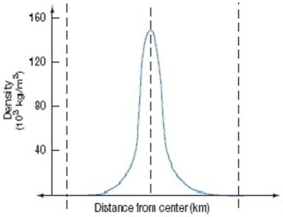 -The above diagram indicates that
The solar corona produces a lot more X-rays than it does visible light.
(True/False)
4.8/5 (84)
(84) What natural barrier tries to prevent two protons from combining?
(Multiple Choice)
4.8/5 (84)
(84) Loops of glowing hydrogen seen hanging over the solar limb during totality are
(Multiple Choice)
5.0/5 (73)
(73) The critical temperature the core must reach for a star to shine by fusion is
(Multiple Choice)
4.9/5 (78)
(78) The area in the Sun's atmosphere located above the chromosphere (1,500 - 10,000 km) where the temperature rises dramatically is called the
(Multiple Choice)
4.8/5 (96)
(96) The sunspot cycle is sometimes described as lasting 11 years, but others prefer to consider it as 22 years; explain the rationale.
(Essay)
4.8/5 (87)
(87) The solar corona is much cooler than the Sun's surface; hence we must wait for a total solar eclipse to glimpse it with the naked eye.
(True/False)
4.9/5 (66)
(66) 
Filters
- Essay(0)
- Multiple Choice(0)
- Short Answer(0)
- True False(0)
- Matching(0)