



 Chat with AI
Exam 1: The Night Sky

Exam 1: The Night Sky88 Questions
Exam 2: Light and Telescopes111 Questions
Exam 3: The Solar System109 Questions
Exam 4: Earth and Its Moon108 Questions
Exam 5: The Eight Planets112 Questions
Exam 6: Small Bodies in the Solar System108 Questions
Exam 7: Formation of Planetary Systems84 Questions
Exam 8: The Sun95 Questions
Exam 9: Measuring the Stars86 Questions
Exam 10: Star Formation and Evolution85 Questions
Exam 11: Stellar Explosions101 Questions
Exam 12: Black Holes77 Questions
Exam 13: The Milky Way Galaxy82 Questions
Exam 14: Galaxies98 Questions
Exam 15: Cosmology and the Universe98 Questions
Select questions type


Only at the equator are all the stars visible over the course of the year.
(True/False)
4.8/5  (82)
(82) While watching a star, you see it moves 15 degrees across the sky. How long have you been watching it?
(Multiple Choice)
4.9/5 (84)
(84) What is the significance of the zodiacal signs, and why can all twelve not be seen on a given night?
(Essay)
4.9/5 (87)
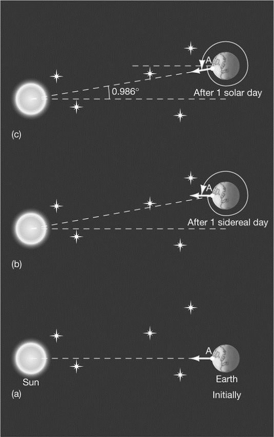
(87) The four extra minutes in the solar day are due to our ________ around the Sun.
(Short Answer)
4.8/5 (83)
(83) 
Why can many more people witness a total lunar eclipse than a total solar eclipse?
(Essay)
4.8/5 (90)
(90) Which of the choices below correctly lists things in order from largest to smallest?
(Multiple Choice)
4.9/5 (77)
(77) The ________ is the totality of all space, time, matter, and energy.
(Short Answer)
5.0/5 (78)
(78) What conditions are necessary for an annular solar eclipse?
(Multiple Choice)
4.8/5 (80)
(80) Which of the following can be described as the totality of all space, time, matter, and energy?
(Multiple Choice)
4.8/5 (75)
(75) Why are summers hotter than winters? Relate this to the Sun's position in the celestial sphere and the length of the days.
(Essay)
4.9/5 (100)
(100) 
Filters
- Essay(0)
- Multiple Choice(0)
- Short Answer(0)
- True False(0)
- Matching(0)