



 Chat with AI
Exam 6: Designing Organizations for the International Environment

Exam 1: Organizations and Organizational Theory81 Questions
Exam 2: Strategy, Organizational Design, and Effectiveness81 Questions
Exam 3: Fundamentals of Organizational Structure68 Questions
Exam 4: The External Environment80 Questions
Exam 5: Interorganizational Relationships73 Questions
Exam 6: Designing Organizations for the International Environment79 Questions
Exam 7: Manufacturing and Service Technologies81 Questions
Exam 8: Information Technology and Control72 Questions
Exam 9: Organization Size, Life Cycle, and Decline74 Questions
Exam 10: Organizational Culture and Ethical Values73 Questions
Exam 11: Innovation and Change75 Questions
Exam 12: Decision-Making Processes73 Questions
Exam 13: Conflict, Power, and Politics74 Questions
Select questions type


Discuss the global geographical structure.

Free
(Essay)
4.9/5  (87)
(87) Correct Answer: Verified
The global geographical structure divides the world into geographical regions, with each geographical region reporting directly to the CEO. Each region has complete control of the functional activities in its region.
Compare and contrast the global product division structure and global matrix structure.
Free
(Essay)
4.9/5 (81)
(81) Correct Answer:Verified
Verified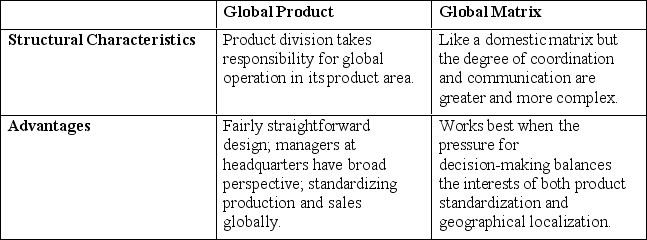
The most advanced and competitive use of global teams involves simultaneous contributions in three strategic areas. List these three areas.
Free
(Essay)
4.9/5 (92)
(92) Correct Answer:Verified
VerifiedFirst, global teams help companies address the differentiation challenge. Second, teams provide the necessary integration. Third, they contribute to learning and knowledge transfer and adaptation on a global level.
Select any organization with which you are familiar-your college or university, the car dealership down the road, an organization where you work, etc. Analyze the global forces that influence the organization you selected. How should the organization respond to those global forces in order to gain international competitive advantage?
(Essay)
4.8/5 (71)
(71)  -Refer to Chart 6.1. Which structure is shown?
Which factor motivates companies to expand internationally and is related to labour and raw materials?
(Multiple Choice)
4.9/5 (81)
(81) The global product structure works best when pressure for decision-making balances the interests of both product standardization and geographical localization, and when coordination to share resources is important.
(True/False)
4.9/5 (85)
(85) High uncertainty avoidance means that people accept inequality in power among institutions, organizations, and people.
(True/False)
4.8/5 (98)
(98) What are the international strategic alliances that companies can choose from to expand globally? Discuss and give an example of each.
(Essay)
4.7/5 (72)
(72) Case 6.0
It was reported in the Wall Street Journal that Ford Motor Co. was reorganizing to place its functions such as product development, sales, and engine/transmissions under their own executives with global authority. Alexander Trotman, chairman and CEO, wanted to create a structure that would avoid costly duplication in different parts of the world and that would foster Ford's development of models such as its Mondeo (Europe) and Contour (U.S.), which could sell worldwide with few modifications. Trotman wanted a company that was strong internationally in product development, manufacturing, and purchasing and that could take advantage of Ford's geographical strengths throughout the world.
The company had been organized geographically into three relatively independent divisions-Ford North America, Ford of Europe, and Ford Asia/Pacific. The new products cited above, Mondeo and Contour, sapped $6 billion in development costs because of expensive coordination time between the sometimes-conflicting European and North American divisions. Elimination of duplication was a goal of the new structure.
Simultaneously a new "program team facility" was being constructed so that all of Ford's new product development would be by teams. The new coupe Mustang was born from an experimental cross-functional team that designed the product in less than three years compared to Ford's normal four-to-five-year development cycle. Trotman emphasized that he wanted to change the process, not just the structure, by which new products were developed. Ford apparently found the team process convincing because the Mustang was developed on a budget about 30% lower than budgets for comparable projects.
SOURCE: Summarized from "Ford to Realign with a System of Global Chiefs," The Wall Street Journal, March 31, 1994, pp. A3-A4.
-Refer to Case 6.0. What sort of structure was Ford using before the proposed change?
(Essay)
4.8/5 (84)
(84) When should a company begin using an international division? What problems are likely to be solved by adopting this structure? As the company progresses in its international development, what problems will likely not be solved by this structure?
(Essay)
4.9/5 (83)
(83) In the third stage (multinational stage) of international development, a company typically shifts its interest from domestic activity to exporting.
(True/False)
4.9/5 (74)
(74) The transnational model reflects the ultimate in both organizational complexity, with many diverse units, and organizational coordination, with mechanisms for integrating the varied parts.
(True/False)
4.8/5 (83)
(83) With a global geographical structure, each division's manager is responsible for planning, organizing, and controlling all functions for the production and distribution of its products for any market around the world.
(True/False)
4.8/5 (86)
(86) Why are global companies sometimes described as stateless corporations?
(Essay)
4.9/5 (80)
(80) Chart 6.2
 -Refer to Chart 6.2. How would you relate the structure diagrammed in organizational chart 6.2 to a global geographic structure?
 (Multiple Choice)
4.9/5 (74)
(74) Functional managers coordinate across functions, whereas country managers coordinate among countries.
(True/False)
4.8/5 (96)
(96) Case 6.0
It was reported in the Wall Street Journal that Ford Motor Co. was reorganizing to place its functions such as product development, sales, and engine/transmissions under their own executives with global authority. Alexander Trotman, chairman and CEO, wanted to create a structure that would avoid costly duplication in different parts of the world and that would foster Ford's development of models such as its Mondeo (Europe) and Contour (U.S.), which could sell worldwide with few modifications. Trotman wanted a company that was strong internationally in product development, manufacturing, and purchasing and that could take advantage of Ford's geographical strengths throughout the world.
The company had been organized geographically into three relatively independent divisions-Ford North America, Ford of Europe, and Ford Asia/Pacific. The new products cited above, Mondeo and Contour, sapped $6 billion in development costs because of expensive coordination time between the sometimes-conflicting European and North American divisions. Elimination of duplication was a goal of the new structure.
Simultaneously a new "program team facility" was being constructed so that all of Ford's new product development would be by teams. The new coupe Mustang was born from an experimental cross-functional team that designed the product in less than three years compared to Ford's normal four-to-five-year development cycle. Trotman emphasized that he wanted to change the process, not just the structure, by which new products were developed. Ford apparently found the team process convincing because the Mustang was developed on a budget about 30% lower than budgets for comparable projects.
SOURCE: Summarized from "Ford to Realign with a System of Global Chiefs," The Wall Street Journal, March 31, 1994, pp. A3-A4.
-Refer to Case 6.0. Describe how Ford's proposed structural changes are different from the usual progression through the stages resulting from international development. Describe how Ford's proposed structural changes parallel the new designs for domestic and global advantage.
(Essay)
4.7/5 (73)
(73) 
Filters
- Essay(0)
- Multiple Choice(0)
- Short Answer(0)
- True False(0)
- Matching(0)