



 Chat with AI
Exam 16: Macroeconomic policy I: monetary policy

Exam 1: Thinking like an economist89 Questions
Exam 2: Production possibilities and opportunity cost123 Questions
Exam 3: Market demand and supply123 Questions
Exam 4: Markets in action123 Questions
Exam 5: Elasticity of demand and supply124 Questions
Exam 6: Production costs123 Questions
Exam 7: Perfect competition125 Questions
Exam 8: Monopoly123 Questions
Exam 9: Monopolistic competition and oligopoly124 Questions
Exam 10: Policy issues: resource taxes and climate change124 Questions
Exam 11: Measuring the size of the economy124 Questions
Exam 12: Business cycles and economic growth124 Questions
Exam 13: Inflation and unemployment121 Questions
Exam 14: A simple model of the macro economy134 Questions
Exam 15: The monetary and financial system124 Questions
Exam 16: Macroeconomic policy I: monetary policy124 Questions
Exam 17: Macroeconomic policy II: fiscal policy123 Questions
Exam 18: International trade and finance133 Questions
Exam 19: Applying graphs to economics37 Questions
Select questions type


With a floating exchange rate,intervention in the FOREX market is usually known as:
(Multiple Choice)
4.9/5  (66)
(66) The policy effectiveness lag refers to the time it takes for:
(Multiple Choice)
4.7/5 (83)
(83) According to the quantity theory of money,if M = 200,P = 1000 and real output of goods and services is 100,then velocity is:
(Multiple Choice)
4.7/5 (68)
(68) The time taken to decide on an appropriate policy response is known as the:
(Multiple Choice)
4.9/5 (86)
(86) If the RBA decides to leave the cash rate unchanged,then it will:
(Multiple Choice)
4.8/5 (70)
(70) Exhibit 16-1
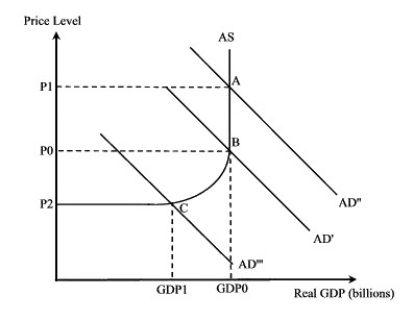 -According to Exhibit 16-1,if the economy is currently operating at point C,the RBA is likely to:
 (Multiple Choice)
4.7/5 (91)
(91) Which of the following is a reason for the Keynesian view that monetary policy plays a minor role in affecting the economy?
(Multiple Choice)
4.9/5 (93)
(93) When the velocity of money is unstable,a rules-based approach to monetary policy is likely to be extremely effective.
(True/False)
5.0/5 (78)
(78) If the velocity of money is constant then the money supply will also be constant.
(True/False)
4.9/5 (71)
(71) The 'conditional-projections' for the growth of the monetary aggregate,M3,were conditional because:
(Multiple Choice)
4.9/5 (82)
(82) If the money supply = $100 billion,nominal GDP = $400 billion and real GDP = $200 billion,then the velocity of money is:
(Multiple Choice)
4.9/5 (80)
(80) Since the Australian dollar was floated in 1983,the RBA has:
(Multiple Choice)
4.9/5 (79)
(79) Since classical economists and monetarists believe that the economy operates at full employment,real GDP,that is,along the vertical segment of aggregate supply,then:
(Multiple Choice)
4.9/5 (87)
(87) 
Filters
- Essay(0)
- Multiple Choice(0)
- Short Answer(0)
- True False(0)
- Matching(0)