



 Chat with AI
Exam 16: Macroeconomic policy I: monetary policy

Exam 1: Thinking like an economist89 Questions
Exam 2: Production possibilities and opportunity cost123 Questions
Exam 3: Market demand and supply123 Questions
Exam 4: Markets in action123 Questions
Exam 5: Elasticity of demand and supply124 Questions
Exam 6: Production costs123 Questions
Exam 7: Perfect competition125 Questions
Exam 8: Monopoly123 Questions
Exam 9: Monopolistic competition and oligopoly124 Questions
Exam 10: Policy issues: resource taxes and climate change124 Questions
Exam 11: Measuring the size of the economy124 Questions
Exam 12: Business cycles and economic growth124 Questions
Exam 13: Inflation and unemployment121 Questions
Exam 14: A simple model of the macro economy134 Questions
Exam 15: The monetary and financial system124 Questions
Exam 16: Macroeconomic policy I: monetary policy124 Questions
Exam 17: Macroeconomic policy II: fiscal policy123 Questions
Exam 18: International trade and finance133 Questions
Exam 19: Applying graphs to economics37 Questions
Select questions type


Monetarists argue that the central bank should allow the money supply to grow:
(Multiple Choice)
4.8/5  (75)
(75) If the velocity of money is 5 and the supply of money is $200 billion,then real GDP is:
(Multiple Choice)
4.9/5 (74)
(74) If M stands for the money supply,V for the velocity of money,P for the average selling price,and Q for the output of goods and services,the equation of exchange is:
(Multiple Choice)
4.8/5 (73)
(73) Modern monetary policy in Australia is implemented by the RBA seeking to maintain the overnight cash rate at a pre-announced level.
(True/False)
4.8/5 (63)
(63) The effect of a decrease in interest rates by the RBA is likely to be that the:
(Multiple Choice)
5.0/5 (90)
(90) 'Statistics released show that real GDP contracted by 0.7 per cent in the previous quarter.' This statement highlights the _____ lag of monetary policy.
(Multiple Choice)
4.7/5 (80)
(80) The time before information about the current phase of economic activity in the real world becomes available is called the:
(Multiple Choice)
4.8/5 (86)
(86) Exhibit 16-1
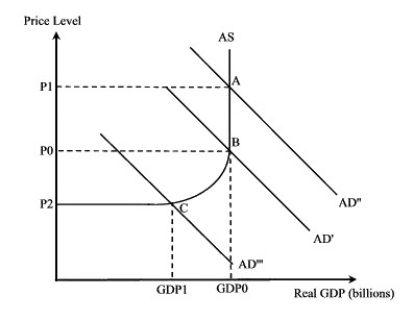 -According to Exhibit 16-1,if the economy is currently operating at point A,the RBA is likely to:
 (Multiple Choice)
4.7/5 (87)
(87) A sharp fall in investment in Australia will most likely result in the RBA:
(Multiple Choice)
4.9/5 (80)
(80) Since the early 1990s,the RBA has implemented monetary policy primarily by focusing on:
(Multiple Choice)
4.9/5 (76)
(76) Causality is clear and mechanical with the quantity theory of money.If M increases because V and Q are:
(Multiple Choice)
4.7/5 (70)
(70) The monetarist transmission mechanism,through which monetary policy affects the price level,real GDP and employment,depends on the:
(Multiple Choice)
4.9/5 (77)
(77) One reason the demand for money became more volatile in Australia during the mid-1980s was:
(Multiple Choice)
4.7/5 (85)
(85) According to the quantity theory of money,if M's growth is lower than Q's,then:
(Multiple Choice)
4.9/5 (77)
(77) Which of the following statements is correct with respect to monetary policy?
(Multiple Choice)
4.8/5 (78)
(78) The Keynesian cause-and-effect sequence predicts that a decrease in the money supply will cause interest rates to:
(Multiple Choice)
4.9/5 (63)
(63) 
Filters
- Essay(0)
- Multiple Choice(0)
- Short Answer(0)
- True False(0)
- Matching(0)