



 Chat with AI
Exam 9: Aggregate Expenditures

Exam 1: The Wealth of Nations: Ownership and Economic Freedom87 Questions
Exam 2: Scarcity and Opportunity Costs87 Questions
Exam 3: The Market and Price System96 Questions
Exam 4: The Aggregate Economy61 Questions
Exam 5: National Income Accounting104 Questions
Exam 6: An Introduction to the Foreign Exchapterange Market and the Balance of Payments99 Questions
Exam 7: Unemployment and Inflation129 Questions
Exam 8: Macroeconomic Equilibrium: Aggregate Demand and Supply122 Questions
Exam 9: Aggregate Expenditures120 Questions
Exam 10: Income and Expenditures Equilibrium134 Questions
Exam 11: Fiscal Policy94 Questions
Exam 12: Money and Banking125 Questions
Exam 13: Monetary Policy141 Questions
Exam 14: Macroeconomic Policy: Tradeoffs, Expectations, Credibility, and Sources of Business Cycles117 Questions
Exam 15: Macroeconomic Viewpoints: New Keynesian, Monetarist, and New Classical103 Questions
Exam 16: Economic Growth95 Questions
Exam 17: Development Economics105 Questions
Exam 18: Globalization85 Questions
Exam 19: World Trade Equilibrium112 Questions
Exam 20: International Trade Restrictions109 Questions
Exam 21: Exchapterange Rates and Financial Links Between Countries132 Questions
Select questions type


The sum of money spent by a person to purchase a new home is considered as a part of investment spending.
(True/False)
4.8/5  (75)
(75) As an household's wealth increases, it will experience a(n):
(Multiple Choice)
4.9/5 (85)
(85) The figure given below shows the consumption functions of an economy.?Figure 9.4
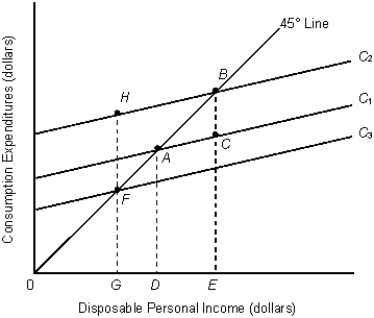 -Refer to the Figure 9.4. If the economy is in equilibrium at A, which of the following is most likely to occur if consumers expect a period of rapid economic expansion?
 (Multiple Choice)
4.8/5 (72)
(72) The consumption function has a positive slope while the savings function has a negative slope.
(True/False)
4.8/5 (82)
(82) Suppose that the consumption function crosses the 45-degree line at a disposable income level of $800. Assume further that saving equals $200 when disposable income is $1,300. This implies that the MPC must equal 0.6.
(True/False)
4.8/5 (86)
(86) The figure given below represents the consumption function of a country.?Figure 9.3
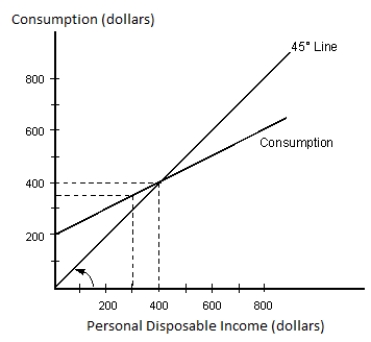 -According to Figure 9.3, autonomous consumption equals:
 (Multiple Choice)
5.0/5 (84)
(84) The figure given below represents the saving function of an economy.?Figure 9.1
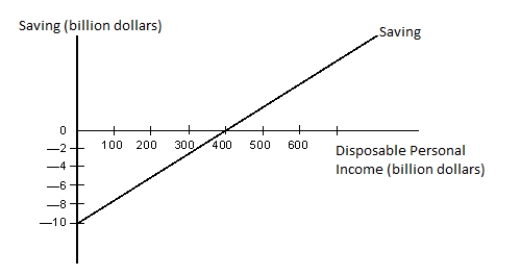 -Refer to Figure 9.1. Which of the following statements is true for real GDP levels below $400 billion?
 (Multiple Choice)
4.8/5 (66)
(66) The figure given below represents the consumption function of a country.?Figure 9.3
-Refer to Figure 9.3. Calculate the marginal propensity to consume.
-Refer to Figure 9.3. Calculate the marginal propensity to consume. (Multiple Choice)
4.8/5 (78)
(78) The figure given below shows the consumption functions of an economy.?Figure 9.4
-Refer to Figure 9.4. Which of the following could explain a downward shift of the consumption function from C₁ to C₃?
-Refer to Figure 9.4. Which of the following could explain a downward shift of the consumption function from C₁ to C₃? (Multiple Choice)
4.9/5 (72)
(72) If it is assumed that there are absolutely no taxes in an economy, then aggregate consumption will be drawn as a function of:
(Multiple Choice)
4.8/5 (84)
(84) The marginal propensity to consume (MPC) is equal to the inverse of the marginal propensity to save (MPS).
(True/False)
4.9/5 (70)
(70) Which of the following variables do not change autonomous consumption?
(Multiple Choice)
5.0/5 (76)
(76) Suppose two successive levels of disposable personal income are $16 and $21 billion, respectively, and the change in consumption spending between these two levels of disposable personal income is $2 billion, then the MPC will be equal to _____.
(Multiple Choice)
4.9/5 (92)
(92) The figure given below shows the consumption function of a household.?Figure 9.2
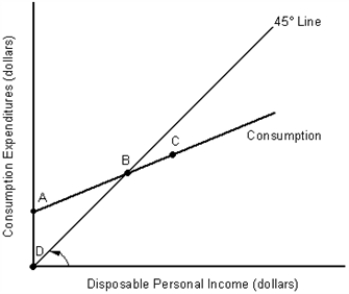 -In Figure 9.2, at any point to the left of point B:
 (Multiple Choice)
4.9/5 (68)
(68) Which of the following will cause the investment function to shift upward?
(Multiple Choice)
4.9/5 (84)
(84) Suppose the Kwik Print Company considers an investment project that involves the purchase of a copier with an expected output of $4,000. If the firm has to borrow $3,000 and the rate of return is 11.1 percent, then the interest rate associated with the loan must be 20 percent.
(True/False)
4.8/5 (92)
(92) 
Filters
- Essay(0)
- Multiple Choice(0)
- Short Answer(0)
- True False(0)
- Matching(0)