



 Chat with AI
Exam 1: The Wealth of Nations: Ownership and Economic Freedom

Exam 1: The Wealth of Nations: Ownership and Economic Freedom87 Questions
Exam 2: Scarcity and Opportunity Costs87 Questions
Exam 3: The Market and Price System96 Questions
Exam 4: The Aggregate Economy61 Questions
Exam 5: National Income Accounting104 Questions
Exam 6: An Introduction to the Foreign Exchapterange Market and the Balance of Payments99 Questions
Exam 7: Unemployment and Inflation129 Questions
Exam 8: Macroeconomic Equilibrium: Aggregate Demand and Supply122 Questions
Exam 9: Aggregate Expenditures120 Questions
Exam 10: Income and Expenditures Equilibrium134 Questions
Exam 11: Fiscal Policy94 Questions
Exam 12: Money and Banking125 Questions
Exam 13: Monetary Policy141 Questions
Exam 14: Macroeconomic Policy: Tradeoffs, Expectations, Credibility, and Sources of Business Cycles117 Questions
Exam 15: Macroeconomic Viewpoints: New Keynesian, Monetarist, and New Classical103 Questions
Exam 16: Economic Growth95 Questions
Exam 17: Development Economics105 Questions
Exam 18: Globalization85 Questions
Exam 19: World Trade Equilibrium112 Questions
Exam 20: International Trade Restrictions109 Questions
Exam 21: Exchapterange Rates and Financial Links Between Countries132 Questions
Select questions type


Villagers in Xiaogang, China, produced more rice than those in surrounding villages because:
(Multiple Choice)
4.9/5  (78)
(78) Specialization according to comparative advantage, followed by trade, allows everyone to acquire more of the goods they want.
(True/False)
4.9/5 (70)
(70) A limitation one faces when shopping for clothes is the amount of time available to shop.
(True/False)
4.9/5 (80)
(80) Choices must be made because of scarcity; people do not have enough time or money to get everything they want.
(True/False)
5.0/5 (86)
(86) According to economic analysis, while making a decision, an individual compares the benefits expected from one option with the benefits expected from other options.
(True/False)
4.9/5 (83)
(83) In 1981, in San Francisco Solano, Argentina, about 1,800 families took over a piece of wasteland. The government was able to deed 60 percent of this land to some families while the remaining part could not be deeded. The resulting houses varied greatly, based on whether the residents received title. Those who received title also behaved differently, having fewer children, and the children experienced more education and better health. This is an example of the results from:
(Multiple Choice)
4.8/5 (85)
(85) Which of the following should not be considered as an opportunity cost of attending college?
(Multiple Choice)
4.9/5 (79)
(79) A positive (non-zero) price for a good means there is a surplus of that good.
(True/False)
4.8/5 (73)
(73) Table 1.4
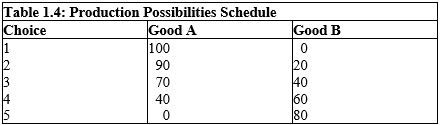 -Assume that our national economy is operating at a point on its bowed-out production possibilities curve. According to the production possibilities schedule in Table 1.4, if our nation produces more of Good A, then:
 (Multiple Choice)
4.8/5 (82)
(82) Figure 1.3
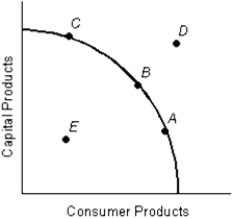 -In Figure 1.3, underutilization of resources is represented by point:
 (Multiple Choice)
4.9/5 (79)
(79) Table 1.4
-According to the production possibilities schedule in Table 1.4, which of the following statements is true?
-According to the production possibilities schedule in Table 1.4, which of the following statements is true? (Multiple Choice)
4.9/5 (82)
(82) Figure 1.3
-In Figure 1.3, which point should society produce at to maximize efficiency?
-In Figure 1.3, which point should society produce at to maximize efficiency? (Multiple Choice)
4.8/5 (75)
(75) In economics, which of the following is considered as financial capital?
(Multiple Choice)
4.7/5 (83)
(83) According to the text, as compared to rich countries, most of the poor countries do not fare well because:
(Multiple Choice)
4.9/5 (77)
(77) 
Filters
- Essay(0)
- Multiple Choice(0)
- Short Answer(0)
- True False(0)
- Matching(0)