



 Chat with AI
Exam 28: Exchange Rates and the Balance of Payments

Exam 1: What is Economics73 Questions
Exam 2: Markets and Prices78 Questions
Exam 3: The Business Firm: Organization,motivation,and Optimal Input Decisions75 Questions
Exam 4: Getting Behind the Demand and Supply Curves75 Questions
Exam 5: Market Demand and Price Elasticity68 Questions
Exam 6: Economic Efficiency,market Supply,and Perfect Competition72 Questions
Exam 7: Monopoly and Its Regulation77 Questions
Exam 8: Monopolistic Competition,oligopoly,and Antitrust Policy73 Questions
Exam 9: Pollution and the Environment56 Questions
Exam 10: The Supply and Demand for Labor73 Questions
Exam 11: Interest,rent,and Profit70 Questions
Exam 12: Poverty,income Inequality,and Discrimination60 Questions
Exam 13: Economic Growth71 Questions
Exam 14: Public Goods and the Role of the Government70 Questions
Exam 15: National Income and Product71 Questions
Exam 16: Business Fluctuations and Unemployment72 Questions
Exam 17: The Determination of National Output and the Keynesian Multiplier75 Questions
Exam 18: Fiscal Policy and National Output75 Questions
Exam 19: Inflation70 Questions
Exam 20: Money and the Banking System78 Questions
Exam 21: The Federal Reserve and Monetary Policy71 Questions
Exam 22: Supply Shocks and Inflation64 Questions
Exam 23: Productivity,growth,and Technology Policy58 Questions
Exam 24: Surpluses,deficits,public Debt,and the Federal Budget68 Questions
Exam 25: Monetary Policy,interest Rates,and Economic Activity72 Questions
Exam 26: Controversies Over Stabilization Policy70 Questions
Exam 27: International Trade70 Questions
Exam 28: Exchange Rates and the Balance of Payments66 Questions
Select questions type


When the euro was launched in January 1999,its price was $1.18.Eighteen months later,its price was $0.94.Over this period,the euro
(Multiple Choice)
4.9/5  (83)
(83) The number of U.S.dollars it takes to purchase a British pound is called the
(Multiple Choice)
4.8/5 (77)
(77) Under a flexible exchange rate system,the equilibrium price of one currency in terms of another is
(Multiple Choice)
4.7/5 (81)
(81) The following question are based on the following diagram, showing the market for Swiss francs. Assume Switzerland and the United States are engaged in a system of fixed exchange rates. The official rate is $0.40 per franc.
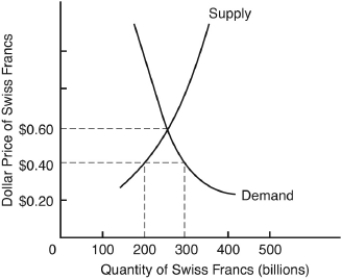 -If the Swiss government does nothing and the U.S.government attempts to remedy the situation by buying and selling currencies,it must ________ billion worth of Swiss francs.
 (Multiple Choice)
4.7/5 (81)
(81) If the United States and Britain were both on the gold standard,trade would be brought into balance because
(Multiple Choice)
4.8/5 (88)
(88) The following question are based on the following graph, showing the market for pesos. Mexico and the United States are engaged in a system of flexible exchange rates.
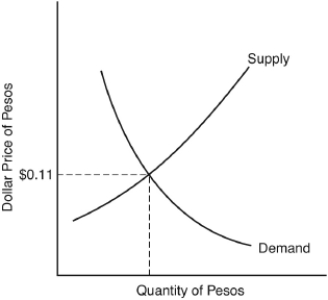 -If people in Mexico decide to purchase shares of stock on the U.S.stock exchange,the exchange rate (in terms of the dollar to the peso)
 (Multiple Choice)
4.8/5 (85)
(85) One argument for a system of fixed exchange rates such as that established under the Bretton Woods agreement in 1944 is that fixed exchange rates
(Multiple Choice)
4.8/5 (87)
(87) Under the gold standard,a country with a rising price level
(Multiple Choice)
4.8/5 (72)
(72) Under a system of fixed exchange rates,a balance-of-payments deficit or surplus is measured by
(Multiple Choice)
4.8/5 (82)
(82) If merchandise exports exceed merchandise imports,the country has a
(Multiple Choice)
4.8/5 (74)
(74) The exchange rate system that has prevailed since 1973 is best described as
(Multiple Choice)
4.8/5 (86)
(86) Which of the following describes the world's experience with the gold standard since the nineteenth century?
(Multiple Choice)
4.9/5 (83)
(83) Given our experience with the gold standard and the Bretton Woods agreement,most economists today would probably agree that
(Multiple Choice)
4.7/5 (78)
(78) Under which of the following systems does a government commit itself to keep fluctuations in its monetary unit within a narrow range?
(Multiple Choice)
4.8/5 (86)
(86) Under a system of flexible exchange rates,balance-of-payments deficits and surpluses show up
(Multiple Choice)
4.9/5 (78)
(78) The exchange rate system for which the International Monetary Fund was designed is best described as
(Multiple Choice)
4.8/5 (79)
(79) If under freely fluctuating exchange rates,1 U.S.dollar exchanges for either 9 Swedish krona or 1.7 Swiss francs,1 Swedish krona exchanges for how many Swiss francs?
(Multiple Choice)
5.0/5 (83)
(83) The 1973 abandonment of the Bretton Woods system was largely brought about by the
(Multiple Choice)
4.9/5 (71)
(71) 
Filters
- Essay(0)
- Multiple Choice(0)
- Short Answer(0)
- True False(0)
- Matching(0)