



 Chat with AI
Exam 24: Surpluses,deficits,public Debt,and the Federal Budget

Exam 1: What is Economics73 Questions
Exam 2: Markets and Prices78 Questions
Exam 3: The Business Firm: Organization,motivation,and Optimal Input Decisions75 Questions
Exam 4: Getting Behind the Demand and Supply Curves75 Questions
Exam 5: Market Demand and Price Elasticity68 Questions
Exam 6: Economic Efficiency,market Supply,and Perfect Competition72 Questions
Exam 7: Monopoly and Its Regulation77 Questions
Exam 8: Monopolistic Competition,oligopoly,and Antitrust Policy73 Questions
Exam 9: Pollution and the Environment56 Questions
Exam 10: The Supply and Demand for Labor73 Questions
Exam 11: Interest,rent,and Profit70 Questions
Exam 12: Poverty,income Inequality,and Discrimination60 Questions
Exam 13: Economic Growth71 Questions
Exam 14: Public Goods and the Role of the Government70 Questions
Exam 15: National Income and Product71 Questions
Exam 16: Business Fluctuations and Unemployment72 Questions
Exam 17: The Determination of National Output and the Keynesian Multiplier75 Questions
Exam 18: Fiscal Policy and National Output75 Questions
Exam 19: Inflation70 Questions
Exam 20: Money and the Banking System78 Questions
Exam 21: The Federal Reserve and Monetary Policy71 Questions
Exam 22: Supply Shocks and Inflation64 Questions
Exam 23: Productivity,growth,and Technology Policy58 Questions
Exam 24: Surpluses,deficits,public Debt,and the Federal Budget68 Questions
Exam 25: Monetary Policy,interest Rates,and Economic Activity72 Questions
Exam 26: Controversies Over Stabilization Policy70 Questions
Exam 27: International Trade70 Questions
Exam 28: Exchange Rates and the Balance of Payments66 Questions
Select questions type


The difference between tax revenues and government expenditures that would result if GDP were at its potential level is called the
(Multiple Choice)
4.9/5  (72)
(72) An increase in the structural deficit most likely reflects the fact that fiscal policy is
(Multiple Choice)
4.8/5 (78)
(78) In his first year in office,President Clinton's fiscal policy proposals led to
(Multiple Choice)
4.9/5 (88)
(88) How did the proposed fiscal policies of President Eisenhower and President Nixon differ?
(Multiple Choice)
4.7/5 (74)
(74) In the 1980s and early 1990s the annual federal budget deficit was ________ percent of GDP.
(Multiple Choice)
4.8/5 (73)
(73) The budget policy that requires revenues to equal expenditures each and every year is called
(Multiple Choice)
4.8/5 (90)
(90) The idea that,under certain circumstances,deficits can increase investment is known as
(Multiple Choice)
4.8/5 (78)
(78) When evaluating the size of the annual federal budget deficit,it is useful to express it as a percentage of the
(Multiple Choice)
4.9/5 (75)
(75) 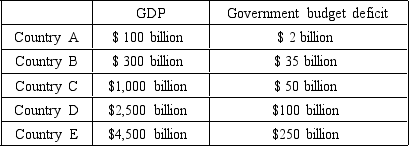 -Which of the following countries in the table above has the most burdensome budget deficit?
 (Multiple Choice)
4.9/5 (77)
(77) When the government finances its expenditures by borrowing from consumers and business firms
(Multiple Choice)
4.7/5 (73)
(73) If the government goes into the credit market to finance a current budget deficit,the
(Multiple Choice)
4.8/5 (81)
(81) The federal budget surpluses experienced at the turn of the twenty-first century disappeared largely because of
(Multiple Choice)
4.9/5 (96)
(96) The budget policy that sets the government's budget to attain a socially optimal combination of unemployment and inflation is likely to
(Multiple Choice)
4.7/5 (85)
(85) 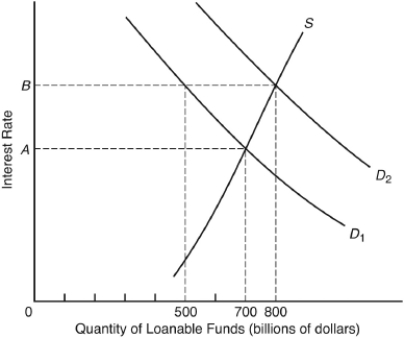 -If S is the supply curve of loanable funds,D₁ is the demand curve for loanable funds before government borrowing,and D₂ is the demand curve for loanable funds after government borrowing,the size of the government deficit must be ________ billion.
 (Multiple Choice)
4.7/5 (83)
(83) 
Filters
- Essay(0)
- Multiple Choice(0)
- Short Answer(0)
- True False(0)
- Matching(0)